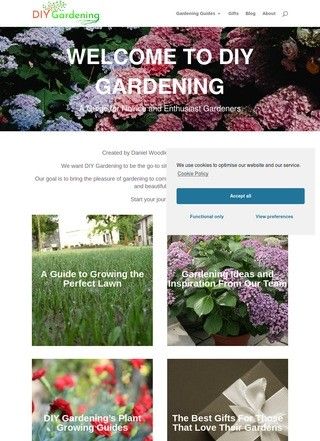
DIY Gardening publishes an affiliate-commission model on the same pages where it rates secateurs, cordless strimmers, telescopic pruners, and cylinder mowers. Named authors conducting hands-on testing is a genuine attempt to keep that arrangement honest, but the arrangement itself deserves the first word here, because the site's entire reputation rests on whether readers trust the product verdicts. The affiliate relationship is disclosed, not buried, and the testing is attributed to specific people rather than pooled from anonymous aggregators. Whether that is enough depends entirely on how suspicious you are by disposition.
The people behind DIY Gardening
The site is operated from the Surrey and Hampshire border by Daniel Woodley, an eighteen-year veteran of hands-on garden work, and Hannah Miller, a qualified horticulturist. Two named practitioners with legible backgrounds is a genuine rarity in a space where gardening guides are typically produced by anonymous teams hired per article. DIY Gardening puts real names on the advice and on the tool reviews. That accountability changes the dynamic, even if it does not fully neutralise the commission question.
Local consultancy versus remote advisory
DIY Gardening operates across two distinct tracks. A local consultancy covers clients near Surrey and Hampshire, offering garden design plans, drainage assessments, maintenance scheduling, and pest identification. A separate remote advisory service is open to anyone across the UK, designed for homeowners who want professional input but are geographically distant from the base. The site is clear about this boundary, and clarity on scope is not a given in this sector.
Drainage diagnostics and contractor referrals
Drainage diagnostics and soil assessment feature prominently among the local services. Homeowners routinely pay to fix preventable drainage errors after a project is already built. A service that catches those problems early has practical value, and DIY Gardening also offers contractor referrals for work that exceeds what a competent amateur should attempt alone. Admitting that limit on a site whose entire brand is self-reliance takes a certain confidence in the expertise being offered.
Two hundred how-to guides
The free content runs to more than two hundred how-to guides covering lawns, plant selection, soil and compost, pest control, hard landscaping, soft landscaping, and drainage. Seasonal planting guides and a blog add time-sensitive material alongside the evergreen reference content. The structure is coherent enough that a visitor arriving via a search query for a single pest can navigate across to connected topics and find each subsequent question already addressed. That kind of internal depth is not automatic; it points to a publishing approach that has maintained consistency over time.
Named authors test the tools
The review section is where the affiliate tension sits most visibly. DIY Gardening attributes each tool verdict to a named author who has physically tested the equipment, not assembled a star-average from retailer pages. For someone about to spend sixty or a hundred pounds on a strimmer, a verdict from someone who has run several models in actual garden conditions is worth more than any pooled aggregate. The testing model is credible on its face. The commission income creates a motive to recommend over dismiss, and no site can fully eliminate that pull. What DIY Gardening does with attribution and disclosed testing is the best available mitigation short of funding product reviews independently, which almost no free gardening resource does.
Trustpilot shows a small number of reviews averaging around four stars. Four stars from a low count does not move the needle in either direction. The site's credibility has never been built on review volume; it rests on the named expertise and the attributed content. That is a coherent position, but it also means there is no independent third-party body of client feedback to anchor confidence in the consultancy side of the business.
Contact options and social channels
Contact requires effort. DIY Gardening has a contact page, but no phone number sits on the homepage, and first-time visitors hoping to confirm a human answers before paying for remote advisory work will have to hunt. YouTube and Pinterest channels run under @diygardeninguk, which extends visibility and gives visitors another way to evaluate the people behind the advice. Neither social presence compensates for a homepage that buries the contact route.
DIY Gardening is a functional reference built by two named practitioners over a sustained period. The guide library is deep, the product testing methodology is more rigorous than the anonymous aggregators that dominate the same search results, and the affiliate disclosure is honest.
The Trustpilot count is low enough to be nearly irrelevant for gauging the consultancy's real-world record, and the contact experience is worse than it should be for a service asking people to pay for remote advice. If the product reviews are your primary interest, the named-author testing approach gives you more to work with than anonymous aggregation. If you are considering the paid consultancy, the credentials are stated and specific, but the absence of an independent review record means you are extending credit on the basis of the site's own framing. That is not nothing, but it is not the same as a clear track record either.


Business address
DIY Gardening
14 Maguire Drive, Frimley,
Camberley,
Surrey
GU169RY
United Kingdom