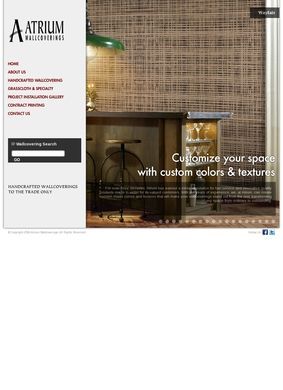
A made-to-order wallcovering starts from a different premise than something pulled off a roll at a decorating store. For Atrium Wallcoverings, a Miami manufacturer, the difference is production to order: panels handcrafted for a specific project, with the colour and texture set by the designer instead of chosen from a fixed catalogue. That premise runs through everything the company shows.
The core line is handcrafted wallcoverings built for commercial and residential interiors. Custom colours and custom textures are the selling point, and the material choices are pitched as part of the craft, so a hotel lobby and a private dining room can carry finishes made for those rooms alone. Atrium Wallcoverings positions this as high-end work, aimed at designers who want a wall treatment nobody else will have.
Handcrafted wallcoverings and the made-to-order promise
The Atrium Wallcoverings website organizes itself around a handful of clear sections: an About page, the handcrafted wallcoverings line, a project installation gallery, contract printing, and a contact page. That structure keeps the focus tight on what the company makes and how a designer would go about buying it, which suits a supplier whose real customer is the trade. A specifier can move from the About page to the gallery to a sample request without wading through padding.
There is a genuine product story in the Atrium Wallcoverings pages, told through specifics instead of adjectives, and that is more than many manufacturer sites manage. The About section fills in the backdrop with the company's long account of itself, while the handcrafted line and the named collections carry the detail a buyer would actually weigh.
Custom colours and textures
The customisation claim anchors the whole pitch. Atrium Wallcoverings makes each covering to order, letting a specifier dial in colour and texture for the space at hand, and it leans on what it calls innovative materials to reach finishes a standard printed paper cannot match. For a designer working a hospitality project on a tight visual brief, that flexibility is the whole point, because an off-the-shelf pattern rarely lands the exact tone a scheme needs.
Where the walls carry the whole mood of a room, that control over tone and finish is what a specifier is paying Atrium Wallcoverings to provide. Texture is the harder half of that promise to deliver, and it is where a made-to-order maker has to prove itself.
The named collections
Beyond bespoke work, Atrium Wallcoverings publishes named collections that give a buyer a starting point: Ginza, Fragment, Corso, Montmartre, and Santorini, each in several colourways. The names read like a designer's mood board, and the multiple colour options per pattern suggest these are meant as adaptable bases a client tailors, not one-shot prints locked to a single look. Each pattern reads as a design in its own right, and the colourway options let a client keep the concept while matching an existing palette.
It is a sensible middle ground between a blank commission and a fixed range, and it lowers the risk for a client who wants something distinctive without starting from nothing.
Contract printing and the installation gallery
Custom manufacturing is one half of what Atrium Wallcoverings does. Contract printing is the other, and it points the business at trade buyers who need volume or a specific reproduction, past the scale of a single feature wall. That widens the customer base from one-off residential jobs toward repeat commercial supply, where a hotel group or a chain might reorder the same finish across many rooms.
The pairing is deliberate. Contract printing lets Atrium Wallcoverings take on jobs a purely bespoke shop would have to turn away, so the company is not relying on one-off commissions alone for revenue. Together, the two services tell a visitor that Atrium Wallcoverings can both invent a finish and reproduce one at quantity.
Contract printing
The contract printing service is aimed at professionals bringing their own requirements, and it sits naturally beside the made-to-order line: a designer who can specify a bespoke texture can also arrive with artwork to be produced at scale.
The two read as companion services for the same customer, which fits a supplier whose buyers are studios and specifiers, not walk-in retail shoppers. It is a service that assumes a knowledgeable buyer, which again places Atrium Wallcoverings in trade supply more than consumer retail. That focus is a strength when the client already knows exactly what they want.
Project installation gallery
The project installation gallery is where the claims meet evidence. Photographs of finished installations do more for a wallcovering maker than any amount of description, since texture and scale only read properly in a real room under real light. A gallery lets a prospective client judge whether the Atrium Wallcoverings finish holds up across a full wall, which is exactly what a specifier needs to see before choosing it for a project.
Without dates or project names attached to the shots, a viewer takes the gallery partly on trust, yet even so it is the most persuasive material on the site. How current and how detailed that gallery is will make or break its usefulness.
Big claims, little outside proof
Atrium Wallcoverings describes itself as the country's leading manufacturer of custom-made handcrafted wallcoverings, and says it has served the world's leading interior designers on hospitality and residential work across more than five decades in business. That is a strong self-portrait. The contact side backs up the impression of a real, reachable operation: a Miami street address, two phone lines, an email for samples, and a straightforward contact page all sit in plain view, so a designer who wants a sample or a quote has an obvious way in.
Requesting a physical sample is, for a texture-led product, the true test of an Atrium Wallcoverings finish, since no photograph conveys how a covering catches light or feels under a hand.
The trouble is what sits under the Atrium Wallcoverings claims. No third-party customer reviews turned up anywhere. Houzz lists Atrium Wallcoverings but shows zero reviews, the page openly inviting someone to be the first.
Yelp and Yahoo Local both carry a business entry under a slightly different name, Atrium Wallcoverings and Fabrics, yet neither showed a star rating or a review count. A maker operating at this claimed level would usually carry a trail of designer testimonials or trade references someone could check; here there is none to find. For a firm claiming half a century of top-tier clients, that silence is striking.
The one rating that did surface makes the picture worse rather than better, and it needs care to read correctly. It comes from Indeed, an employer-review site, where a single former worker left a one-star score. That number describes one person's time as an employee and says nothing about the wallcoverings themselves, so it cannot stand in for the customer feedback that simply is not there. The absence does not prove the product is poor; it means the confidence has to be taken on the company's own word, with the gallery as the only outside-facing evidence.
A buyer weighing Atrium Wallcoverings is left with a confident company describing world-class clients and decades of work, and not one verifiable customer voice, anywhere, to confirm that any of it holds true on the wall.