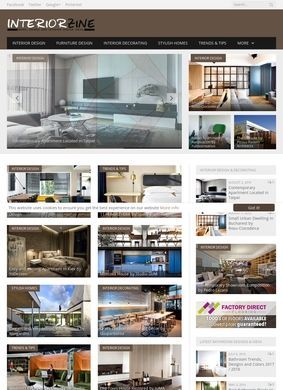
Where does someone go to keep up with what is happening in interior design without paying for a glossy magazine? InteriorZine answers that plainly. It is a long-running web magazine covering interior design, furniture, decorating, lighting, flooring, textiles, product design, landscaping, and art, with a steady flow of editorial pieces and an archive deep enough to browse for an afternoon.
The scope is genuinely broad. Someone landing on InteriorZine for the first time will find the front page split across clear subject areas, so a reader chasing lighting ideas is not forced to wade through unrelated furniture launches to get there.
What the magazine publishes
The editorial mix is the reason to bookmark the place. Articles run the gamut of apartment tours, renovation case studies, new product and furniture launches, and profiles of showrooms and design studios. That is a working spread of formats, and it means the content is not one note. One visit might turn up a walkthrough of a redone flat; the next might be a piece on a chair that just hit the market. InteriorZine keeps that variety turning over rather than settling into a single template.
Sections are labelled the way a reader thinks: Interior Design, Furniture Design, Interior Decorating, Stylish Homes, Design Trends, Lighting, Flooring, Wallcoverings, Textiles, Product Design, Landscaping, News and Tips, and Art. Thirteen distinct lanes is a lot of ground for a design publication to hold, and InteriorZine holds them all under one masthead.
The archive and how far back it reaches
The archive is the part that separates a real publication from a page that was posted once and abandoned. Dated posts stretch from 2009 into the present, and the back catalogue runs past 200 pages. That is more than a decade of continuous publishing. For a reader, that depth has a practical payoff: search for a specific style, material, or era of trend and there is a fair chance InteriorZine already covered it years ago, then covered it again as tastes shifted.
Longevity like this also tells you something the front page cannot. A design blog that keeps posting across so many years has survived the churn that kills most of them. The output on InteriorZine has been consistent, not a burst of enthusiasm that fizzled after a season.
Who it is really for
Three audiences are served on InteriorZine, and they do not all want the same thing. Homeowners and casual readers come for ideas and the vicarious pleasure of a good apartment tour. Designers and architects come for a place to be seen, and InteriorZine gives them a "Submit Your Work" route to pitch projects for feature coverage. Brands come for reach, and a magazine with this kind of readership is a natural place to buy it.
The three groups feed each other: reader traffic makes the ad space worth something, ad revenue keeps the editorial going, and the editorial is what draws the submissions in the first place.
That last group is handled openly through an "Advertise" page for businesses wanting placement. It is worth noting that InteriorZine wears its commercial side on its sleeve, so a reader knows the publication takes ads and accepts submissions. Transparency about how the lights stay on is a point in its favour, and it beats pretending the editorial exists in a vacuum.
Reach, standing, and the credibility question
Judging a magazine like this from the outside is trickier than judging a shop. InteriorZine carries no star ratings on Google, Trustpilot, Yelp, or the BBB. That is normal for an editorial site; readers rarely leave five-star reviews for a blog the way they would for a plumber, and their absence is not a knock against the site. It just means the usual rating scoreboards do not apply here.
What the search did surface is a traffic estimate from an analytics site putting daily visitors in the low thousands, around 2,500 a day. Traffic figures from third-party estimators are rough, but a number in that range points to a real, sustained readership. A ghost site does not pull that kind of daily audience. It also lines up with the volume of published work; a magazine sitting on a decade of posts and steady social channels is the sort of thing that accumulates readers by inertia alone, and the estimate reads as plausible rather than inflated.
The scam-checker flag, in context
One automated validator, a "Scam Detector" style page, assigns interiorzine.com a "medium" risk score. That deserves a clear-eyed read. These validators are algorithmic; they weigh domain age, ownership data, and other technical markers, and they routinely flag ordinary sites, especially ones that carry advertising or hide registration details. It is not a customer complaint and it is not a rating from anyone who read the magazine.
Set against a decade-plus of dated posts and a steady audience, a machine-generated "medium" score does not amount to much. It is still worth naming, so a cautious reader can weigh it for themselves. Nobody hands over money on an editorial site the way they would on a store, so the practical stakes of that flag were low from the start. A reader is here to look at rooms and read about furniture, not to enter a card number.
Getting in touch and keeping up
Contact is straightforward to locate. The footer carries a Contact link sitting alongside Home, Archives, Submit Your Work, Sitemap, Terms of Use, and Privacy Policy, so anyone wanting to reach the publication has an obvious door to knock on. A phone number or postal address was not visible on the homepage itself; those details, if published, would live on that linked page.
Terms and a privacy policy in the footer are a modest but genuine sign of a site run with some care.
Publications that never bother with either tend to be the ones that vanish. Here the housekeeping links sit right where a reader would expect them, which is a low bar, but plenty of sites still fail to clear it. The Submit Your Work link doubling as a footer fixture also tells a designer exactly where to knock without hunting through menus.
Social presence rounds out the picture, with Facebook, Pinterest, and X channels plus a newsletter. Pinterest in particular makes sense for a publication built on interiors, since the imagery travels well there and gives readers a lower-effort way to follow along than checking the site daily.
The newsletter covers the readers who would sooner have new features land in an inbox, and between the two, InteriorZine gives its audience a few reasonable ways to stay in the loop without visiting the homepage on a schedule. None of this is flashy. It is the ordinary plumbing of a working online magazine, and it is all present.
So is InteriorZine worth the click? For anyone who likes interiors and wants a regular feed of tours, product news, and trend pieces without a paywall, it is. Set it beside Dezeen, the obvious heavyweight in design coverage, and the difference in focus becomes clear: Dezeen leans architecture and industrial design at a global, news-driven pace, while InteriorZine keeps its attention on homes, decorating, and the softer end of the trade.
A reader who wants the residential angle and the apartment tours will find InteriorZine the more comfortable fit, and the long archive gives it staying power that a newer competitor cannot match.