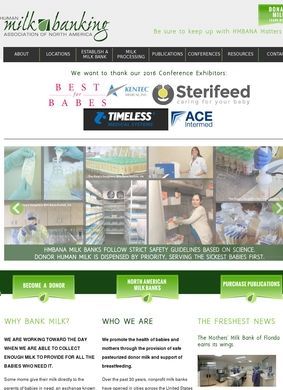
When a NICU nurse needs pasteurized donor milk and the mother cannot supply it, the answer in the United States and Canada often runs through the Human Milk Banking Association of North America, the nonprofit body that writes the safety standards those milk banks follow and accredits the ones that meet them. The site exists to connect three groups who rarely meet: hospitals that need a reliable, screened supply, mothers with surplus milk willing to donate it, and clinicians who have to trust that what reaches a fragile infant has been handled correctly from expression to bottle.
Finding accredited milk banks
The most practical thing on the site is the milk bank locator. A parent whose child has been discharged with a prescription for donor milk, or a hospital pharmacist sourcing for a unit, can find an accredited bank without guessing which operations are legitimate. That distinction does real work here. The Human Milk Banking Association of North America represents nonprofit banks operating under its accreditation, which separates them from for-profit milk collection businesses, and a family searching during one of the worst weeks of their life is unlikely to know the difference on their own. Putting the locator front and center answers the question most visitors arrive with, and it does so without burying the result under layers of navigation.
Donor recruitment process
Donation is the other side of the same exchange, and the site treats lactating mothers with surplus supply as a constituency in their own right. The Human Milk Banking Association of North America provides recruitment information for prospective donors, and donor milk only exists if women volunteer it and pass screening. The pipeline only functions when both ends are served, so it makes sense that the Human Milk Banking Association of North America gives donors a clear path in alongside the families and hospitals drawing milk out. A mother weighing whether to donate gets enough to understand what the process asks of her, which is the right level of detail for that first visit.
Clinical standards protect fragile infants
Clinical guidance is where the association shows its depth. The site carries guidelines and best practices for expressing, storing, handling, and pasteurizing human milk, the unglamorous procedural detail that decides whether donor milk is safe. Pasteurization protocols, storage temperatures, and handling chains are not topics a general parenting site can cover with authority, and this is precisely the gap a standards-setting body is built to fill. Alongside the protocols sit publications and research support tied to donor milk safety and clinical use, which gives neonatologists and lactation consultants a reference rooted in evidence instead of folklore.
This is the part of the operation that justifies the word accreditation. A milk bank carrying the endorsement of the Human Milk Banking Association of North America has agreed to screen donors, test milk, and pasteurize it according to a written common standard, so a hospital ordering from one accredited bank can expect the same handling discipline as from another. That consistency is the quiet engine behind the whole network. Without a shared rulebook, every bank would be a separate question mark for the clinicians relying on it, and the locator would point to a patchwork of unequal practices instead of a vetted set.
For the primary recipients, premature and critically ill infants in neonatal intensive care, the stakes behind those standards are not abstract. Donor milk is often used precisely because a fragile gut tolerates it where formula struggles, so the screening and pasteurization steps are the difference between a therapeutic feeding and a risk. The Human Milk Banking Association of North America frames its work around that population first, and the rest of its constituencies, donors and clinicians and administrators, are organized around keeping that supply safe and moving.
The audience the Human Milk Banking Association of North America is built for is wider than parents. NICU staff, neonatologists, hospital administrators, and lactation consultants all appear in the way the resources are organized, and the member portal for affiliated milk banks makes clear that part of the site is an operational hub for the institutions themselves, an inward-facing layer running alongside the public information. An accrediting organization has to talk to its members and the public at once, and the structure here keeps those two jobs from colliding.
Advocacy rounds out the picture, and it is more pointed than a generic mission statement. The Equitable Donor Milk Access Blueprint addresses disparities in who actually gets donor milk, an honest acknowledgment that supply and access are not the same problem. A bank can be accredited and well stocked while the families who most need its output never reach it, and naming that gap rather than papering over it gives the Human Milk Banking Association of North America more credibility than a tidier message would. Volunteer opportunities are listed as well, which fits an organization that depends on participation from donors, clinicians, and supporters to function. The blueprint reads as policy work, not marketing, and that tone runs through how the Human Milk Banking Association of North America presents itself across the site.
What holds the whole thing together is that the Human Milk Banking Association of North America occupies a narrow, serious niche and does not wander outside it. The site stays clear of becoming a general infant-feeding resource or a lifestyle destination. The Human Milk Banking Association of North America sets standards, accredits banks, points families and providers to those banks, recruits donors, and pushes on access policy. Every section maps back to one of those functions, and the focus is part of why the resource is worth consulting: there is little noise to wade through before reaching the thing you came for. A reader looking for the difference between a screened nonprofit milk bank and an informal milk-sharing arrangement will find the answer here, grounded in the association's own accreditation framework.
The Human Milk Banking Association of North America also serves a quieter purpose for clinicians who need to defend a decision. When a neonatologist recommends donor milk over formula for a premature infant, the underlying safety case rests on the kind of standardized pasteurization and screening the association codifies. Having that framework documented in one place, with research support attached, turns a clinical preference into a defensible protocol. That is not flashy, but for the people making those calls it is the reason the organization matters.
Nonprofit versus for-profit operations
It is worth being clear about what the Human Milk Banking Association of North America is not. It does not itself ship milk or run a single bank you can call directly; it sits a layer above the individual banks, setting the rules they follow and vouching for the ones that comply. A visitor expecting a retail experience will instead find a locator, a rulebook, and an advocacy platform. Weighed against a commercial provider such as Prolacta Biosciences, the contrast clarifies the role.
Prolacta operates as a for-profit company processing donor milk into fortifiers sold to hospitals. The Human Milk Banking Association of North America is the nonprofit standards-and-accreditation network whose member banks distribute pasteurized donor milk on a mission basis. For parents and donors looking for the nonprofit path, it is the more direct and relevant resource of the two.