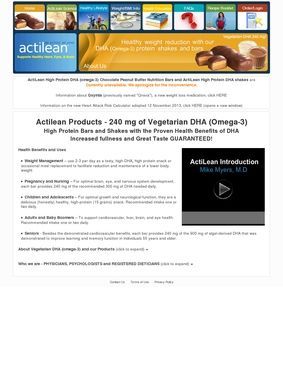
Every ActiLean bar promoted on weight.com is built around one figure: 240 mg of what the brand calls vegetarian DHA, an omega-3 the site says arrives without the fish smell or taste people tend to expect from that ingredient. The bars and shakes are pitched as higher in protein than standard nutrition bars and as carrying far more DHA than competing products. All of it sits under a name that promises something wider and more neutral than a single product line, and that gap is where a visitor to Objective Medical Information on Obesity has to start thinking.
As a title, Objective Medical Information on Obesity reads like a public-health resource, the sort of place a doctor might point a patient toward. What loads is a storefront for a branded bar and shake, wrapped in supporting material that argues the case for buying it. The distance between those two things sets the tone for everything else on the page.
Bars, shakes, and the DHA number
The product core is a range of nutrition bars and shakes carrying the ActiLean name. The vegetarian angle does real work in the pitch. Sourcing the DHA without fish removes the taste and odour problem that puts some people off omega-3 supplements, and the brand claims its bars deliver significantly more of it than what else is on the shelf.
High protein is the second headline. For a shopper standing in a shop comparing labels, those are checkable claims, at least in principle, and the specificity of the 240 mg figure is the most concrete thing the page puts on the table.
The comparison itself is worth reading closely. The claim is that these bars beat competing products on DHA content, but the page does not name a competitor, cite a test, or show the figures it is measuring against. A number stated with no baseline is easy to print and hard to trust, and that pattern, a precise-sounding claim floating free of any source, recurs across the site.
Where it widens out further is the audience. The same bars and shakes are aimed at general weight management, at pregnant and nursing women, at children, at adults, and at seniors. That is a broad sweep for one product, and the breadth is worth pausing on, because the tone stays reassuring across every one of those groups. Everything Objective Medical Information on Obesity puts forward here is a variation on that single bar, repositioned for whoever happens to be reading.
From pregnancy to seniors
Marketing one nutrition product to nursing mothers and to young children in the same breath is the sort of claim that deserves scrutiny rather than a sales page. Nothing in the material names an independent body standing behind the DHA figure or vouching for the product across those age groups.
A parent weighing whether to hand one of these bars to a child would want more than the brand's own assurance, and the clinical tone that Objective Medical Information on Obesity adopts supplies mostly the brand's own assurance, dressed up as guidance. The confidence is uniform; the outside corroboration is absent.
Science, education, and a prescription drug in the mix
Objective Medical Information on Obesity runs its navigation across Science, Lifestyle, Weight Management, Education, FAQs, and Recipes, so the site clearly wants to read as a reference as much as a shop. There is material on Qsymia, a prescription weight-loss medication, sitting alongside the bars, which pulls the content toward genuine clinical territory. The claim to authority comes from the stated team: physicians, psychologists, and registered dietitians described as having experience in weight-management research and treatment.
That framing is exactly what the name leans on. A tab labelled Science and a roster of credentialed staff give the shop the feel of a clinic, and the recipes and FAQs fill out the impression of a place you go to learn rather than to spend.
The difficulty is that every path eventually points back toward ActiLean. A section called Education on a page whose reason for existing is a branded bar cannot be read the way an independent explainer would be, and the Qsymia material, useful as it might be on its own, shares the page with a product the same site is selling.
The Recipes and Lifestyle sections make the pull explicit. A recipe tab on a shop for meal-replacement bars tends to route back toward the bars, and once a reader notices that gravity, the neutral-sounding headings start to read as packaging. Objective Medical Information on Obesity presents these as free guidance, but guidance and sales here occupy the same square of screen.
The team it names
Stating that physicians, psychologists and dietitians stand behind the content counts for something, but the page is the only source for it. No individual is credited in a way a reader could verify, no clinic or institution is attached to the names, and the recipes, FAQs and lifestyle notes all funnel back to the same shakes and bars. The medical-staffing claim props up the Objective Medical Information on Obesity name without ever quite proving it.
A registered-user log-on and the standard Terms of Use and Privacy Policy links round out the structure, which is the ordinary furniture of an online shop more than a research body.
Making contact and the quiet wider record
The landing page keeps its contact details out of sight. No phone number, address or email shows on the main page, the sort of basic information a business directory entry would put up front. A contact route exists only through a link tucked into the footer, so anyone wanting to reach a person has to go hunting for the path. For a site presenting itself as Objective Medical Information on Obesity, burying the way to get in touch does the credibility no favours, and it sits awkwardly with the openness the name implies.
The wider web is where Objective Medical Information on Obesity goes properly quiet. A search for reviews or ratings of weight.com, or of the ActiLean products by name, turns up nothing about them at all. What comes back instead is academic obesity literature from clinical and library sources, plus a scatter of unrelated commercial sites that happen to share the word weight: a fitness-equipment seller, a diet-programme brand, an unrelated app, none of which speak to this business.
There is no third-party trace to weigh here, favourable or otherwise, which leaves the site's own pages as the sole witness to its own claims.
So the central doubt never resolves. A site that calls itself Objective Medical Information on Obesity, sells its own branded bars to everyone from children to seniors, keeps its contact route in the footer, and leaves no independent footprint anywhere on the wider web, is asking a visitor to take its neutrality entirely on faith while handing over almost nothing beyond its own marketing to justify that faith.