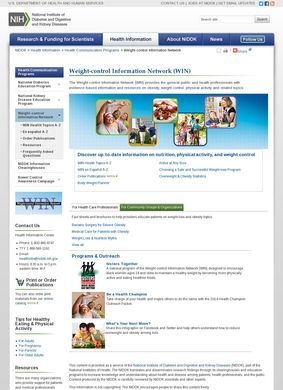
What turns up when you go looking for the Weight-control Information Network (WIN) today? Not the standalone resource it used to be. The old web address forwards to the health information hub of the National Institute of Diabetes and Digestive and Kidney Diseases (NIDDK), a component of the U.S. National Institutes of Health, and the weight material that gave the site its name now lives inside a much larger clearinghouse.
That reframing is worth stating up front. For years the Weight-control Information Network (WIN) was NIDDK's dedicated channel for plain-language, science-based information on obesity, weight control, and nutrition. It has not disappeared. Its subject matter has been absorbed into a broader library that also covers diabetes, kidney and urologic disease, digestive disease, liver and blood conditions, and a range of endocrine topics.
So the honest starting point is simple. A visitor is no longer arriving at a single-subject site. The destination is the front door of a federal disease-information center that happens to carry the exact topic the Weight-control Information Network (WIN) was originally built to handle. This is a research clearinghouse, not a business directory of weight-loss clinics someone might expect after a generic search.
Where the weight-control material sits after the redirect
The landing page is organized by condition, and weight management is one entry in that list, not the headline act. Someone who came specifically for portion control, physical activity guidance, or obesity statistics has to navigate a wider menu to reach it, which is a small cost for a much deeper shelf of related material. On balance the trade favors the reader who wants context around a weight question, not less of it.
The good news is that the substance the Weight-control Information Network (WIN) was known for did not get thrown out in the reshuffle. It was reclassified. Below are the parts of the current site most relevant to a weight-loss inquiry, along with one caveat for anyone hoping to lean on the page for direct help.
It helps to remember what kind of publisher stands behind this. NIDDK is one of the institutes that actually funds obesity and metabolic research in the first place, so the weight guidance here is downstream of the studies, not scraped from secondary coverage. That is the quiet advantage a reader inherits by starting here.
Plain-language publications, reviewed and bilingual
The core promise carries over cleanly. Publications on the site are described as informed by NIDDK research and reviewed by physicians, and they are offered in both English and Spanish. That editorial chain is the whole reason the Weight-control Information Network (WIN) mattered in the first place: information written for a general reader but vetted by the same institute that funds and tracks the underlying science.
For a topic as crowded with bad advice as weight loss, a source that separates evidence from marketing has obvious value. The bilingual coverage widens who can actually use it, and I found that detail more meaningful than it first appears, because so much consumer health writing on obesity never reaches Spanish-speaking readers at all.
Weight and nutrition among the broader disease areas
Weight management and nutrition are listed alongside diabetes, kidney and urologic disease, digestive disease, and endocrine conditions, and that grouping is more useful than it might sound. Obesity rarely travels alone. It overlaps with type 2 diabetes, fatty liver disease, and kidney health, and a reader who lands on the weight pages can move sideways into those connected topics without leaving the same trusted source. The original Weight-control Information Network (WIN) treated weight in relative isolation.
The consolidated structure lets someone follow the actual clinical picture, from weight-loss strategies to the conditions that weight often influences. Portion control, physical activity, and the statistics that used to anchor the WIN pages remain part of what the site covers.
Research, funding, and outreach toolkits
Beyond patient-facing articles, the page opens onto the institutional side of NIDDK. There are research and funding sections covering grant opportunities, training programs, and technology transfer, which serve a different audience than the average person Googling a diet question. There are also community outreach toolkits tied to public health campaigns such as National Diabetes Month, National Kidney Month, and Diabetes Alert Day.
A clinician, a health educator, or a community organizer will get more out of this layer than a casual reader will, and that breadth is a fair reason to treat the current home of the Weight-control Information Network (WIN) as a working professional resource rather than a consumer pamphlet rack. The material spans the science that produced the advice and the campaigns that push it into communities.
The outreach toolkits in particular are the sort of thing a local clinic or school nurse can pick up and use during an awareness month without building materials from scratch, which extends the reach of the underlying weight and nutrition guidance well past the website itself.
There is also a practical thread running through the site for people weighing a next step: mentions of diagnostic tests and clinical trials. For a reader whose weight question is really a question about a related condition, that pathway from reading to participation is a genuine feature, and it is one a purely consumer-facing weight site would rarely offer.
The suspended inquiry service
Here is the caveat, and it is a real one. The page carries a current-status notice stating that the NIDDK Health Information Center is not providing inquiry response services due to HHS and NIH restructuring, and it points people to nih.gov for help instead. In plain terms, the direct question-and-answer function that the Weight-control Information Network (WIN) once offered is suspended.
A visitor can still read every published resource, but the human on the other end who used to field specific questions is not available through this channel right now. That is not a knock on the quality of the content. It does mean expectations should be set correctly: this is a reading resource at the moment, and the personalized help line that once distinguished the Weight-control Information Network (WIN) is on pause while the agency reorganizes.
Taken together, the picture is a strong library with a temporarily missing service desk. The published material is exactly what made the Weight-control Information Network (WIN) trustworthy, and none of that authority is diminished by living under the NIDDK banner. What changed is the packaging and the loss, for now, of the interactive piece.
For a reader deciding whether to bookmark it, the answer depends on what they came for. If the goal is credible, physician-reviewed reading on obesity, weight-loss approaches, or nutrition, the destination that the Weight-control Information Network (WIN) redirects to delivers, and it delivers with the connected disease context that a standalone weight site never could. If the goal was to email a specific question and get a tailored reply, that route is closed until the restructuring settles.
Weighed against MedlinePlus, the consumer health service from the National Library of Medicine, the comparison is instructive. MedlinePlus is broader still, friendlier to browse, and it aggregates from many institutes, so a first-time searcher may find it easier to land on. But its weight and obesity entries frequently lead back to NIDDK sources anyway. Going straight to the home the Weight-control Information Network (WIN) now occupies means reading the primary institute rather than a summary of it, and for anyone who wants the source that MedlinePlus itself cites, that is the version worth keeping open.