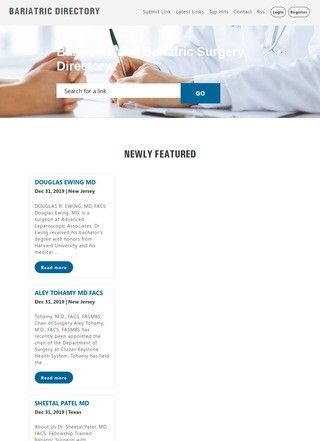
Bariatric Directory's clearest feature is its Medical Dictionary, an A-to-Z glossary that lines up bariatric and related medical terms in the plain order you would find them in any reference book. Next to it, the homepage pushes a short set of featured topics, and one of them is Gastric Plication, a procedure most people never hear named until a surgeon says it out loud in a consultation. That pairing sets the tone for everything else: this is a site built to translate the vocabulary of weight-loss surgery for the people about to live through it.
Bariatric Directory is an informational website, not a clinic and not a booking service. It gathers a searchable body of material on bariatric surgery and the subjects around it, then hands a visitor two basic tools: a glossary to look terms up and a search box to jump to a specific one. The usual About, Terms of Use, and Privacy Policy pages sit in the background. It is a modest promise, and for the most part the site keeps to it.
The medical dictionary at the center
Most of what gives Bariatric Directory a reason to exist sits in that dictionary. Anyone who has walked out of a surgical consultation knows the particular feeling of nodding along to words they will end up looking up in the car afterward. A glossary pointed squarely at this one field is a sensible answer to that, and putting it at the front of the site is the right instinct for the audience it wants. The rest of the pages orbit it, but the dictionary is the thing a first-time visitor is most likely to actually use and come back to.
That emphasis reads like a deliberate choice rather than an accident of site architecture. A resource built around bariatric surgery could easily have led with procedure pages, patient stories, or a directory of surgeons; instead the front door is a dictionary, which suggests the builders decided the first problem worth solving was vocabulary itself. It is a narrower promise than a full patient guide would make, but it is one the site can actually deliver on, page by page.
An A to Z of unfamiliar terms
The dictionary is organized alphabetically, which sounds too obvious to mention until you are the person hunting for a half-remembered word from a pre-op appointment. Weight-loss surgery drags in vocabulary from several directions at once. There are the operations themselves and their variants. There is the anatomy they rearrange. There is the nutrition regime that governs the rest of a patient's life afterward, and there is the list of complications every candidate gets warned about.
Bariatric Directory keeps all of that under one alphabetized roof, which spares a person from bouncing between general medical sites that bury the bariatric meaning of a term three definitions deep. Someone who only knows the single word their surgeon used can find it here without first learning three other terms to get there.
How much value that holds depends on depth the available material does not measure, so a visitor is wise to treat what Bariatric Directory gives them as a starting point for a conversation with an actual clinician, not a stand-in for one. The honest limit is straightforward: a definition tells you what a word means, not whether the procedure behind it suits your body, and the glossary makes no pretense of doing that second job.
As a first pass at decoding a consent form the night before an appointment, it does an honest job. As the final word on a medical decision, no glossary should be.
Searching for one term
Beyond browsing the alphabet, Bariatric Directory carries a search function for people who arrive already knowing the exact word they need. Type it in, land on the entry, move on. For a reference site that small feature is what separates a tool people actually use from a static page they skim once and abandon, and its presence signals the site is meant to be consulted in a hurry, not read cover to cover.
It also quietly says the builders expect a stressed, time-pressed visitor rather than a browser with an afternoon to spare, and shaping the tool around that reader is a sensible, unglamorous choice. Paired with the alphabetical browse, it covers the two ways people usually reach a reference: knowing the exact word, or knowing only that they need one and having to feel their way toward it.
The featured topics and who reads them
The subjects a site chooses to spotlight say a lot about the reader it imagines. On Bariatric Directory the front-page picks are Weight Loss Surgery, Gastric Plication, and Calorie Restriction, three topics that line up almost too neatly with the questions running through someone's head before they commit to a surgical path.
None of the three looks like a random pick. A site could just as easily have spotlighted anesthesia risk, insurance approval, or post-operative diet plans, and each would have pulled in a different kind of visitor. Bariatric Directory chose one broad category, one specific procedure, and one non-surgical alternative instead, which reads like an attempt to meet a visitor at whatever stage of research they have already reached, whether or not surgery is a settled decision yet.
From weight loss surgery to calorie restriction
Weight Loss Surgery is the umbrella heading, the broad category a person starts under before narrowing down to any one operation.
Under it sits a family of procedures a patient eventually has to choose between, from the more common stomach-reducing operations down to less familiar restrictive techniques, and a newcomer needs the vocabulary before that choice makes any sense at all. Gastric Plication is far more specific: a restrictive technique that folds and stitches the stomach to shrink its capacity without cutting tissue away, precisely the sort of term nobody can parse cold. Calorie Restriction pulls the other way entirely, toward the non-surgical, dietary side of the same problem.
Putting those three together is a smarter piece of curation than it might look. Calorie restriction is no detour on a surgery site; it is the pre-operative diet many patients are placed on, the lifelong habit an operation is supposed to enforce, and the alternative some readers will decide to try first. Bariatric Directory lining up diet, the general category, and one named procedure, whether by design or by accident, traces the same arc a lot of patients actually walk.
The reader in the middle of a decision
This is plainly a site for the researching patient, the person stuck somewhere between the first time a doctor floats the word surgery and a date on the calendar. Bariatric Directory does little for a practicing surgeon and nothing for a hospital; its entire shape is aimed at the individual trying to close the distance between what a specialist told them and what they walked away actually understanding.
It is also the reader most likely to arrive frightened, half-informed, and short on time, which raises the stakes on getting the plain facts right. For that reader, Bariatric Directory's focused glossary and a few well-chosen topics carry genuine worth, especially at the stage where every source still sounds like a foreign language.
What the site does not settle
The gaps are where confidence starts to drain, and they are worth stating flatly. Bariatric Directory shows no direct contact information on the pages reviewed: no phone number, no email, no street address. There is a Feedback link that routes through to a contact page, so a visitor is not sealed off completely, but reaching a human means a detour to a separate form instead of anything offered up front. The About, Terms of Use, and Privacy Policy pages meet the baseline any site should clear, yet none of them says who is responsible for the medical content.
That question grows heavier the moment you go looking for outside opinion. A search for reviews of Bariatric Directory returned nothing about this site in particular. The hits were other bariatric resources altogether: physician directories, provider-review listings, and professional bodies in the field, not one of which rates or endorses this specific site. So there is no independent read on its accuracy, no user feedback to weigh, and nothing anywhere pointing to the doctors or editors who stand behind the definitions.
For plenty of subjects that anonymity would be a shrug; for surgical medicine it sits closer to the center of whether the information can be trusted at all.
A glossary of ordinary words could shrug that off. An operation that permanently reshapes a person's stomach and rewrites the rules a patient eats by cannot: this is the doubt that refuses to settle. The Bariatric Directory glossary does real work putting a name to a frightening term, but nothing confirms who wrote the definitions or whether a qualified doctor ever checked them, and on a subject this consequential, a guess is not good enough.
Business address
United States