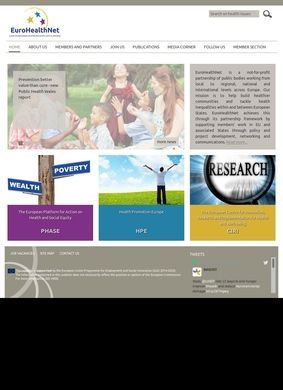
Opening EuroHealthNet's site, the first thing worth bookmarking is the Health Inequalities Portal, and it sets the tone for what the rest of the organization does. It pulls together data, policy framing, and practical material on why health outcomes diverge so sharply between regions and social groups across Europe, and it treats that gap as a problem to be measured and acted on, not simply described. EuroHealthNet builds much of its public work around exactly that distinction.
Tools and guides for policymakers
Sitting alongside the portal are the EuroHealthNet Magazine, an e-guide for financing prevention and health promotion, a Flashcard Tool built around the European Pillar of Social Rights, and a National Focal Points guide for EU funding. That mix tells you who the audience is before any mission statement does: people who write health policy, people who run programmes, and people who research what works.
EuroHealthNet is a Brussels-based not-for-profit partnership. Its members are national and regional public health institutes, academic research centres, and government health authorities, which means the organization is less a single voice than a network coordinating many. The stated focus areas are public health, disease prevention, health promotion, wellbeing, and the reduction of health inequalities across EU member states. Those are broad headings, but the site does the useful work of breaking them into concrete thematic strands.
Three pillars organize the work
The work splits into three pillars, and the labels are refreshingly plain. Policy covers monitoring EU health developments and trying to shape them. Practice is about capacity-building and sharing what member institutes have learned from implementing programmes on the ground. Research is aimed at pinning down evidence-based approaches to health equity. The separation matters because these are genuinely different activities. Watching a directive move through Brussels is not the same job as helping a regional health authority run a prevention scheme, and EuroHealthNet keeps them distinct instead of blending everything into one vague advocacy posture.
Thematic areas shaping public health work
The thematic list reads like a map of where European public health attention has gone over the past decade. Ageing, mental health, chronic disease, climate and health, diet and physical activity, fair economies, digital health, housing, infectious disease, and sustainable health systems all get their own work areas. Housing and fair economies sitting next to infectious disease is telling in itself. It places EuroHealthNet on the side of the argument that health is driven heavily by the conditions people live in, with clinical care as one input among many, and the breadth of those headings backs that position up with actual programmes, not slogans.
Who each resource serves
A researcher will probably head for the research pillar and the evidence material first. A civil servant in a national health ministry is more likely to want the funding guide and the policy monitoring, because knowing which EU instruments can pay for prevention work is a practical, recurring need. A practitioner running a local programme gets the capacity-building side and the chance to see how peers elsewhere handled a similar challenge. The site does not pretend everyone wants the same thing, and the structure reflects that.
How research practice and policy connect
There is a coherence here that is easy to underrate. Many organizations working at this level drift between research, lobbying, and service support without ever explaining how the three connect. EuroHealthNet draws a straight line: research identifies what reduces inequality, practice spreads it, policy work tries to lock it into law and budgets. That loop is the spine of the whole approach, and it is stated openly rather than left for a visitor to reconstruct. Whether every project lives up to it is something only the underlying reports can answer, but the framing is honest about what the partnership is trying to do.
Insider knowledge from member institutes
The membership-network model shapes the content in a way worth noting. Because the institutes themselves are members, a lot of the practical knowledge on the site comes from bodies that have already run the programmes being described. The financing e-guide is a good example. Funding prevention work is one of the perennial headaches in public health, since prevention budgets are usually the first to be cut and the hardest to defend with short-term numbers, and a dedicated guide to where the money can come from is the sort of resource that gets used repeatedly. EuroHealthNet leans on this insider knowledge throughout.
A strictly European policy focus
The European focus is consistent, and EuroHealthNet does not stretch beyond it. The reference points are EU member states, EU policy, and EU funding streams. For anyone working inside that frame, the specificity is the value. The Flashcard Tool built on the European Pillar of Social Rights takes a dense political document and turns it into something a practitioner can carry into a meeting and use directly. That instinct, translating high-level policy into working tools, runs through more of the site than the headline pillars suggest.
Purpose of the EuroHealthNet magazine
The EuroHealthNet Magazine deserves a separate mention because it does a different job from the portals and guides. Reports and data tools serve people who already know what they are looking for. A magazine reaches people who are scanning, who want to know what the network thinks is important right now and which debates are live. It is the part of the offering that keeps the membership and the wider field connected between the heavier publications, and it gives EuroHealthNet a regular voice alongside the archive.
One thing the site handles well is scope discipline. With ten-plus thematic areas and three pillars, the obvious failure mode would be to spread so thin that nothing has depth. The portals and guides push against that by being specific deliverables rather than topic landing pages. The Health Inequalities Portal, the funding guide, the focal points guide, the flashcard tool: each is a defined thing with a defined use, which suggests the breadth is built on actual output and not a desire to claim every subject at once.
Absence of public user reviews
A search turns up no aggregated user reviews for EuroHealthNet on the usual consumer platforms, which is expected for a professional network of this kind. The audience is institutions and practitioners, and those relationships play out through memberships, publications, and project collaborations, not public ratings. The absence of a Google or Trustpilot footprint is not a gap; it reflects the territory EuroHealthNet operates in.
The trade-off of being a coordinating partnership is that EuroHealthNet's value depends on its members staying active and contributing. A network of public health institutes only produces useful shared knowledge if the institutes keep feeding it, and the site is essentially the shop window for that collective effort. For policymakers and researchers working on health equity inside the EU, the combination of policy monitoring, peer-tested practice, and an evidence base in one place is the practical draw. The funding guidance paired with the prevention financing e-guide covers a question that comes up in nearly every public health planning cycle: where the money is and how to make the case for spending it on prevention. That is a concrete enough answer to land EuroHealthNet on the short list for anyone navigating EU health policy.