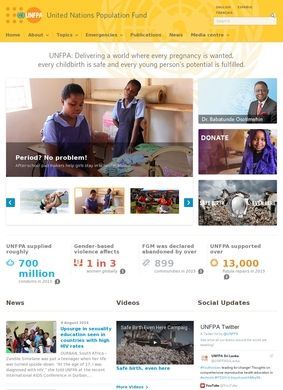
"Every pregnancy is wanted, every childbirth is safe and every young person's potential is fulfilled" is the sentence the United Nations Population Fund (UNFPA) puts at the front of everything it does. It sounds aspirational until you look at what sits behind it: the sexual and reproductive health agency of the United Nations, operating in more than 150 countries and running programs in places where those three simple wishes are anything but guaranteed.
The span of that mandate is easy to underestimate. The United Nations Population Fund (UNFPA) covers family planning, maternal health, the prevention of gender-based violence, and the collection of population data, and each of those is a large field in its own right, not a line item on a bigger charity's page. The site organizes them clearly enough that a first-time visitor can find the thread they came in for without wading through jargon, which is a real achievement for an agency this size. Anyone landing here expecting a single-issue cause will recalibrate within a screen or two.
Reproductive health at the centre
The core of the work is health care that too many systems still treat as optional. Family planning and safe childbirth run through almost everything the United Nations Population Fund (UNFPA) publishes, and the material keeps returning to the same measure: whether a woman can decide if and when to have children, and survive the birth if she does.
That focus gives the site a spine, so the individual programs read as parts of one argument instead of a scattered list.
Family planning and sexuality education
Under this heading the agency groups contraception access and comprehensive sexuality education, the second of which draws political fire in a lot of countries. The material is framed around choice and information, aimed at young people who often reach adulthood without much of either.
It is practical content, and the site does not soften the subject to spare anyone discomfort, which is part of why it reads as honest work rather than public relations.
Maternal health and midwifery
Midwifery gets its own emphasis, and that makes sense once you see how many maternal deaths trace back to a birth with no trained attendant in the room.
The United Nations Population Fund (UNFPA) supports the training and the services on this front, and the pages treat midwives as skilled professionals central to the mission instead of a footnote to doctors. I came away thinking this was the least headline-grabbing part of the site and quietly one of the most consequential.
Rights, data and protection
Away from the clinic, the agency does work that looks more like statistics and law than medicine. This is where the United Nations Population Fund (UNFPA) becomes harder to summarize in a line, because the range widens fast and pulls in fields most people would never connect to a health body.
Gender-based violence and harmful practices
The prevention work targets specific, named harms: child marriage and female genital mutilation sit at the front of it. The site sets these beside programs for HIV and AIDS services, support for LGBTQIA+ people, menstrual health, and disability inclusion, a spread that shows the Fund reading reproductive rights broadly rather than narrowly. For anyone who assumed this agency only handed out contraception, the section quietly corrects the record.
Population data and civil registration
Numbers underpin the rest of it. The United Nations Population Fund (UNFPA) runs census support, civil registration, and vital statistics work, the unglamorous machinery that tells a government how many people it has and where they live.
Without accurate counts, health and rights programs aim in the dark, so this is one of the areas where the United Nations Population Fund (UNFPA) does slow, structural work that few other bodies are set up to carry.
Where the work reaches
Scale is a large part of the argument. Operating in more than 150 countries, the agency also runs emergency response programs across more than fifteen crisis regions, including Gaza, Ukraine, Syria, Yemen and the Democratic Republic of Congo. These are places where ordinary health systems have thinned out or collapsed entirely.
In those settings the mission gets sharper. Pregnancy and childbirth do not pause for war, and the United Nations Population Fund (UNFPA) moves midwives, supplies and protection services toward the places where hospitals have gone dark. The site carries a donation portal and a newsletter for readers who want to follow or fund that response, and the emergency pages track current crises instead of resting on generic language. Keeping those pages current is what lets a reader confirm the organization is genuinely on the ground where the headlines fall, its presence documented while a crisis is still live.
A public-health student or a policy researcher will find plenty to work with here, and so will a donor trying to decide where a contribution would do the most good. Begin with the family planning and maternal health sections to see the everyday work, then read the emergency updates from Gaza and Ukraine to see the same principles under pressure. The breadth can feel overwhelming on a first pass, though that breadth is precisely the point of an agency asked to carry reproductive health for most of the world at once.