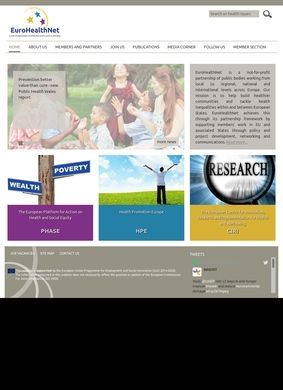
A regional health official sitting inside a national institute, watching the gap widen between the wealthiest and poorest districts they serve, eventually hits the same wall: how do you turn a stack of evidence about social determinants into policy that Brussels will move on, and who else across Europe is fighting the same fight? Euro Health was built for exactly that person. It is a Brussels-based non-profit partnership linking national and regional public health institutes, government authorities, and academic research centres, and its whole reason for existing is to chip away at health inequalities by going after their social roots at the European policy level.
Policy, practice, research
The structure of Euro Health is easier to grasp once you see the three operational pillars it runs on. There is Policy, where the work is monitoring EU health activity and pushing for evidence-based approaches to equity. There is Practice, the capacity-building side: helping member organizations swap knowledge, learn from each other, and find their way to EU funding streams that many smaller bodies would never navigate alone. And there is Research, where Euro Health promotes sound methods and helps researchers stitch together the consortia that European grant programmes tend to demand. None of these pillars stands alone. A piece of research feeds an advocacy position, which a member institute then carries home and tries to put into practice. That circulation is the core product.
Sixteen thematic work areas
The abstract mission breaks down into sixteen thematic work areas that read like a map of what keeps public health staff up at night. Ageing populations. Mental health. Climate and sustainability. Diet and physical activity. Housing. Infectious disease. These are not slogans bolted onto a mission statement. Housing sitting beside infectious disease beside diet is Euro Health quietly admitting that where someone lives and what they can afford to eat shapes their health as much as any clinic does. For a body whose stated job is addressing social determinants, that spread of topics is the mission made concrete, and it tells a visiting professional very quickly whether their own problem has a home here.
Published resources and tools
The published material is where a curious visitor can test the work without joining anything. Euro Health puts out a magazine carrying its thinking and the thinking of its network, and it runs a Health Inequalities Portal that gathers resources on the subject in one place. There is an e-guide on financing prevention and health promotion, a pointed choice of subject: prevention is famously the thing everyone agrees on and nobody funds, so a practical guide on paying for it is more useful than another report restating the problem. There is also a European Pillar of Social Rights Flashcard Tool, which takes a dense policy framework and turns it into something a working team can reference.
Tools like that are the difference between an organization that talks about influence and one that hands people instruments they can pick up. Finding Euro Health listed in a business directory with a clear link to these resources is a small but real help for a researcher trying to orient quickly.
Who joins Euro Health
Membership tells you who Euro Health is really speaking for. The roster is public health institutes, regional health authorities, and academic centres spread across European states, which means the partnership is connecting the institutions that already hold budgets and statutory responsibility. That changes how a newcomer should read it. If you are a citizen looking for health advice, this is not your destination and it does not pretend to be. If you are inside one of those institutions, or studying the field, the value is in the network you plug into and the seat at the European table that comes with it.
Operating at the EU policy level
It is worth being clear about the limits of an organization built this way. A partnership that works at the EU policy level and through its member bodies is, by design, a few steps removed from the patient or the neighbourhood. Euro Health exerts influence through advocacy, through funding it helps secure for others, and through the slow accumulation of evidence into policy, none of which produces the kind of immediate, visible result that a frontline service can point to. That is not a flaw so much as the nature of the work, but anyone expecting direct service delivery will be looking in the wrong place. The payoff is structural and long-horizon.
A search for independent reviews or ratings turns up nothing: no platform covering Euro Health in the way a commercial business might attract consumer feedback. That is consistent with what it is. Institutional partnerships operating at the EU policy level do not accumulate star ratings, and their standing is measured through citations, membership numbers, and presence at policy events. The absence of a review count reflects the sector, not a weakness in the record.
From evidence to credibility
Where Euro Health is convincing is in the coherence between what it says it does and what it puts in front of visitors. The mission is reducing health inequalities. The pillars are organized to attack that from three angles at once. The thematic areas show the breadth of the determinants it takes seriously. The magazine, the portal, the financing guide, and the flashcard tool are the visible outputs that let an outsider judge the substance. For an institution deciding whether to join, or a researcher weighing whether to build a consortium through this network, this entry gives enough to make a reasoned call. The evidence-based framing is consistent throughout, which counts for a body whose currency is credibility with policymakers.
Does this organization fit your needs?
The question is whether the European policy level is where a particular health inequality problem gets solved, or whether it needs fixing somewhere nearer the ground. Euro Health operates at altitude by design, and the organizations that get the most from it are the ones already operating there.