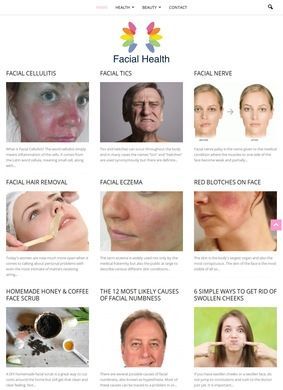
Click into the Facial Health website and what you find is a straightforward blog: plain-language articles about things that go wrong with the face, alongside a smaller set of homemade skincare guides. The publication splits into two lanes. One covers medical conditions, the other covers everyday beauty routines, and both are written so a non-specialist can follow along without needing a clinical dictionary.
Medical conditions and beauty routines
The health side is the meatier of the two. Facial Health works through a list of conditions most people would only half-recognise from a doctor's letter: facial nerve palsy, facial numbness (the article uses the clinical term hypesthesia), cellulitis, eczema, varicose veins, flat warts, facial tics and twitches, and swollen cheeks. That spread tells you something about who the site is for. It is aimed at the person who has noticed a symptom on their own face, typed it into a search bar at eleven at night, and wants to understand what they are looking at before deciding whether to call anyone. Putting a tic article next to one on cellulitis is a wide coverage range, and the goal appears to be breadth of reassurance over any single specialism.
Health articles covering facial symptoms
The beauty section is lighter and more practical. Here you get homemade moisturisers, facial scrubs, and natural skincare routines, the sort of kitchen-cupboard guidance that has a long life on blogs because it costs nothing to try. There is no product to buy on the way out, no affiliate funnel detectable from the page structure, just instructions. That gives the section a slightly old-school flavour, in the good sense: someone wrote down how to mix a scrub and left it there for whoever needs it. Facial Health addresses both men and women, which is worth flagging because so much skincare writing quietly assumes a female reader and stops there.
Homemade skincare recipes for everyday use
The whole thing runs as a blog, and individual articles are the unit of value. Facial Health describes its purpose as a guide to keeping and protecting a beautiful and healthy face, which is an honest statement of scope. This is reading material, not a service. You will not book an appointment through it, you will not order anything, and you will not get a consultation with a named clinician. The listing category of procedures and therapies might set an expectation the site does not try to meet. What it covers is the explanation that comes before any procedure, not the procedure itself. If someone arrives after finding this entry in a directory expecting a bookable service, they will need to look elsewhere.
Reading material without clinical services
How much weight a reader puts on the content depends on that distinction. Articles about facial nerve palsy or cellulitis sit close to real medical territory, where the gap between a tidy summary and a personalised diagnosis is the whole ballgame. Facial Health appears to stay on the explanatory side of that line, which is the responsible place for an anonymous blog to occupy. Still, a reader should treat it as a starting point for understanding a symptom, then take anything alarming to a professional who can examine them in person. Good background reading and a substitute for a clinic are two different jobs, and Facial Health only claims the first one.
Where does the medical advice end?
Now to the part that gives pause. Facial Health has no contact information anywhere on the site. No phone number, no email, no postal address, no contact page turned up during review. For a beauty blog passing along scrub recipes, that absence is unremarkable. For a publication that writes about nerve palsy, cellulitis, and skin infections, it is harder to set aside. When content edges toward health advice, a reader reasonably wants to know who is behind it, what credentials they hold, and how to reach them with a correction or a question. Facial Health offers none of that, and the silence is not easily waved away.
No contact information or author details
The reputation trail is equally quiet. A search for outside reviews of Facial Health came back with nothing specific to it on Google, Trustpilot, Yelp, the BBB, or any other platform. The results were crowded instead with unrelated facial-service companies and academic papers, which is a common fate for a site whose name is made of two extremely generic words. There is no chorus of users vouching for the accuracy of the articles, and no pattern of complaints either. Facial Health exists in a kind of evidence gap, where the only thing to judge is the content itself and how it is presented.
Absence of reviews or outside verification
One more detail sits oddly: Facial Health has a login and password-recovery area whose purpose is not explained anywhere a visitor can see. It might be a leftover from the platform the site was built on, or it might be for contributors, or it might point to some member feature that is not advertised. Without an explanation it is just a closed door on an otherwise open blog, adding a faint note of mystery rather than any obvious benefit to a casual reader.
Unexplained login area on the site
Weighed up, Facial Health is a free, reasonably broad reference for someone who wants to read about a facial symptom or try a homemade skincare recipe, with no cost and no sales pressure attached. The writing meets ordinary people where they are, the topic mix covers real ground for the worried-symptom crowd, and the beauty guides have their own modest appeal. Against that, the verifiable backing is nowhere to be found. No named authors, no publication standards, no outside reviews, no way to reach whoever runs it. A site that discusses medical conditions of the face yet tells a reader nothing about its authorship and offers no route to question or correct the content asks for a level of faith that the published evidence alone cannot justify.