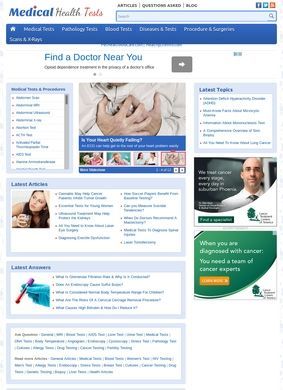
What is that test your doctor just ordered, and why does it matter enough to bother with? Medical Health Tests is built to answer questions shaped exactly like that. Its tagline sets the scope plainly: the types of tests, the procedures involved and why each one matters. Its homepage makes the pitch that medical tests are something everyone goes through at some point, so it is worth understanding what they are and why they are done.
This is a content site, an educational resource about medical testing, not a lab, clinic or booking service. Nothing in what is publicly visible points to appointments, sample collection, pricing or products for sale. Medical Health Tests is in the business of explaining, not performing. That distinction sets the standard the site should be judged against: a reference you read, weighed on how clear, accurate and trustworthy the reading is. A lab earns trust through accreditation and results; a reference like this earns it through clear writing, sound sourcing and openness about who is doing the writing.
A plain-language guide to medical tests
The stated aim is accessibility. One of the Medical Health Tests index pages opens with a line about getting medically literate, addressed to readers looking for treatment options or simply trying to understand a diagnosis. That framing tells you the intended audience is the ordinary reader, someone handed a test name they do not recognise who wants it in words they can follow.
For that audience, the value is easy to picture. A person told they need a particular scan or blood panel often leaves the appointment with more questions than answers, and a plain guide to what the test involves, why it is ordered and what the procedure feels like fills a real gap. The need it targets is common and easy to recognise; almost everyone meets an unfamiliar test at some point. Medical Health Tests aims squarely at that moment of uncertainty, the stretch between being told to take a test and actually taking it.
There is genuine public value in that mission. Health anxiety often comes from not knowing, and a calm, readable explanation of a frightening-sounding test can do real good, lowering the temperature before someone even walks into the clinic. Judged on intent alone, Medical Health Tests is pointed at a worthwhile target. The harder question is execution and trust, and that is where a reader has to look closer.
Types, procedures and their importance
The three words in the tagline, types, procedures and importance, are a sensible spine for this material. Types tells a reader what exists and what their own test belongs to. Procedures cover what will physically happen, which is the part that most eases nerves before an appointment. Importance answers the quietly nagging question of why it is being done at all and what the result might change. It is a structure that mirrors how a clinician would introduce a test, which is a point in the site's favour on organisation, whatever the questions about sourcing.
If Medical Health Tests delivers on all three consistently, it covers the questions a worried patient tends to ask in roughly the order they ask them.
Articles you can read and submit
Beyond the core guides, Medical Health Tests runs an articles section, described as a place where users can read articles on different topics and also submit their own. It also signals ambition beyond a fixed set of pages, since a submission channel is how a small reference site grows its coverage over time. That second half is worth pausing on. An open submission model can broaden a site quickly and bring in first-hand accounts, which have their own value, but it also changes what a reader is actually getting.
The read-and-submit setup pulls in two directions at once. First-hand accounts from people who have been through a procedure can be more reassuring and more honest than any clinical summary, precisely because they come from the patient's chair. The flip side is that an open door lets in whatever walks through it, including confident claims from people with no medical training. Without a visible gate, a reader cannot tell which sort of article they are reading, and on health matters that ambiguity carries a cost.
What user-submitted content means for trust
User-submitted content is only as reliable as the person who wrote it and the oversight it passed through on the way to publication. On a topic like medical testing, that is not a small point, and for a resource like Medical Health Tests it is the whole question.
There is a wide gulf between an article written or reviewed by a qualified clinician and one contributed by an anonymous user with no stated background, and from the outside those two can look identical on the page. The reader carries all the risk of telling them apart.
Judging a health resource you cannot trace
This is where the review has to turn cautious. Health information carries a heavier burden than casual reading, because acting on it can change a decision about a real body. For Medical Health Tests, the questions worth asking are questions of provenance: who wrote this, what are their credentials, was it checked, and when. None of those answers surfaced in what is publicly indexed. No named authors, no stated medical review process, no visible editorial standard came through. The absence of a byline is the single most telling gap, because a byline is where medical accountability normally begins.
Transparency is the currency of a health site, and here the account comes up short. Medical Health Tests offers no contact route that a search could surface, no phone number, no email, no address, no contact page. For most businesses a missing email is nothing. For a site asking you to trust it on matters of health, the absence of any traceable way to reach whoever runs it is a heavier gap, because it removes the accountability that a name and an address quietly provide.
A name and an address are not bureaucratic decoration; they are the thread that lets a reader trace a claim back to a responsible source, and that thread is what a health reader most wants to be able to pull.
Outside validation is missing too, and the honest thing is to say so plainly. No genuine third-party rating or review of Medical Health Tests turned up anywhere. There is a single listing with its name on a pharmacy scam-check directory, but that entry carries only boilerplate disclaimer text, no score, no review count, nothing that amounts to an actual verdict.
Other results that look related on first glance, a government methods guide and several similarly named testing sites, belong to different organisations entirely and say nothing about this one. If anything, that stray directory entry is a small trap: someone searching for reassurance might mistake a boilerplate scam-check page for an endorsement, when it verifies nothing at all.
None of that proves the content is wrong. A page can be accurate and anonymous at the same time. But it does mean a reader has no external handhold, no reviews to consult, no visible credentials to check, no way to ask a question and see who answers. With Medical Health Tests, you are left judging the writing entirely on its own internal merits, and on a health topic that is a real limitation to keep in front of you.
The site could answer all of this tomorrow by putting names, credentials and a contact route on its pages. Until it does, Medical Health Tests asks for a level of trust it has not visibly earned.
Who to trust it for, and how to use it
A patient facing an unfamiliar test and wanting a gentle first orientation before a clinical conversation could reasonably start with Medical Health Tests, useful for turning a blank worry into specific questions. The concrete next step is to treat it exactly that way: use it to draft the questions you want answered, then take those questions to your own doctor or the lab running the test, and cross-check anything that will drive a decision against a named, credentialed medical authority before you act on it.
As a first prompt, Medical Health Tests has a place; as a last word on your health, it has not earned that trust, and nothing found here suggests you should give it.