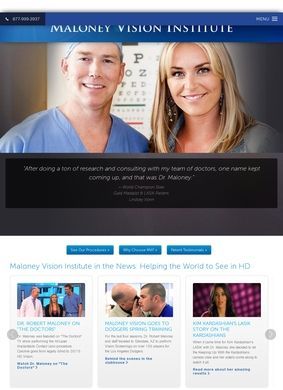
Maloney Vision Institute is an ophthalmology and refractive surgery practice in Los Angeles that handles vision correction, cataract and lens procedures, and cornea disease from two offices, one on Wilshire Boulevard and a second in Pasadena. The site leads with its numbers: 28 years serving Greater Los Angeles and more than 95,000 procedures performed, plus doctors named to a Los Angeles top doctors list for the coming year. Those claims set the expectation of a high-volume group that has been doing this a long time.
What caught my attention first was how the practice sorts prospective patients by age before it ever mentions a specific operation. Maloney Vision Institute splits its recommendations into three brackets, 18 to 45, 45 to 60, and 65 and older, then points each group toward the procedures that tend to fit. That is a practical way to guide someone who knows they want clearer sight but has no idea whether they are a LASIK candidate or closer to needing a lens replacement.
It is a small design choice, but a telling one. Most eye-surgery sites open with a single hero procedure and expect you to self-diagnose from there. Maloney Vision Institute instead treats the age question as the real starting point, because a twenty-year-old with strong nearsightedness and a sixty-five-year-old developing cataracts are rarely candidates for the same fix. That framing runs through the rest of the site.
Vision correction and lens work
The core of what Maloney Vision Institute does is elective vision correction, and the menu runs deeper than the single procedure most people picture when they think about laser eye surgery. The practice also treats medical eye conditions that a purely cosmetic clinic would hand off, which changes how you read the whole operation.
LASIK and the EVO ICL option
Standard LASIK is here, along with WaveLight Plus LASIK and PRK for people whose corneas rule out a flap-based procedure. For stronger prescriptions Maloney Vision Institute offers the EVO ICL, an implantable lens that sits inside the eye and can later be removed, which is a real path for patients who have been told they are not LASIK candidates. Refractive Lens Exchange and monovision correction fill out the list, so a fifty-something who is starting to reach for reading glasses gets a different conversation than a nearsighted graduate student.
That breadth keeps the recommendation from being forced toward LASIK just because that is the procedure that brought the patient in.
Cataract surgery and lens implant choices
Cataract work is the other pillar, and this is where Maloney Vision Institute shows real depth. It performs laser cataract surgery and offers a genuinely long list of implants: Light Adjustable lenses that can be fine-tuned after the eye heals, multifocal and extended-range lenses, toric lenses for astigmatism, and small-aperture designs. For anyone comparing surgeons, that variety is worth more than it first appears.
The implant you can actually get often decides how well you see without glasses once everything settles, and a clinic that stocks only one or two lens types has quietly narrowed your result before you pick anything. Maloney Vision Institute keeping the full spread in-house gives the surgeon room to match the lens to the eye.
Cornea repair and Fuchs' dystrophy
The cornea side is smaller but more specialized. DMEK and DSEK are both partial-thickness corneal transplants used for problems like Fuchs' dystrophy, and Maloney Vision Institute lists treatment for Fuchs' by name. This is not elective territory. It is the sort of progressive eye disease a refractive-only storefront would refer out, so seeing it handled directly tells you the group carries more clinical range than a clinic built solely around laser vision correction. That combination, everyday LASIK sitting next to transplant-level cornea care, is the thing that separates Maloney Vision Institute from a walk-in laser chain.
It also affects how you should read the volume claim. A group performing more than 95,000 procedures across nearly three decades, while still doing delicate corneal transplant work, is spreading that experience across a serious range of eye problems. Someone whose main issue turns out to be medical rather than cosmetic can be assessed and treated in the same practice, which spares the referral shuffle that so many single-focus clinics force on their patients.
Standing across Los Angeles and how to reach them
On outside reviews, the practice does well, and the sample sizes are large enough to trust. The Birdeye profile shows a 4.9-star rating drawn from more than 2,100 reviews, which is a lot of feedback to gather without steady results behind it. Yelp adds another 339 reviews with over 150 patient photos attached, and nicelocal.com carries further patient comment.
Indeed shows a 4.0 employer rating, but that reflects staff experience rather than patient care, so it belongs in a separate column from the clinical scores. Taken together, the third-party picture for Maloney Vision Institute is strong and unusually well populated for a surgical specialty.
The volume of reviews, more than the star average itself, points to consistency. A single glowing testimonial says little; a few thousand of them clustered near the top of the scale is difficult to manufacture, and it lines up with the procedure count the practice advertises. Prospective patients still ought to read the substance of individual comments, since surgical satisfaction turns on details a number cannot capture, but the raw weight of feedback behind Maloney Vision Institute is a point in its favor.
One small thing is worth flagging before booking. The phone number shown on the practice's own site does not match the number on its Yelp listing, a minor inconsistency that is easy to sort out with a quick call to the office you plan to visit.
Reaching the office is otherwise easy. Both the Los Angeles and Pasadena addresses are published, a contact page is one click from the main navigation, and appointments run through an online scheduling link. Maloney Vision Institute also accommodates out-of-town patients and offers virtual consultations, which is genuinely useful given how many people travel into the city specifically for refractive surgery. If you want to test the waters before flying in or driving across town, you can do a fair amount of the early legwork from home.
The two-office layout is worth a word on its own. Having a Wilshire Boulevard practice on the Westside and a second one in Pasadena means Maloney Vision Institute reaches patients on both ends of a famously traffic-choked city, and for anyone who has skipped a medical appointment because the drive was impossible, that geographic spread is a real convenience. Between the physical locations, the virtual option, and the out-of-town handling, the practice has removed most of the ordinary reasons a person puts off booking.
A short caution keeps the verdict honest. Big review counts and a two-doctor top-list mention are encouraging, but they are marketing-adjacent, and no rating replaces a surgeon actually measuring a patient's corneas and naming which procedure, if any, fits. Maloney Vision Institute makes that appointment simple to arrange, and the volume history points to plenty of practice behind the scalpel, yet the sensible move is still to treat the numbers as a reason to book a workup, not as a decision on their own.
Weighed against a place like the Stein Eye Institute at UCLA, the academic center a Los Angeles reader might also consider, Maloney Vision Institute trades teaching-hospital prestige for a private group that runs on volume, a wide implant catalog, and a heavily reviewed public record.
For a straightforward LASIK or cataract question, that trade looks reasonable, and the two-location setup with virtual consults lets you start without committing to anything. Someone with a rare or complicated case may still want that second academic opinion, but the published record on its own gives Maloney Vision Institute a solid case for anyone deciding where to get vision correction done in the city.
Business address
Maloney Vision Institute
10921 Wilshire Blvd #900 ,
Los Angeles,
CA
90024
United States
Contact details
Phone: 877-999-3937