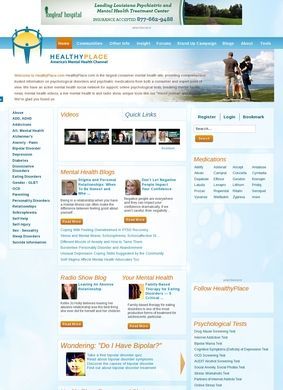
Mental health information online ranges from medically useless to actively misleading, which makes a site like HealthyPlace worth examining in some detail. HealthyPlace has been publishing condition-specific content for years, and its library now spans more than fifteen diagnoses: depression, bipolar disorder, anxiety, ADHD, eating disorders, PTSD, schizophrenia, and more. Articles explain symptoms, treatment routes, medications, and the therapies attached to each condition in plain language that does not assume the reader already carries a clinical vocabulary. That plainness is a deliberate editorial choice, and it shows throughout.
Therapy approaches and medication guidance
The coverage goes well past simple definitions. HealthyPlace names specific therapy approaches, including cognitive behavioral therapy, EFT, and ABA, so a reader can arrive at a first appointment with at least a working idea of what those acronyms mean. A separate strand on psychiatric pharmacology pairs medication information with guidance on prescription assistance for people facing cost barriers. Pregnancy and mental health receives its own section, a topic many general health sites either skip or bury under broader reproductive health material. Clinical trial information rounds out the reference side for anyone curious about experimental options.
Self-assessment screeners and mood journal
Beyond static reading, HealthyPlace offers tools that have day-to-day practical value. Self-assessment screeners cover depression, anxiety, and ADHD. A mood journal lets a person track how they feel over time rather than relying on a single moment of self-reporting. The site is careful to frame these as starting points, not diagnostic conclusions, and that restraint is appropriate. A mood journal is particularly useful because a person can bring it to a first therapy appointment as a record of patterns, which makes it more genuinely helpful than a quiz that returns a score and nothing else.
Inside the condition-specific blogs
What separates HealthyPlace from a static encyclopedia of conditions is its network of condition-specific blogs. These are ongoing, written from inside the experience of living with a particular illness. A newsletter keeps the material reaching subscribers regularly, and video content addresses the same range of topics for people who absorb more from watching than from reading. Mental health is rarely a one-time lookup; people return to these subjects across months and years, and a site with an active publishing rhythm is far more useful for repeat visits than a frozen set of fact sheets.
Comparing textbook facts with lived experience
The blogs do something the article library cannot. A clinical explanation of bipolar disorder tells a reader what the textbook says. A blog post written by someone managing it day to day tells them what the textbook leaves out. HealthyPlace runs both in parallel, which gives the site a texture that purely informational resources lack. That said, the first-person material carries its own risk: voices vary in quality and perspective, and a reader has to weigh personal accounts as accounts, not as medical guidance.
On the question of factual trustworthiness, there is an outside data point worth noting. Media Bias/Fact Check rates HealthyPlace as High for factual reporting, crediting it with proper sourcing and adherence to pro-science standards, while flagging a Left-Center editorial lean. For a health resource, the factual rating is the decisive measure, and a High mark from a third party that actively scrutinizes sourcing is a meaningful point in its favor. The political lean is a minor footnote for a site whose subject is symptoms and treatments rather than policy.
Sparse outside review record
The outside review record is sparse in a different way. No Trustpilot, Google, or BBB presence for healthyplace.com surfaces in a search, and looking up the name mostly returns an unrelated supplement retailer at a similar-sounding domain, which muddies any attempt to gauge public sentiment. The one direct rating that does exist, a 2.2-star average across five reviews on SmartCustomer, is too small a sample to be conclusive on its own. But a low average across whatever little exists is not a result a confident operation would want sitting unaddressed, either.
Contact page without phone or address
The contact footprint is the other soft spot. A contact page exists and is reachable from both the footer and the navigation, so a reader who wants to reach the people behind the content has a route. What is harder to find is the reassurance that usually accompanies a serious health publisher: no phone number and no physical address appear on the homepage, and no email address is listed directly, only a contact form. For a site offering medical information, the absence of a visible address or direct phone line leaves the question of who exactly stands behind the editorial work harder to answer than it should be. A contact form is there, and that is something, but it is not the same as a named organization with a listed number.
Who benefits from HealthyPlace?
HealthyPlace offers no direct clinical services, no professional consultations, and no way to book a therapist through the platform. It is a reading and reference destination with self-help tools attached. People seeking general knowledge about a condition, whether for themselves or for someone close to them, will find the depth they want. People experiencing symptoms and trying to make sense of them before seeking professional help can use the screeners and the plain-language articles to orient themselves. Caregivers who need to understand a condition they do not personally have are served by the breadth of topics and by the first-person blogs that show what living with an illness looks like from inside it.
Weighing strengths against credibility gaps
The strengths of HealthyPlace are genuine. A wide, well-sourced library covering a serious range of diagnoses, a High factual rating from an independent reviewer, interactive screeners and a mood journal with real practical utility, and an active publishing operation that prevents the material from going stale. Set against those strengths is a credibility gap the site has not closed. The outside review record is nearly nonexistent, and the one direct consumer rating that does exist is low and unanswered. The contact footprint withholds the basic markers of accountability that a phone number and a visible street address would normally provide. The content reads as careful and the third-party fact-check from Media Bias/Fact Check is encouraging, but a person relying on HealthyPlace for mental health information is still extending some trust without the public record that would fully justify it.