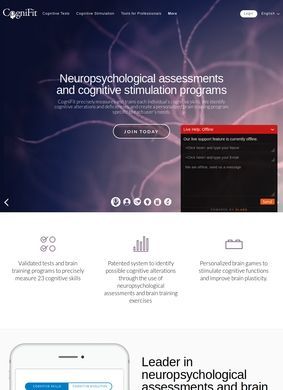
CogniFit is a web and mobile platform for cognitive training and assessment, built around the idea that mental skills can be measured and exercised the way a fitness app tracks the body. The core offering is a set of more than twenty assessments covering memory, attention, reasoning, perception, and hand-eye coordination, paired with a library of training games that the company says have been played over 135 million times. New users take a battery first, and an algorithm flags the areas where they scored lowest, then steers them toward exercises aimed at those gaps. That adaptive loop is the selling point, and it is a sensible design for anyone who wants structure instead of picking games at random.
Who uses CogniFit
What surprised me when looking past the consumer pitch is how wide the audience net is thrown. The platform is sold to clinicians running cognitive rehabilitation with patients, to researchers who need standardized test batteries and participant management tools, to teachers assessing students, to employers folding it into wellness programs, and to coaches working on athlete performance. CogniFit publishes user numbers to back the breadth: roughly 6.45 million accounts in total, with about 3,585 clinicians, 771 researchers, and 1,063 schools on the books. There is also an API for professionals who want to plug the assessments into their own systems. Apps run on both iOS and Android, so the training travels off the desktop.
That professional reach is the part of the CogniFit offering I find most defensible. Brain-training apps aimed at consumers have a long history of overpromising, and a tool genuinely used by hundreds of research groups and clinics is operating under more scrutiny than a casual game. The participant-management and study-battery features are not the kind of thing a company bolts on for marketing. They imply a customer base that needs reproducible measurement, and that pulls CogniFit toward something more accountable than the average memory game.
Research credibility and evidence
This is where a careful reader has to slow down, because the gap between what CogniFit claims and what the evidence supports is the whole story for a product like this. There is genuine positive evidence: a piece in The Conversation, written from an academic standpoint, named CogniFit as one of only two brain-training programs that met its evidence bar, citing a high-quality randomized controlled trial. For a category crowded with apps that have no published trials at all, clearing that threshold even once is meaningful and worth saying out loud.
Transfer to daily life remains unclear
The caution is equally grounded. A review on MindTools.io found the integrative feedback limited, meaning CogniFit tells you how you did on its own exercises better than it tells you what that means for daily life. Whether training on these specific tasks transfers to remembering names, staying focused at work, or any goal that brought someone to the platform is the central unanswered question across this entire field, and CogniFit does not escape it. A skeptical Reddit thread, with 56 votes behind it, called out the claims as exaggerated. Both things can be true at once: the assessments rest on more research than the typical rival app, and the everyday payoff is still uncertain.
Mixed user reviews and safety ratings
The third-party picture of CogniFit is genuinely mixed, and pretending otherwise would do a reader no favors. On SmartCustomer the platform sits at 2.9 out of 5 across 93 reviews, which is a middling-to-poor score from a decent sample. The Apple App Store lands around four stars, but with a recurring complaint that the app is buggy; an analysis by JustUseApp went through 1,662 reviews and assigned a safety score of 33.3 out of 100, a number that deserves a second look from anyone cautious about data and permissions. RealReviews.io shows 4.6 out of 5, though only from five reviews, so there is not much to draw from it either way.
Reading those together, CogniFit looks like a product people find useful in concept but rough in execution, with stability and trust questions trailing it. That is a fair thing to know before paying for a subscription. The strongest endorsement comes from the academic and professional side, while the loudest grumbling comes from everyday app users who hit bugs or felt the claims ran ahead of the experience.
Support and contact options
Reaching support is the weaker link on first impression. There is no phone number or street address listed publicly, and the routes to reach a person are not prominent. What exists is a contact form and a separate help portal at the support subdomain, which handles questions and tickets. For a software service that arrangement is normal enough, and a support portal is arguably the right channel for a product whose users are spread across dozens of countries. A buyer who wants to talk to someone before paying will have to dig for it, and the missing direct line is a modest mark against the otherwise professional presentation.
Clinicians versus casual users
CogniFit knows which audience pays its bills, and the product is built accordingly. An individual chasing a guaranteed sharper memory should keep the open scientific questions firmly in mind, because no app in this space can promise that yet. A clinician, researcher, or educator who needs standardized cognitive measurement and a way to track many people over time is looking at one of the better-supported options in this category, API and all. The published evidence is enough to justify serious consideration from professionals, and the scale of CogniFit's research user base adds real weight to that case. For a casual user, the picture is murkier, and the realistic upside is more modest than CogniFit's own marketing implies.
Business address
P.O. Box 7360,
New York,
NY
10116
United States