That is the question worth asking of any directory that puts itself between a person in distress and a clinician, and Muslim Therapists answers it more specifically than the typical aggregator bothers to. The therapists listed on Muslim Therapists are pre-screened, their licenses are validated where applicable, and every profile goes through an annual review. A listing that was accurate twelve months ago has been looked at again. For a service where a lapsed license or a quietly closed practice turning up in results can do harm, that re-check is the part that earns my attention, and it is where the weight of this whole assessment sits.
What Muslim Therapists does
Start with what the platform is. Muslim Therapists is a U.S.- and Canada-facing service that connects people seeking mental health support with Muslim therapists and psychologists. The premise is plain: a shared cultural and faith frame changes what happens in the room, and if someone spends the first session explaining who they are before they can say why they came, that session is half-spent on context. The fix Muslim Therapists offers is to remove that explaining step from the start.
How the vetting process works
Most directory platforms in this space accept submissions and move on. The annual re-check is not standard, and it changes what the listing is worth. License validation and a yearly pass are a different kind of assurance than a star average; they can be checked against a state licensing board in a way a Trustpilot tally cannot. That trade is defensible for a niche this narrow, and it is the strongest thing on the site. It is also not a guarantee. Pre-screening tells a user that someone looked; it does not replace the user confirming a chosen therapist's credentials themselves before booking. Treat the vetting as a filter that has already removed the obvious problems, then do the last check on your own.
Free listings expand the therapist pool
The free-listing policy feeds the same mechanism. Therapists can list on Muslim Therapists at no cost, which pulls in independent practitioners who would never pay a directory fee, and for faith-aligned mental health care a wider pool is exactly what someone searching here needs. A paywalled directory in this niche would shrink to whoever could afford it. Muslim Therapists chose breadth, and the annual review is what keeps breadth from becoming a list of stale entries nobody maintains.
Search and messaging options
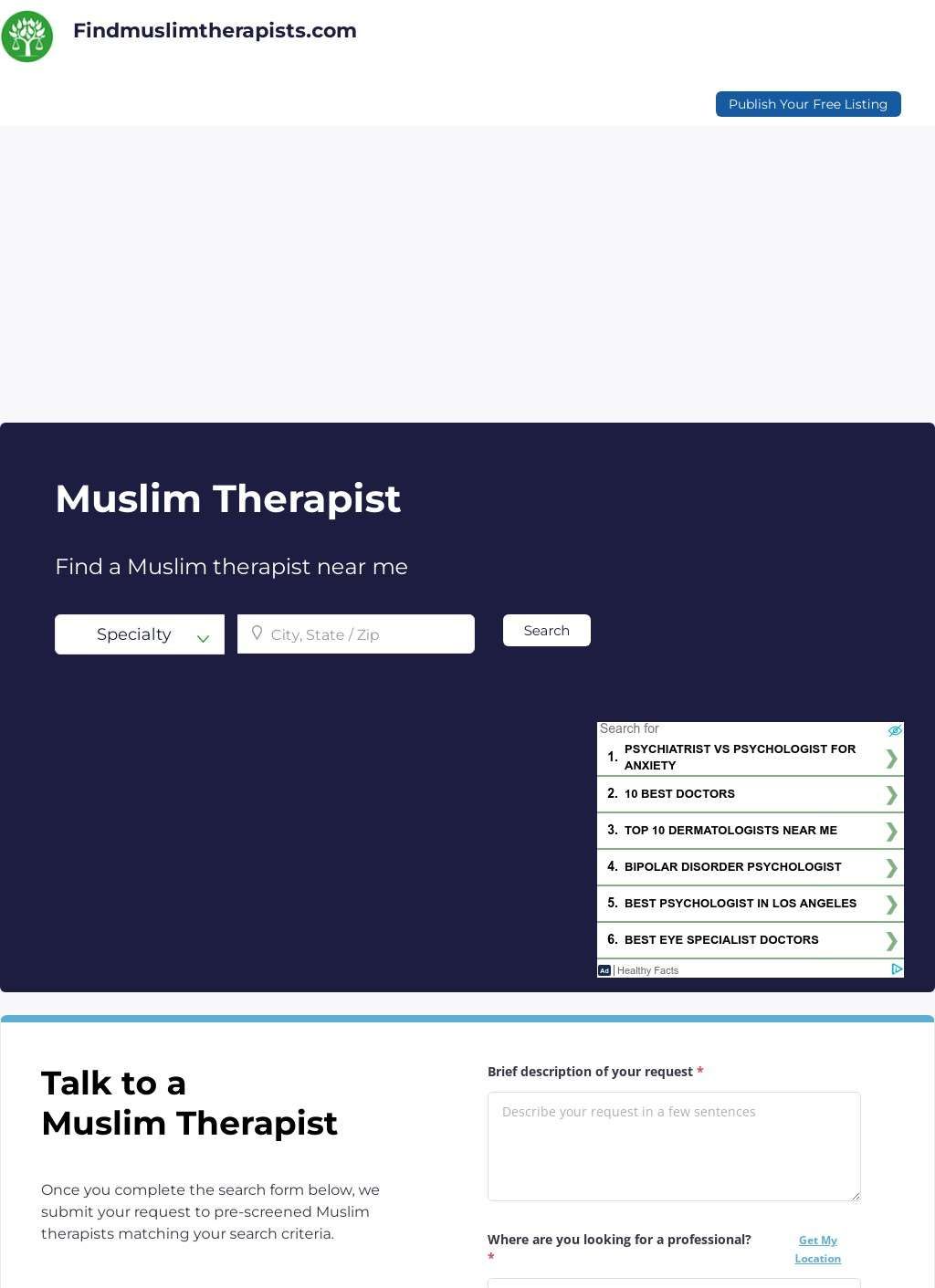
Two ways in support this. A search form lets a person describe what they are dealing with and receive matched therapist referrals forwarded by the platform. A browsable directory sorts by specialty and geography across more than fifty U.S. cities. Individual therapists can also be messaged directly through their profiles, which keeps the choice of who to contact in the user's hands instead of routing everyone through one intake queue.
The range backs the screening claim. More than twenty-four specialties are represented on Muslim Therapists: adult, child and adolescent, family, individual, and marriage counseling, alongside recognised clinical modalities including CBT and general psychotherapy. The issue-specific categories run to anxiety, depression, addiction and substance abuse, grief, and eating disorders. A parent worried about a teenager and a couple in a rough patch are handled by the same platform without being forced into one generic funnel. That spread reads as professionals working from established practice, not something improvised around a faith angle.
Telehealth access across regions
Telehealth is built in, and it counts for more on Muslim Therapists than it would on a general directory. Culturally-informed clinicians are scarce outside the largest metro areas; in plenty of regions there is no nearby match to find at all. Without a virtual option, the geographic browsing would leave most of the map empty. The combination of location search plus a telehealth fallback is the clearest structural decision on the site, and it keeps a person in a mid-sized city from being turned away with nothing.
Missing external validation and operator contact
Two weaknesses deserve naming. First, outside validation is absent: a search for ratings returns no Google reviews, no Trustpilot page, no Yelp profile, and no BBB entry for Muslim Therapists. What surfaces instead are competing directories, muslimtherapist.directory, therapytribe.com, and zencare.co, plus the platform's own internal pages. A focused niche service accumulates public review volume slowly, so the silence is not proof of anything, but a person who needs a crowd of outside voices before trusting a platform will not find that crowd on Muslim Therapists, and the credibility case then rests entirely on the screening discipline described above.
Second, reaching the operator is awkward. A contact page exists, yet no operator phone number appears on the main landing view, no physical address is posted, and no direct email for the people running the platform shows up in an obvious spot. Communication with therapists runs through their profiles or the on-site messaging form, which is fine for the user-to-therapist connection, since the therapists are the offering. The harder case is knowing who to reach at the platform level for a billing dispute, a question about a listing, or how the screening on Muslim Therapists is performed. For a service handling something this sensitive, a named operator contact would have closed a hole that a form page leaves open.
Weighed together, the verdict tracks one's tolerance for self-reported assurance. The specialties on Muslim Therapists are precise enough to narrow by problem type, the telehealth fallback stops geography from closing off options, and the annual re-check is genuinely more rigorous than what most aggregators in this space offer. Someone who has already decided that cultural and faith alignment matters in a therapist, and who is prepared to lean on the platform's vetting and then verify a chosen clinician's license independently, has a usable starting point here. Someone who treats external ratings as the price of trust should know going in that Muslim Therapists does not supply them, and no amount of screening discipline changes that.
One detail tells you where the build effort went: the search form asks for the issue and the geographic constraint up front, so the referral list comes back already shaped by problem and place, not as the full directory dumped on the user to sort.