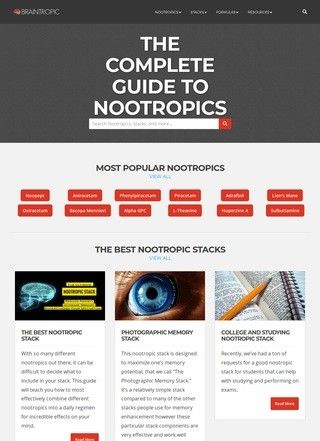
Piracetam gets its own page here, sitting alongside deep write-ups on Noopept, Phenylpiracetam, Aniracetam, Adrafinil and Lion's Mane Mushroom, each one a standalone entry rather than a paragraph buried in a longer article. That is the shape of Braintropic: a free reference library about nootropics, the family of compounds sometimes marketed as smart drugs, built out compound by compound. Anyone trying to figure out what Modafinil does, or how Adrafinil converts in the body, lands on a page dedicated to that single substance instead of a vague roundup. The site has been running since 2012, which in a corner of the internet full of sites that appear and vanish is worth noting on its own.
Compound profiles and stacks
The Braintropic catalogue runs past thirty individual compounds, and the depth is the point. A catalogue of that size only earns trust if the entries hold up, and the ones read through here treat dosing, effects and the more uncertain corners of the research with more care than the average supplement blog, which tends to skip straight to a buy button. Braintropic does sell attention in a sense, through affiliate-style product reviews, but the compound profiles read like reference material first.
Beyond the single-compound pages, Braintropic organises everything into stacks, which is where nootropics get interesting and also risky. There are pre-built combinations aimed at different goals: a general "Best Nootropic Stack," stacks pitched at students, and versions leaning on natural ingredients for people wary of the more experimental synthetics. Stacking is exactly the territory where a beginner can get into trouble mixing things, so having someone lay out sensible starting combinations has genuine value. The guidance stops short of prescribing, which is the right call for a site that cannot know its reader's health situation.
Branded formula reviews
Then there is the branded review layer. Braintropic covers commercial formulas including Mind Lab Pro, Alpha Brain, CILTEP, New Mood and Performance Lab's Whole-Food Multi, and it compares what each blend claims against what the ingredients plausibly do. These reviews are where the money likely comes from, and a careful reader should keep that in mind. To the site's credit, the writing does not read as breathless. It walks through formulas, flags what is underdosed or padded, and lands on measured conclusions. Whether every verdict is fully independent of the affiliate relationship is something no reader can verify from the outside, and that tension sits under this whole category of content.
Safety guidance for newcomers
For newcomers, the educational spine covers the obvious questions head-on: what nootropics are, whether they are safe, how to buy without getting scammed, and an analysis drawn from a survey of which compounds users rated most effective. That safety guide outweighs the rest combined, given that some of the substances profiled here (Modafinil in particular) are prescription drugs in many countries and legal grey areas in others. Braintropic does not pretend these are risk-free, and a reader arriving with no background gets pointed toward caution instead of hype.
The Braintropic newsletter dangles a free ebook, "The Encyclopedia of Nootropics," as the sign-up hook. It is a standard email-list play, and there is nothing wrong with it, though the ebook is plainly also a funnel back into the site and its recommendations. Nothing here is hidden; the trade is clear enough that a reader can decide whether an email address is worth the download.
Anonymous authorship and verification
Now for the part that gives me pause. Content on Braintropic is attributed to a "Research Team," not to named individuals with stated credentials. In a field where a reader is weighing information that touches directly on what they put in their body, anonymity is a real limitation. There is no bylined pharmacologist, no visible medical reviewer, no bio explaining who assembled the dosing tables. Plenty of the writing is careful and clearly informed, but "careful and anonymous" only carries so far when the subject is drugs that affect the brain. The articles do carry "last modified" dates, and some of the branded reviews were last touched a few years back, so a reader checking whether a given page reflects current research has to weigh how recently it was updated.
On reaching the people behind it, there is a contact page at the site, plus links out to Facebook, Twitter, Instagram and an RSS feed for anyone who wants to follow along. What is missing is a phone number or a physical mailing address, so the contact route is a web form and social profiles rather than anything you could pin to a place. For a free information site that is fairly normal, and the presence of a real contact page is more than some content farms bother with. It does mean, though, that if a reader had a serious question or a correction, the channel is a form and a hope for a reply.
Outside the site itself, there is not much to go on. A search for Braintropic does not surface Google, Trustpilot, Yelp or BBB listings, no aggregated star rating, no body of user testimony one way or the other. What comes back is mostly the site's own articles ranking for the compounds they cover, plus a stray Goodreads entry for a self-published book with a similar title that has nothing to do with this site (and carries a single one-star rating that would be misleading to attach here). So there is no external chorus confirming or denying the quality of the information. A reader is essentially judging Braintropic on the internal evidence: the writing, the sourcing, the dates.
Taken together, Braintropic works best as a solid starting map, not a final authority. The breadth of compound coverage holds up, the stacks give beginners a structured way in, and the safety-first framing is more responsible than the category norm. The educational guides do the unglamorous work of explaining basics that many competing sites skip. For orientation, comparison shopping among branded blends, and getting a first sense of what a given compound does, Braintropic is a useful place to read.
But the doubt does not fully close. A site advising people on psychoactive supplements, funded in part by selling the very products it reviews, written by a team that will not put its names to the work, with no outside track record to check it against, asks for a lot of trust it cannot fully substantiate. The information reads well, and that is exactly what makes the missing authorship hard to shrug off: careful prose is easy to produce and impossible to audit when nobody signs it, and on a topic like this the reader is the one carrying the risk of being wrong.