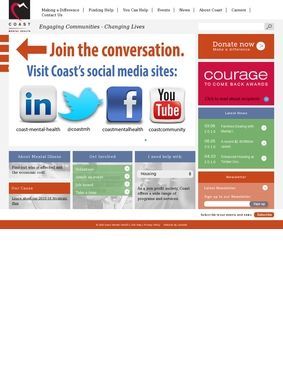
Coast Mental Health has been working in the Greater Vancouver area for more than fifty years, which is a long time for any charity to keep going, let alone one in a field where funding and public attention come and go. It is a registered non-profit (charity number 86150 8018 RR0001) built around mental health recovery for adults living with mental illness. That longevity is the first thing worth knowing, because plenty of organizations in this space arrive with good intentions and fade after a grant cycle or two. Coast Mental Health has outlasted that pattern by decades, and that fact alone sets the baseline for any fair assessment of what it offers.
Housing support and employment programs
The work breaks into three connected areas, and the site lays them out plainly. The first is housing: residential support programs for people living with mental illness, the kind of supported accommodation that gives someone a stable base instead of a shelter bed or a couch. The second is support services, covering peer support, crisis assistance, and broader community mental health work. The third is employment and education, meaning job training and learning programs aimed at helping people rejoin the community on a more lasting footing. Read together, these three areas form a single path: a roof first, then support, then a way back into work and ordinary life. Coast Mental Health frames them as a sequence, which makes structural sense.
I find the housing-first logic of that sequence convincing, because it matches how recovery tends to play out in practice. Stability of place comes before anything else can take hold. Pairing housing with both crisis support and a route toward employment shows Coast Mental Health thinking about the whole arc of a person's life, well beyond a single crisis point. Whether the execution lives up to that on the ground is something a prospective client or family member would need to test directly, but the structure itself is sound.
Courage to come back awards
One feature that sets Coast Mental Health apart from a standard service provider is the Courage To Come Back Awards, a public recognition program honouring individuals who have come through mental health struggles and other serious adversity. It does two useful things at once: it puts real faces and stories in front of the public, which chips away at the stigma that keeps people from seeking help, and it raises the profile of the organization running it. For a charity that depends on community goodwill and donations, a visible annual event like that is genuine outreach, not decoration.
The clear audience is adults in the Greater Vancouver region living with mental illness, along with their families and the social workers, clinicians, and case managers who refer into services like these. The geographic focus matters here. Coast Mental Health operates as a place-based organization rooted in one city and its surrounding communities, working in person rather than as a national hotline or an online platform, which is exactly what you want when the services include physical housing and direct support.
Behind the contact information
Contact details sit right on the homepage. There is a street address at 293 East 11th Avenue in Vancouver, a local phone line, a toll-free number for callers from further out, and a fax line for the referrals and paperwork that still move that way in healthcare and social services. Nothing is buried. A family trying to find help for a relative, or a professional making a referral, can find the number within seconds of landing on the page. That ease counts for a lot in this kind of service, more than it would for an ordinary commercial site.
Reputation across employer and client reviews
On outside opinion, the picture is uneven, and it is worth being precise about what the numbers actually represent. Most of what surfaces is employee feedback rather than client feedback. On Glassdoor, Coast Mental Health carries about 65 reviews at roughly 3.2 out of five, with a little over half of reviewers saying they would recommend it as a workplace. Indeed shows a comparable picture across around 61 Canadian reviews, with sentiment splitting along a familiar line: frontline staff culture viewed more warmly than management. BirdEye lists three client-side reviews without an aggregate rating. No Google, Yelp, Facebook, or Trustpilot consumer ratings turned up in any business directory search.
So the rating data tells you more about Coast Mental Health as an employer than about the day-to-day experience of the people it serves, and those are different questions. A 3.2 staff rating in a sector known for heavy workloads, emotional strain, and tight non-profit budgets is unremarkable and not a red flag on its own. The near-absence of service-user reviews is harder to read either way. People who rely on supported housing and crisis services are often not in a position, or of a mind, to post about it online, so the low count is not evidence of much. It means the public reputation signal is quieter than it would be for a restaurant or a retailer, and anyone weighing Coast Mental Health should lean on referral channels and direct conversation more than on an online score.
A verifiable track record
Set against the wider field, what this listing shows is how concrete the organization is. Fifty-plus years of operation, a clear charitable registration, a physical address, three defined program areas, and a named public awards initiative add up to a real institution with a track record. The transparency around Coast Mental Health's registered charity status is the sort of thing a careful donor or referrer checks for, and it is present and easy to confirm. The institutional history behind the listing is decades deep and fully verifiable through the public registration record.
For those reasons, Coast Mental Health reads as a credible entry point for supported housing and recovery services in Greater Vancouver. The practical question is capacity and fit, and that means phoning the Vancouver line or the toll-free number to ask which programs currently have openings and what the referral process looks like. Availability in this kind of service is the detail that decides whether an organization with a good structure can actually help at a given moment, and only a direct call will answer it.