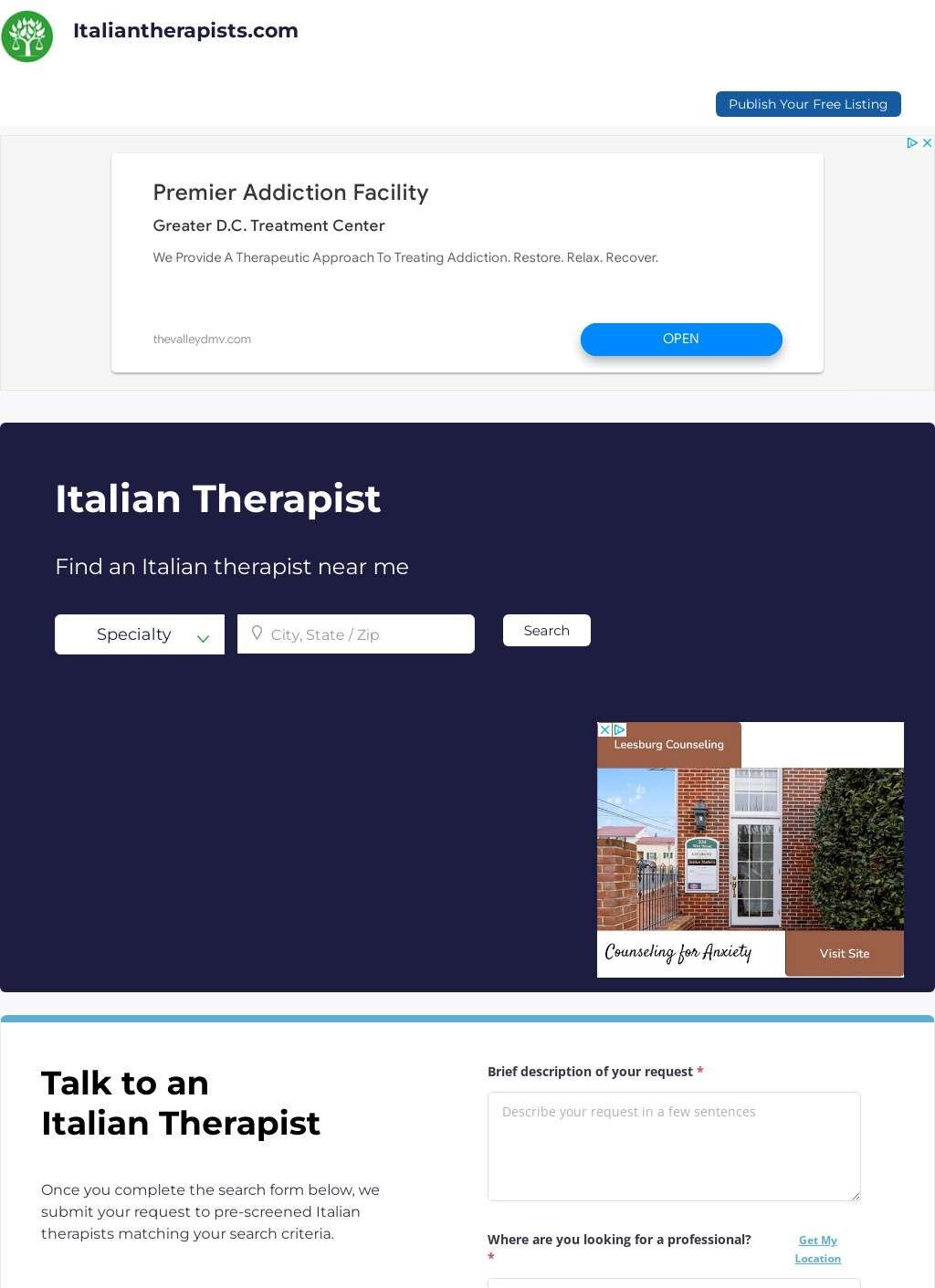
Italian Therapists is an online directory and matching service for people who want to speak with a mental health professional in Italian, built mainly around the United States and Canada but reaching into Italy, Spain and a few other countries. The premise is narrow and specific, which is its whole strength. Plenty of people living abroad never feel fully themselves explaining anxiety or grief in a second language, and the site treats that gap as its entire reason to exist.
How the matching service works
The mechanics are simple to follow. A visitor fills in a search form on Italian Therapists, sets a few parameters, and the platform passes the request along to pre-screened therapists who fit the criteria, with a reply promised inside twenty-four hours. You can also browse and filter directly: by U.S. state and city (California, Missouri, San Francisco, Los Angeles, St. Louis show up in the navigation), or by country pages for Italy and Spain. Therapist profiles are public, so a cautious user can read through who is available before reaching out, and direct on-site messaging lets that first contact happen without handing over a personal email straight away.
Browsing therapists by location
That dual approach, push and browse, suits the subject. Some people in distress want to type a few details and let the system find them a name; others want to scroll, read, and stay in control of who they reach out to. Italian Therapists offers both lanes, and the on-site messaging means neither path forces a phone call before the user is ready for one. The twenty-four-hour reply window is a promise rather than a guarantee, but setting an expectation at all is something many listing sites skip entirely.
Choosing between push and browse methods
What pushes the site past a plain listing wall is the screening claim that Italian Therapists puts front and center. Italian Therapists says it checks every therapist before publishing, validates licenses where applicable, and re-reviews the listings once a year. That last detail, the annual review, is the one I found most reassuring, because directories tend to rot quietly as practitioners move, retire or let registrations lapse, and an explicit refresh cycle at least acknowledges the problem. Stating a process is a step above the many sites that simply collect names.
Screening and annual review process
The specialty filters are broad enough to cover most reasons someone seeks help. Anxiety, depression, addiction and substance abuse, psychotherapy, behavior therapy, crisis intervention: the heavier end is represented alongside the gentler "talk it through" categories. There is also a clear split by life stage, with separate adult therapy, child and adolescent therapy, and family or marriage counseling on Italian Therapists. Telehealth appears as its own filter, and for this particular audience it is more than a convenience: an Italian speaker in a small Missouri town may have no in-person option at all, so the video session needs to be the default rather than a fallback.
Specialty filters and therapy types
That breadth tells you who Italian Therapists is really for. It is aimed at the expatriate or immigrant who is fluent enough to live an English-speaking life but wants the relief of therapy in the mother tongue, and at families where the parents think in Italian while the kids drift toward English. The location pages reinforce this. Coverage clusters where Italian communities historically settled, and the country-level pages for Italy and Spain hint at ambitions beyond North America. For therapists, listing on Italian Therapists is free, which lowers the barrier to building out that supply and explains how a niche service can hope to cover so many cities.
Free listings for therapists
The free-listing model cuts both ways, and it is worth naming. It helps the directory grow its roster fast, which is exactly what a language-specific service needs to avoid the dead-end of a user searching their city and finding nobody. The flip side is that a no-cost listing usually draws more sign-ups than a paid one, which puts more weight on the screening step. Free entry without vetting would just produce a crowded page of unverified names. Taken together, the free model and the screening promise are meant to balance each other, and Italian Therapists clearly intends them to. As part of this business directory category, that balance is what separates a useful tool from a directory that merely looks busy.
Newsletter updates for users
A newsletter signup sits on the page too. It is a minor feature, though for a service like Italian Therapists a regular note about coping strategies or new practitioners in a region is a sensible way to stay useful between the infrequent moments someone needs to book a session.
Operator transparency and outside reviews
Here the picture gets complicated, and it is worth being honest about it. Italian Therapists shows no phone number and no physical address on its landing page or in its search results. There is also no "about the team" section, so the operator behind Italian Therapists remains largely anonymous. The only way to reach the platform itself is the web request form, and the only way to reach a therapist is the on-site messaging. For matching with a counselor, that closed-loop design is defensible: it keeps the conversation on the rails and protects both sides early on. For the platform behind the matching, the silence is less comfortable. When a site is vouching for the licenses and quality of mental health professionals, a visitor reasonably wants to know who is doing the vouching.
On independent opinion, there is not much to draw on. A search for outside reviews of Italian Therapists turned up nothing notable, no body of Google or Trustpilot ratings to confirm or contradict the experience the platform describes. That is not damning. Highly specialized directories often fly under the radar of the big review platforms precisely because their audience is small and geographically scattered. It does mean a prospective user is judging Italian Therapists almost entirely on its own presentation, which throws the burden back onto those public profiles and the screening promise the site makes for itself.
Comparing Italian Therapists to general platforms
Set against the obvious alternative, the calculus becomes clearer. A general platform like Psychology Today carries an enormous roster and well-known filters, and many of its U.S. therapists can be searched by language spoken, Italian included. What it cannot easily do is guarantee a critical mass of Italian speakers in a given city, or surface them without wading through hundreds of unrelated listings. Italian Therapists trades the giant's volume and name recognition for a single, sharply defined promise: everyone listed speaks the language, and someone has at least looked over their credentials. If that promise holds, the focus is genuinely useful, and the limited operator transparency is the part of the published presentation a careful visitor should weigh hardest.