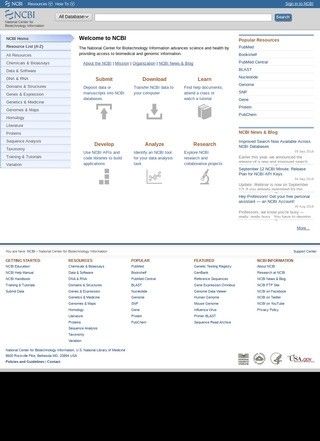
For a large share of the world's life-science community, reading the biomedical literature, pulling a gene sequence, and checking a clinical variant without paying for any of it has meant going to the same address for years, and the National Center for Biotechnology Information is the reason. Run as a division of the National Library of Medicine within the National Institutes of Health in Bethesda, Maryland, it gathers an enormous spread of biomedical and genomic data into one connected set of databases and search tools, all free to use.
Biomedical literature databases
The literature side is what most people meet first. PubMed indexes citations and abstracts from biomedical journals and is, for many clinicians and students, the default starting point for any search. PubMed Central sits next to it with full-text open-access articles, so a citation often leads straight to the complete paper instead of a paywall. Bookshelf rounds this out with full-text books and longer documents across the biomedical and life sciences. Together these three cover a lot of ground, from a quick reference check to a sustained pass through primary research.
Genomic and sequence resources
Past the reading material, the genomic and sequence resources are where the National Center for Biotechnology Information does work that few other places match. There is the Nucleotide database, Genome, Gene, the Assembly database, and dbSNP for genetic variation. Protein data lives in its own database alongside PubChem, which holds chemical compound structures, bioassay results, and pharmacological information. ClinVar handles clinical variant interpretation, the kind of resource a genetics lab depends on when deciding what a particular mutation means. The pieces are built to talk to each other, so a search that starts in a paper can move to a gene and then to the variants tied to it without switching systems.
Comparing sequences with BLAST
BLAST, the Basic Local Alignment Search Tool, deserves its own mention because so much daily lab work passes through it. It lets a user compare a nucleotide or protein sequence against the databases here and find regions of similarity, which is fundamental to identifying genes, checking what an unknown sequence might be, or finding related organisms. Supporting tools handle sequence alignment and taxonomic classification, filling in the steps around that core comparison.
Programmatic access through E-utilities
For anyone building software, the E-utilities (also called Entrez) give programmatic access to all of these databases through an API. Bioinformaticians who need to query at scale or fold these resources into their own pipelines get far more out of the API than point-and-click searching allows. There are also structured submission portals for researchers depositing sequences, manuscripts, and experimental data, which is how a good deal of this content arrives in the first place.
Access and support for users
The site does not stop at raw data and tools. It carries tutorials, webinars, and help documentation aimed at people learning how to navigate what is, frankly, a deep and sometimes intimidating system. The National Center for Biotechnology Information also runs its own intramural research programs and collaborative projects, so it is a working scientific body as much as an archive. That dual role shows in how the resources are maintained and extended over time.
Free access for all users
Worth noting: the core services are open to everyone with no registration. A student in another country can reach the same PubMed and BLAST that a funded lab uses. Only the submission services ask for an account, which makes sense, since depositing data needs a record of who did it. That open-access stance is the practical heart of what the National Center for Biotechnology Information offers, and it shapes who ends up depending on it.
The audience is broad by design. Biomedical researchers, clinicians, genomics scientists, pharmacologists, and students all draw on these resources, often without thinking much about where the data comes from. A clinician might use ClinVar to weigh a variant found in a patient; a graduate student might run BLAST on a sequence from a class project; a pharmacologist might dig into PubChem for compound data. The same set of databases serves wildly different needs, which is part of why the National Center for Biotechnology Information has become so embedded in everyday scientific practice.
One honest caveat for newcomers: the sheer size can be daunting, and the interface assumes you already know roughly what you are after. The tutorials help, but a first visit can feel like walking into a very large library with no map. That is the price of comprehensiveness, and the National Center for Biotechnology Information consistently errs toward giving you everything rather than hiding complexity behind a simpler surface.
Tips for first time visitors
If you write code, check whether the E-utilities API fits your project before building anything from scratch. If you are new to genomics, run a PubMed search on a topic you know well to see how the results connect, then try BLAST with a sample sequence to feel out the workflow. The National Center for Biotechnology Information rewards the time spent learning its layout, and for serious biomedical work it is close to indispensable.