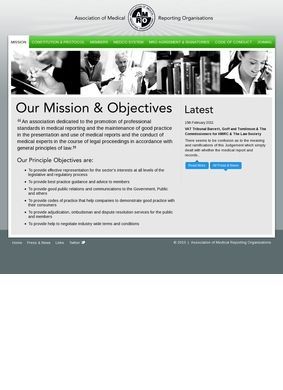
A trade body that also runs an ombudsman for the general public is a slightly unusual thing, and that dual role is the first thing worth understanding about the Association of Medical Reporting Organisations. On one side it looks inward, setting standards for the companies that produce medical reports used in personal injury and other legal claims. On the other it faces the public, offering a route for someone unhappy with one of those companies to bring a complaint and have it adjudicated. Most sector associations do only the first job. This one carries both.
Medical reporting organisations sit at an awkward junction in the claims process. A solicitor needs an independent medical opinion, an insurer wants that opinion to be credible, and the injured person is caught between the two. The firms that arrange these reports, booking the examinations, handling the paperwork, chasing the doctors, have a commercial incentive that could quietly pull against impartiality. AMRO exists partly to hold a line against that pull, and the site is organised around the tools it uses to do so.
Self-regulation through codes and protocols
The core of the offering is self-regulation. The site sets out best-practice guidance and advice for member organisations, plus codes of practice and professional protocols that a member is expected to follow and, when questioned, to point to as evidence of good conduct. A code is only worth something if a member can be measured against it, and that measurability is the whole point. The Association of Medical Reporting Organisations frames its protocols as a demonstrable standard, not a vague promise, which is the right instinct for a body whose members trade on their neutrality.
Complaints process for external scrutiny
Sitting alongside the codes is the dispute machinery. There is an adjudication and ombudsman function with dispute resolution that reaches beyond the membership to the public. If a claimant or a solicitor believes a member firm handled a report badly, there is a defined complaints path to follow. I find that the presence of an external-facing complaints route says more about an association's seriousness than any amount of mission language, because it invites scrutiny rather than deflecting it. A body that only ever spoke to its own members would have no reason to build such a thing.
How standards reinforce dispute machinery
The two functions reinforce each other. The codes give the adjudicators something concrete to judge against, and the adjudication gives the codes teeth. Without one, the other would drift toward decoration.
Legislative representation for member firms
The second half of what the Association of Medical Reporting Organisations does points outward, toward Parliament and the regulators. The medical reporting industry has been reshaped repeatedly by legislation and reform in the way personal injury claims are handled and priced in the UK, and firms operating alone have little sway over how those rules land. The site describes representing members in legislative and regulatory matters that affect the sector, and providing support for industry-wide negotiation on terms and conditions. That collective bargaining role is a familiar reason trade associations exist at all, and here it is stated plainly.
Verifying membership in the directory
For anyone trying to verify a firm, the members directory is probably the most immediately useful page. It lets a solicitor, an insurer, or a claimant check whether a given medical reporting organisation is a member and therefore signed up to the codes and the complaints process. That single lookup does a lot of quiet work, turning membership from a logo into something checkable. The Association of Medical Reporting Organisations also publishes documentation on its regulatory agreements and associations, so a reader can see which other bodies it works alongside.
Governance documents and regulatory transparency
Rounding out the site are the governance materials: constitutional and structural documents that explain how the association is run and who answers to whom, plus the standard cookie and privacy policy pages. Governance documents are dry, but for a self-regulatory body they are load-bearing. An organisation asking to be trusted as a referee needs to show how it is constituted, and putting those papers where anyone can read them is the correct call.
A search for independent reviews of the Association of Medical Reporting Organisations itself turns up nothing on the usual consumer platforms, which is unsurprising: its audience is firms and claims professionals, not the public rating a purchase. Its standing has to be judged on the codes and the complaints record it publishes, not on stars it was never going to collect. This is a body for a narrow slice of the legal-medical supply chain, not a general resource on medical evidence or on making an injury claim.
A member of the public who lands here hoping for advice on their own case will find a complaints route and not much else, and that is by design. The value is concentrated for the two audiences it actually serves: the firms deciding whether to join and abide by the codes, and the people or advisers who need to challenge one of those firms.
It helps to be clear about what the Association of Medical Reporting Organisations is not. Someone weighing it against MedCo, the government-backed portal that accredits and allocates medical experts and reporting organisations for whiplash-related claims, should know the two are different animals. MedCo is a mandatory accreditation and matching system built into the claims process itself, while AMRO is a voluntary association layering standards, representation and an ombudsman on top. For a firm that must already register with MedCo, the question is whether membership of the Association of Medical Reporting Organisations adds a further, self-imposed standard worth signing up to. On the evidence of this site, the codes and the public complaints route are exactly what would make that worthwhile.