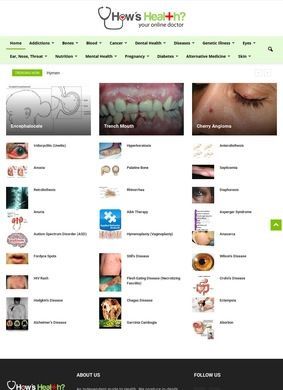
How's Health tries to cover nearly the whole span of consumer medicine from a single address, and that ambition is the first thing worth weighing. The site is a health information library: articles and blog posts sorted into topical shelves that run from addictions and substance abuse through bones, joints and muscles, blood and immunity, cancer types and their treatments, dental and oral care, genetic illnesses, eye and vision trouble, ear, nose and throat disorders, nutrition and diet, mental health, pregnancy and women's health, diabetes and the endocrine system, alternative medicine and home remedies, and skin, hair and nail conditions. Few sites this size promise that much breadth without either a clinical staff or a named editorial team behind it, and that tension shapes how the whole thing reads.
Breadth across medical topics
The intended reader is easy to picture. Someone types a symptom or a condition into a search box, lands on a page here, and wants a plain-language explanation before deciding whether to worry or book an appointment. On that count the layout does its job. Grouping the material by body system and by concern means a person hunting for information on, say, joint pain or a thyroid question is not forced to wade through unrelated content to reach it. The category structure is the most useful thing on offer, because it turns a large pile of articles into something a non-specialist can actually walk through.
Category structure aids navigation
Breadth cuts both ways. A single site claiming competence on cancer treatment, genetic disease, mental health and home remedies at once is doing the work that, in practice, is usually split across specialist publishers and reviewed by clinicians in each field. Nothing in the public-facing material names who writes the articles or what qualifies them, and that absence matters more when the subject is oncology or endocrine disorders than when it is a general wellness tip. The categories are sensible and the coverage is wide, but wide coverage without visible authorship is a thing a careful reader has to hold at arm's length.
Authorship and credentials remain unclear
To the site's credit, it does not pretend to be more than it is. How's Health carries an explicit disclaimer stating the content is for informational purposes only and is not a substitute for professional medical advice. That is the honest and legally sensible line for a publisher in this space, and its presence suggests whoever runs the site understands the limits of what a general audience should do with a web article. It is the right guardrail. It also quietly concedes the point that the writing is a starting place, not a diagnosis.
How's Health also runs a privacy policy page, which is the baseline any content site handling visitor data should have. Links out to Facebook and Twitter round out the picture of a publication that wants a social presence and a return audience. None of this is remarkable, but it is all in order, and for a health-content site the housekeeping being in order counts for something.
Transparency and contact information
How's Health provides a contact page where a visitor can reach the people behind the site through a web form. That is a real contact route and it should be counted as one. What is missing is anything more concrete: no phone number and no physical address appear anywhere on the site, and the landing page itself carries no direct way to get in touch beyond pointing toward that form. For a business selling a product this would be a minor gripe. For a site publishing medical information, the anonymity sits less comfortably, because a reader who wants to know who stands behind a claim about a treatment has nowhere obvious to look.
No third-party reviews or ratings
The reputation side gives a reviewer almost nothing to hold. A search turned up no third-party reviews of How's Health, and the results that did surface were unrelated noise tied to a similarly named documentary and other health-titled sites. That is not evidence against the site, but it is not evidence for it either. There is no pool of user ratings, no independent commentary, no external signal that people have used the material and found it sound. A visitor is left to judge the content on its own terms, with no outside voices to lean on.
Verifying claims requires reader judgment
Put those two gaps together, the unnamed authorship and the near-total absence of outside commentary, and trust is the thing a reader has to settle for themselves before using any of this. Health information is only as good as the source standing behind it, and here the source is deliberately kept in the background. A form-only contact model is a defensible choice for a content publisher wary of spam, and plenty of legitimate sites run that way. The concern is not that How's Health is hiding, it is that a reader has very little to verify against.
As a place to get oriented on a broad list of conditions, How's Health is organised well enough to be genuinely usable, and its own disclaimer tells you exactly how far to trust it. What it cannot supply is the thing that would let a cautious person rely on it: a named, checkable authority behind the medical claims, or an outside record of readers who found the guidance accurate. Until one of those exists, How's Health remains a tidy, wide-ranging reference whose credibility a visitor has to take almost entirely on faith, and on a subject like this that is not a small thing to ask.