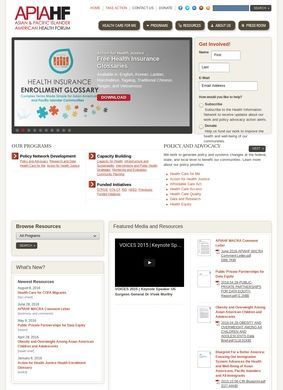
More than a million Asian American and Native Hawaiian/Pacific Islander people gained health coverage through enrollment help connected to the Asian & PacificIslander American Health Forum (APIAHF), and that single figure tells you most of what kind of organization this is. It works at the scale of federal policy, but the proof of the work shows up in individual sign-ups for marketplace coverage under the Affordable Care Act. The site presents a national nonprofit that has spent more than 38 years pushing on health policy for a population the brief puts at 28.6 million people spread across every U.S. state and territory.
Enrollment assistance through marketplace coverage
The reach here is consequential because the AANHPI label covers a wide span of communities, languages, and histories, and a generic health campaign tends to flatten those differences. The Asian & PacificIslander American Health Forum (APIAHF) builds its programs the other way around, addressing disparities that are specific to subgroups within that population. The site frames its core work in three pieces: advocacy at the federal level, community organizing on the ground, and capacity building for the smaller groups doing local work. Those three functions feed each other, which is the part that gives the organization its shape.
How the network connects policy to community work
The clearest example of that loop is the network. The Asian & PacificIslander American Health Forum (APIAHF) reports partnerships with more than 300 community-based organizations across the country. A policy shop in Washington can write good positions and still miss what is happening in a clinic that serves recent immigrants in a language the federal forms do not offer. A network of 300 local partners is how a national group keeps its advocacy connected to real conditions, and it also gives those local groups a louder collective voice than any one of them would have alone. The two San Francisco and Washington DC offices reflect this split deliberately, one foot in community-level work and one in the legislative process.
Language access as a health issue
On the program side, the ACA marketplace enrollment assistance is the most concrete thing the Asian & PacificIslander American Health Forum (APIAHF) can point to. Helping over a million people enroll in coverage is a measurable outcome, not a mission statement, and language access sits at the center of it. For populations where a parent may be navigating an English-only system on behalf of a whole household, the difference between an accessible enrollment process and an inaccessible one is whether the coverage gets used at all. The site treats language barriers as a health issue in their own right, a sharper read than advocacy groups that fold language access into a footnote.
Pandemic resource centers for cultural legibility
The COVID-19 work followed the same logic. The Asian & PacificIslander American Health Forum (APIAHF) set up culturally and linguistically accessible resource centers during the pandemic, a move that sounds routine until you consider how much public-health messaging in that period assumed an English-reading, internet-comfortable audience. Translating guidance is the easy part; making it culturally legible to communities with different relationships to medical authority is harder, and that is the gap these resource centers were built to close. Whether they fully closed it is not something the site can prove on its own, but the framing is honest about what it set out to do.
From conference convening to policy reports
Beyond direct services, the Asian & PacificIslander American Health Forum (APIAHF) runs an annual Voices Conference aimed at advocacy and movement building, and it publishes newsletters and policy reports. The conference is the convening arm of the same network, a place where the 300-plus partner organizations and individual advocates come together and compare notes. The published reports are how the policy positions get documented and argued in front of Congress, where the brief notes the organization has a record of direct engagement. None of this is flashy, and that is appropriate for a group whose influence is measured in legislative outcomes and enrollment numbers, not public profile.
Health equity across AANHPI populations
Health equity is the through-line connecting all of it. The site keeps returning to access to care, the language barriers that block that access, and the specific disparities that affect AANHPI communities differently from the population at large. That focus is what distinguishes the Asian & PacificIslander American Health Forum (APIAHF) from a general health charity. The Asian & PacificIslander American Health Forum (APIAHF) is not trying to serve everyone; it is trying to serve a population that broad national health efforts have historically treated as a monolith or overlooked entirely, and the program list maps onto that intent with reasonable consistency.
There are limits to what a listing like this can confirm. The enrollment figure and the partner count are the Asian & PacificIslander American Health Forum (APIAHF)'s own reported numbers, and the site naturally presents its work in its strongest light. A reader who wants to weigh the actual impact of the COVID resource centers or the policy reports would need to go to the reports themselves, which the site does make available. What the page establishes well is the structure: a national nonprofit with a long operating history, two offices, a large partner network, and a clear set of programs tied to a clearly defined population.
The Asian & PacificIslander American Health Forum (APIAHF) is a focused advocacy and policy organization with a real track record in the area it has chosen. Thirty-eight years of operation and a 300-organization network take sustained institutional effort to build; they do not appear by accident or by marketing alone. For anyone working on AANHPI health, whether as a community organization seeking a national partner, a policy researcher tracking health-equity advocacy, or someone trying to understand how marketplace enrollment reached communities that federal outreach often misses, the site is a substantive starting point. If that population is outside your scope, the value is narrower. The depth is proportionate to the mission, and the mission is clearly stated.