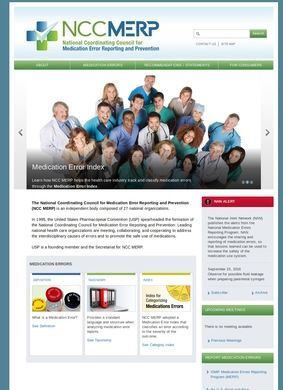
Founded in 1995 by the United States Pharmacopeial Convention, the National Coordinating Council for Medication Error Reporting and Prevention is an independent U.S. body that addresses the systemic causes of medication errors and pushes for safer prescribing, dispensing and administration across the healthcare system. It draws together 27 national member organizations under one table, and that structure is the detail that tells you what kind of resource this is. It is not a single research lab or a vendor with a product to sell. It is a coordinating body where pharmacy, medicine, regulation and patient-safety groups agree on shared language and shared standards.
Shared language for medication errors
That shared language is where the site does most of its work. The National Coordinating Council for Medication Error Reporting and Prevention publishes a formal definition of what counts as a medication error, along with a classification framework that lets very different institutions describe the same kind of event in the same terms. A hospital in one state and a manufacturer on the other side of the country can use the framework and mean the same thing. Anyone who has tried to compare safety data pulled from two systems with differently defined categories will know why a common definition is practically valuable in a way the words alone do not convey.
Medication Error Index by severity
Built on top of that definition is the NCC MERP Medication Error Index, which sorts errors by the outcome for the patient. The scale runs from events that reached no one and caused no harm through to errors that contributed to a death. Grading by severity is what turns a pile of incident reports into something a safety committee can act on, because it separates the near-miss that needs a process tweak from the event that demands a full investigation. The National Coordinating Council for Medication Error Reporting and Prevention pairs the index with a standardized taxonomy for analyzing and reporting the underlying data, so the people doing the analysis are not each inventing their own categories from scratch.
Who the materials address
The audience here is broad, and the materials reflect that. Healthcare professionals, hospitals and health systems, pharmacists, pharmaceutical manufacturers and policymakers are the obvious readers, since they are the ones who can change a label, a workflow or a regulation. The National Coordinating Council for Medication Error Reporting and Prevention writes for all of them, publishing recommendations and official statements aimed at practitioners, at manufacturers, and at the institutions that sit between the two. The tone of that output is advisory and consensus-driven, which fits a group that has no enforcement power of its own but real weight because of who sits at its table.
Patient safety resources
Consumers are not left out. There is a set of educational materials on safe medication practices written for ordinary people rather than clinicians, the kind of plain guidance a patient or caregiver can use to avoid a mix-up at home. Alongside that is a dedicated block of opioid safety resources, a focus that needs no explanation given how much attention opioid harm has drawn in the U.S. over the past decade. The National Coordinating Council for Medication Error Reporting and Prevention placing patient-facing content next to its technical frameworks is a sensible reach, since a good share of medication errors happen after the prescription leaves the pharmacy.
Links to established reporting systems
One thing worth being clear about: the National Coordinating Council for Medication Error Reporting and Prevention does not run its own error-reporting database for the public to file into. It points to the established systems and lets them do the collecting. The site links out to the ISMP Medication Errors Reporting Program and to FDA MedWatch, the two channels a clinician or member of the public would use to report a problem. That is the right call. Building a competing pipe would only fragment the data that the National Coordinating Council for Medication Error Reporting and Prevention spends its energy trying to standardize.
National Alert Network safety alerts
For people who need to stay current, the National Coordinating Council for Medication Error Reporting and Prevention publishes National Alert Network safety alerts, the NAN bulletins that flag specific hazards as they emerge. These are the time-sensitive output: warnings about a particular drug name, packaging or practice that has been linked to harm. A pharmacy director or risk manager following the National Coordinating Council for Medication Error Reporting and Prevention can treat them as a feed to watch rather than a document to file once and forget.
Member organizations and governance
The rest of the site documents how the body operates and keeps itself accountable. There are listings of the member organizations, leadership rosters, meeting summaries and schedules, and press releases. None of that is glamorous, but a consensus body's credibility rests entirely on who agreed to the statement being issued. Being able to see all 27 organizations by name, and read summaries of what was discussed, lets a reader judge the standing of a recommendation before relying on it.
Put together, the offering is coherent in a way that not every standards site manages. The definition feeds the index, the index feeds the taxonomy, the taxonomy supports the analysis, and the alerts and recommendations are what come out the other end. The educational materials translate the technical work for the public, and the membership and meeting records show the machinery behind it. A pharmacist building an internal reporting policy, a manufacturer reviewing how its packaging might be misread, and a parent trying to dose a child correctly are all served from the same site, each at a different depth.
On outside reputation, a search for reviews of the National Coordinating Council for Medication Error Reporting and Prevention on general platforms turns up nothing, which is expected for a standards and policy body of this kind. Its standing in the medication-safety field comes from the organizations it convenes and the frameworks practitioners have adopted, not from consumer ratings.
What does the council actually do?
The limits here are honest ones. The National Coordinating Council for Medication Error Reporting and Prevention sets the terms and issues guidance; it does not police compliance, and it does not collect incident reports itself. Whether it is useful to a given reader depends on what that reader came for. If the need is a vocabulary, a severity scale, or an authoritative statement to anchor an internal standard, the National Coordinating Council for Medication Error Reporting and Prevention supplies exactly that. If the need is to file an incident or force a change at a specific hospital, the site points elsewhere and is upfront about it. That clarity about scope is itself useful, and it keeps the site from pretending to be something it was never set up to be.