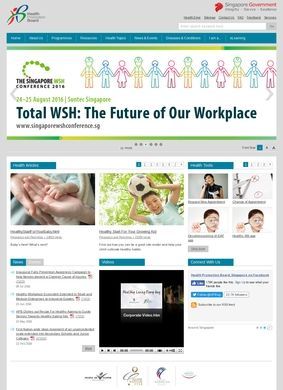
What does a national health agency put online when its job is to keep an entire population from getting sick in the first place? In Singapore's case, the answer is a sprawling set of programmes and apps that try to nudge everyday behaviour: how people eat, move, sleep, and whether they get screened for the conditions that tend to creep up unnoticed. The Health Promotion Board - Singapore sits under the Ministry of Health as a statutory board, and its remit is prevention at the level of the whole country, not treatment of the individual patient.
Apps that track fitness and behaviour
The digital side is where a casual visitor probably lands first, and it is more developed than you would expect of a government agency website. Healthy 365 is the flagship app, tracking fitness, nutrition and sleep, and folding all of it into challenges that reward participation. LumiHealth goes a step further by tying into the Apple Watch for personalised health goals. HealthHub handles the records end of things, giving residents a place to keep and manage their personal health information. There is also Health Insights Singapore, or hiSG, a national study that uses wearables to watch how the population's habits shift over time. That last one tells you something about the Health Promotion Board - Singapore approach: it treats data collection and behaviour change as two halves of the same project, feeding research back into the programmes it runs.
Screening programmes for symptom-free residents
Beyond the apps, a large part of the work is unglamorous and steady. HealthTrack SG is a structured programme aimed at residents who are managing a chronic condition or trying to lower their risk of developing one. Subsidised screening sits alongside it, with outreach pitched squarely at people who feel fine and therefore tend not to book a check, which is exactly the group these tests are meant to catch. The messaging around asymptomatic residents is deliberate, and it is the sort of thing a body focused on population health has to keep repeating because the audience never thinks the warning applies to them.
Support for smokers who want to quit
Smoking gets its own track within the Health Promotion Board - Singapore remit. The I Quit Programme offers structured support to people trying to stop, and there is a separate training pathway, the Smoking Cessation Counselor course, for community health workers who want to deliver that support themselves. Building the helpers as well as helping the smokers is a sensible piece of design. It means the effort does not live or die on a single hotline.
Inside the healthier food labelling system
The part I find genuinely interesting is how far the Health Promotion Board - Singapore reaches into the food supply. The Healthier Choice Symbol marks packaged products on the shelf, and the Nutri-Grade system grades beverages so a shopper can see at a glance how a drink stacks up on sugar. For restaurants and food stalls, the Healthier Dining Grant Schemes put money behind reformulating recipes or adding healthier options, with subsidies to soften the cost of changing what an operator already sells. This is the agency working on the supply side, shaping what is available, instead of only telling people to choose better. It is harder to do and easier to ignore, so the Health Promotion Board - Singapore takes it on regardless.
Programmes across workplaces schools and communities
The same logic runs through the settings where Singaporeans actually live their days. The Health Promotion Board - Singapore workplace programmes single out small and medium enterprises, the businesses least likely to have a wellness budget of their own. Schools and pre-schools have accreditation schemes, the Healthy School and Healthy Pre-School marks, plus programmes pitched at both students and the educators teaching them. Out in the community there are Health Promoting Malls, a Health Ambassadors volunteer scheme, and mental well-being awareness work that has clearly grown in prominence. Physical activity programmes round it out, built so that exercise is accessible to ordinary residents instead of being the preserve of the already fit.
Layers of prevention across daily life
Put together, the breadth is the point. The Health Promotion Board - Singapore is not running one campaign; it is running dozens, layered across age groups, income levels and daily settings, with the apps acting as connective tissue between them. A teenager being weighed at a Healthy School, an office worker logging steps in Healthy 365, a hawker reformulating a dish under a grant scheme, a smoker calling the I Quit line: all of them are touching different parts of the same organisation.
If there is a tension on the site, it is the one that comes with this kind of scale. The volume of programmes, acronyms and apps can be a lot to take in, and a first-time visitor may need a few clicks to work out which one applies to them. That is the cost of trying to cover an entire population's health from a single body. For anyone wanting to understand how a state actually pursues prevention rather than just talking about it, the Health Promotion Board - Singapore is a fairly complete worked example, from a food label on a bottle right up to a national wearables study.
Behind the visibility gap in health programmes
Most residents will encounter Nutri-Grade letters on a drink can or receive a subsidised screening invitation long before they think to look at the Health Promotion Board - Singapore website. That gap between invisible infrastructure and visible programme is something the site could do more to bridge, but it does not undercut what is on offer. As a public record of how prevention at population scale actually works in practice, Health Promotion Board - Singapore is one of the more thorough examples of its kind available online.