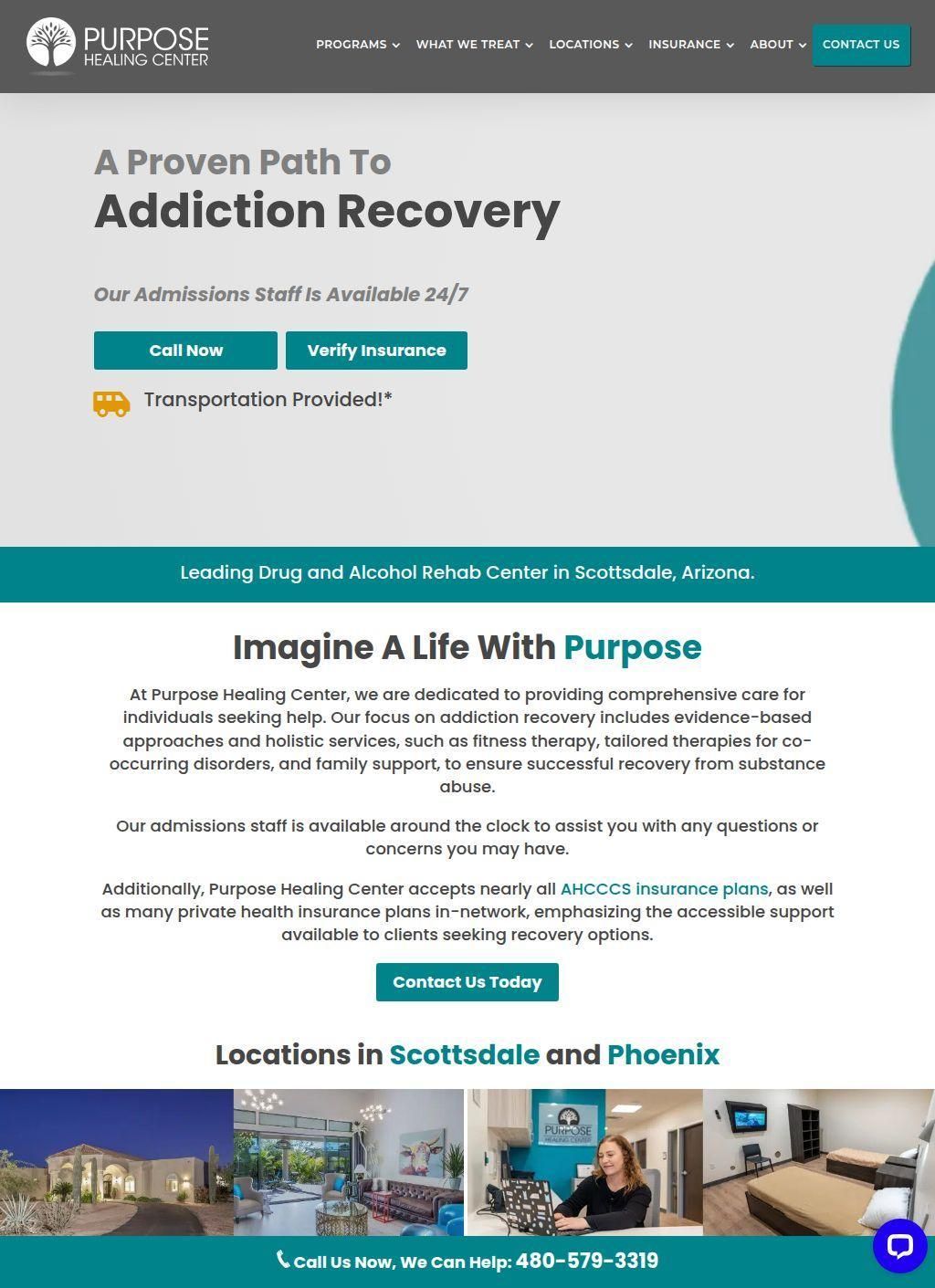
Someone calls a treatment line at two in the morning because a family member has stopped responding to texts and there is fentanyl in the house. That is the moment Purpose Healing Center in Arizona is built to answer, with a round-the-clock admissions number that picks up and a medical detox program ready to take a person who cannot safely stop on their own. The site is organized around that first phone call, and the structure of the place reflects it. Detox comes first, then residential inpatient with round-the-clock care, then step-down levels for people who are stable enough to live at home but still need daily clinical contact.
Medical detox and residential treatment levels
Those step-down levels are spelled out plainly. There is a Partial Hospitalization Program for clients who need most of a day in treatment, and an Intensive Outpatient Program for people further along who are holding down some of normal life. Medication-Assisted Treatment runs alongside the talk-based work, which is the piece that changes the odds in opioid and alcohol cases where willpower alone tends to fail and a medication like buprenorphine makes the actual difference. Read together, these are the recognized rungs of a real continuum of care, not a single program dressed up with several names. What Purpose Healing Center in Arizona offers a caller, then, is a route that can start with a detox bed and carry through to outpatient months later without bouncing the person between unrelated providers.
Partial hospitalization and outpatient programs
The substances the center names are the ones filling Arizona emergency rooms: alcohol, opioids, methamphetamine, cocaine, benzodiazepines, and fentanyl. It also takes co-occurring conditions such as depression and bipolar disorder, treating the mental health side instead of parking it. That dual focus is the difference between a detox bed and an actual recovery program, because most people who relapse are medicating something underneath the using. Purpose Healing Center in Arizona puts the psychiatric and the addiction work under one roof, which is what dual diagnosis is supposed to mean and often does not.
Dual diagnosis for addiction with mental health
On clinical method, the listed approaches are conventional and defensible. Individual, group, and family therapy form the spine. Cognitive-behavioral therapy and trauma-focused therapy fill in the evidence-based work, and there is a holistic and fitness wellness component layered on top. None of this is exotic, and that is a point in its favor. The combination is what most reputable facilities run, and naming trauma work specifically is a good sign the program understands how often abuse and PTSD sit underneath a substance use disorder.
Evidence-based therapy methods
The clinical leadership at Purpose Healing Center in Arizona is named, which is more than many treatment sites bother to do. Chief Clinical Officer Robin Byrne holds an LCSW, and Medical Director Ehad Abdullah is an MD. Two named, credentialed people accountable for clinical and medical decisions is a fair indicator, and it lets a prospective client or referring doctor check those credentials independently. A center that publishes its leaders' names and letters generally expects to be looked up.
Named clinical leadership
The outside reputation is mixed but worth weighing honestly. Birdeye carries around 75 reviews averaging 4.2 stars, which is a decent volume at a respectable rating. Yelp shows a smaller set of about 15 reviews for the Phoenix location. Recovered.org gives it a top mark on its trust score, and the center appears across recovery-specific directories with full program details. The caveat sits on the Better Business Bureau profile, which carries at least one formal complaint about a failure to provide a completion certificate. That is a paperwork failure, not a clinical one, but for a court-ordered client a missing certificate can mean a violated probation, so it is not trivial. An honest reading of Purpose Healing Center in Arizona takes the strong Birdeye numbers and the BBB complaint together instead of picking whichever flatters the verdict.
Online reviews across multiple platforms
That court-ordered detail deserves its own note, because the center explicitly accepts court-ordered clients. Many private facilities quietly decline them. Taking them on is useful for people moving through the justice system who need treatment that a judge will accept, and it widens who Purpose Healing Center in Arizona can actually help. It also raises the stakes on the administrative side, which is exactly where that BBB complaint landed.
Reaching Purpose Healing Center in Arizona is straightforward. The round-the-clock admissions phone number sits prominently on the homepage, an admissions and contact form is available, and there is an online insurance verification tool. For families in crisis, a phone number that answers at any hour is the single most useful thing the center can offer, and it takes about two seconds to find. The Phoenix address at 1841 N 24th St shows up on Yelp, and the center operates a second site in Scottsdale, so the physical footprint is verifiable.
Insurance acceptance and payment options
The payment side is unusually concrete. Purpose Healing Center in Arizona accepts AHCCCS, the state Medicaid program, and says it works in-network with most major insurance plans, with online verification to confirm coverage before anyone commits. AHCCCS acceptance is the detail worth noting here: it means the door is open to lower-income Arizonans who get turned away from cash-only luxury rehabs. Treatment that takes Medicaid serves a population that genuinely needs it, and that single fact tells you more about who this place is for than any amount of wellness language would.
Service areas in Arizona
Geographically the reach is broad. Beyond the Phoenix and Scottsdale locations, the stated service area for Purpose Healing Center in Arizona covers Tempe, Tucson, Mesa, Gilbert, and Chandler, so most of the Valley and a good stretch of southern Arizona fall inside it. Whether all of those areas get the same depth of service or simply admit clients who travel in is not something the page settles, and a careful reader should treat the wider list as catchment rather than as branch offices. The two confirmed physical locations are the solid part.
If there is a soft spot beyond the BBB note, it is that the marketing keywords hint at offerings the brief does not fully confirm, things like equine therapy and a rehab ranch setting. The verifiable core of Purpose Healing Center in Arizona is the medical detox, the inpatient and outpatient levels, the MAT, and the named clinicians, and that core is solid enough to stand on its own without leaning on the ranch imagery. A prospective client would do well to ask directly which of the more specialized therapies are actually running before counting on them.
Weighing it all, Purpose Healing Center in Arizona reads as a legitimate, full-continuum addiction and mental health provider with credentialed leadership, broad insurance acceptance including Medicaid, and a reputation that is solid if not spotless. The Birdeye rating and the AHCCCS acceptance are the strongest marks in its favor. The BBB completion-certificate complaint is the one thing a court-ordered client should raise on any intake call. The clinical foundation is sound; the administrative track record is where a careful caller should press hardest, and the published evidence is enough to justify a direct inquiry while keeping the certificate issue on the table.

Important pages
Business address
Purpose Healing Center
8712 E Vía De Commercio,
Scottsdale,
Arizona
85258
United States
Contact details
Phone: 4805793319