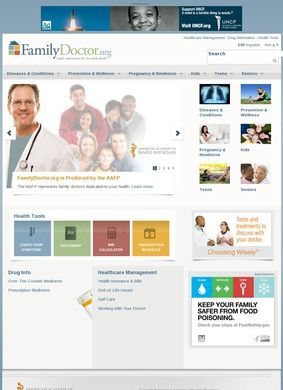
A parent sits up at 2am with a feverish toddler, phone in hand, typing symptoms into a search bar and getting back a wall of forum posts, ad-stuffed listicles, and pages that contradict each other within two clicks. That moment is exactly where Family Doctor becomes useful. The site, run by the American Academy of Family Physicians, sets out to answer ordinary health questions with information that a working family physician would actually stand behind, and it does so without making the reader wade through pop-ups and affiliate links.
Inside the A to Z conditions library
The backbone of Family Doctor is an A to Z conditions library running into the hundreds of entries. ACL injuries, sleep apnea, stroke, and diabetes each get their own page, written and reviewed by physicians rather than assembled by an anonymous content mill. What gives the library its shape is how it sorts the same material by stage of life. There are dedicated sections for infants, children, teens, men, women, and seniors, so a question about a rash on a six-month-old leads somewhere different from the same question asked about a seventy-year-old. Age changes what a symptom means, and a flat alphabetical index would flatten that distinction out entirely.
Prevention and wellness topics
Beyond the catalogue of conditions, Family Doctor groups much of its material around staying well instead of treating illness. Prevention and wellness sections cover nutrition, fitness, brain health, and sexual health, with separate areas for mental health, vaccines, and COVID-19. None of this reads as filler. Each topic sits where someone might plausibly look for it, and the prevention material goes through the same physician oversight as the clinical pages. A reader who arrives worried about a specific diagnosis can drift sideways into the habits that might keep the next problem from arriving, and the path between the two is short.
Checking symptoms with interactive tools
The interactive tools on Family Doctor are more than decorative. A Symptom Checker lets a visitor work from what they are feeling toward a list of possible explanations. A BMI Calculator and a set of Immunization Schedules turn abstract guidance into numbers and dates a person can act on. There is also a Medical Terms Dictionary, which sounds minor until you have stared at a discharge summary full of words no one explained at the appointment. These tools do the quiet work of translation, taking the language of a clinic and handing it back in a form a non-specialist can use.
Finding local care through Neighborhood Navigator
Two resources push past pure information delivery. The Neighborhood Navigator helps a reader find local health services, closing the gap between reading about a problem and finding someone nearby who can address it. myHealthFinder produces preventive care recommendations tailored to the person asking, so the advice stops being generic and starts pointing at specific screenings or shots. These features move Family Doctor from a reference book toward something closer to a starting point for action, and that is a meaningful difference for a person who knows something is wrong but has no idea what the first step should be.
Doctor's notes and video content
There is a human layer on top of all this. Doctor's Notes collects commentary authored by physicians, which reads less like an encyclopedia entry and more like a clinician thinking out loud about a topic. Video content rounds things out, with material on vaccines and respiratory illness for people who would rather watch an explanation than read one. The mix of formats means the site can meet a visitor wherever their comfort level sits, whether that is a dense article, a short calculator, or a few minutes of video.
Behind the physician-reviewed content
What holds the whole thing together is editorial discipline. Every page is produced under AAFP oversight, and family physicians write and review the material. That single fact changes how the content should be read. A symptom page on Family Doctor is not one person's blog opinion or a brand trying to sell a supplement. It has the backing of the professional body that represents family doctors across the country, which is precisely the kind of source a parent at 2am should be reaching for over the tenth result on an unfiltered search.
A plain-language approach for families
It helps to be clear about what the site is and is not. Family Doctor is consumer health education, written in plain language for individuals and families, not a clinical reference aimed at practitioners. That choice shows in the tone of the conditions library, which explains a diagnosis the way a good physician explains it in the exam room: enough detail to understand the problem, not so much jargon that the patient leaves more confused than they arrived. For most people likely to land on the site, that approach is the right one.
The breadth is genuinely wide. A single household might use Family Doctor to read up on an infant's vaccine schedule one week, check a teenager's sports injury the next, and look into a grandparent's blood pressure after that. Because the same editorial standard runs through all of it, a reader does not have to recalibrate their trust moving from the children's section to the seniors' pages. That consistency across age groups and topics is one of the harder things to pull off in health publishing, and Family Doctor manages it because a single professional organization owns the entire output, with no patchwork of scattered contributors pulling it in different directions.
Covering COVID-19 and vaccine guidance
The COVID-19 and vaccine material deserves a specific mention, if only because those are the topics where unreliable information has done the most damage in recent years. Having a section on both, written under the same physician review as everything else, gives a reader a place to check claims they have heard elsewhere against guidance from people who treat patients for a living. The respiratory illness videos serve the same purpose, putting straightforward explanation where rumor usually rushes in to fill the vacuum.
Limits of the symptom checker
If there is a limit to keep in mind, it is the one the site itself implies. Family Doctor explains conditions and points toward local care, but it cannot examine anyone, and the Symptom Checker is a guide rather than a diagnosis. The Neighborhood Navigator exists precisely because the next step often has to happen in a real exam room. A reader who treats the site as a well-informed first stop, then takes what they have learned to an actual appointment, is using Family Doctor the way it was clearly designed to be used.
Outside reputation is limited. A search turns up no substantial third-party review volume for Family Doctor as a site in itself, which is common for an institutional health resource people use and move on from without rating. The AAFP's standing in American medicine is long-established and not in question. The conditions library anchors everything else, with hundreds of physician-reviewed entries sorted by both diagnosis and stage of life, and the tools and local-service finders layered on top. A person can move from a calculator to a clinical page to a video without leaving the site or losing the thread of who stands behind the words.