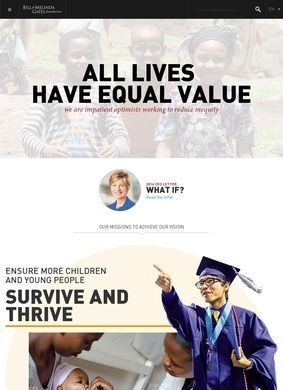
Few philanthropic organizations publish enough operational data to let an outsider actually audit the work, and the Bill and Melinda Gates Foundation is one of them. Based in Seattle, it runs 51 program strategies, holds 2,506 active grants, and works with 1,472 grantees, with the heaviest concentration in sub-Saharan Africa and South Asia. Total charitable support disbursed sits at $8.5 billion. Those figures appear on the site's main program pages in plain view, queryable through a grant database that names recipients, purposes, and amounts. That published structure is what separates this site from one that summarizes without disclosing.
Funding behind family health programs
Under the family health category, the Bill and Melinda Gates Foundation lands as an unusual listing. It is not a clinic, a product, or a service anyone books directly. It is the engine sitting behind programs that families in affected regions never see by name: a vaccine reaching a rural district, a nutrition initiative aimed at infants, a peer coaching model for chronic disease built around trained community members, with minimal clinical staff involvement. Someone expecting personal care will not find it here. Someone trying to understand where serious money flows in global and family health, and on what terms, will find a substantial amount to examine.
Programs against malaria and other diseases
The health side of the portfolio is specific. The Bill and Melinda Gates Foundation funds maternal and child health programs, vaccination campaigns paired with delivery logistics that actually get doses to people, premature infant care, and nutrition work aimed at early childhood. Disease-specific commitments extend to malaria, tuberculosis, HIV/AIDS, and polio eradication, which has been a defining effort for years. Read together, these programs describe an organization attacking illness at several points at once: prevention, treatment, and the unglamorous middle layer of getting care where it needs to go.
Expanding funding beyond health
Health is the headline, but the website is direct about the breadth beyond it. The Bill and Melinda Gates Foundation also funds digital financial services aimed at entrepreneurs shut out of conventional banking, support for small business development, agricultural innovation built for smallholder farmers, and women's economic empowerment as its own line of work. Education appears as well, including bilingual programs in places like Senegal. The connective logic is plain enough: poverty, health, and opportunity tend to move together, so the foundation treats them as parts of the same problem, not as isolated lines of work.
Explore the searchable grant database
For anyone who wants to go past the program summaries, the site is genuinely useful. Annual reports are published. The grant database is searchable, which is the feature most casual visitors underestimate. Being able to query who received funding, for what, and roughly how much turns the Bill and Melinda Gates Foundation from a name into something a person can trace. Research and data resources sit alongside the database, program stories put faces and places to the figures, and a media center holds press materials for reporters who need them.
Career and ethics resources
The site also addresses the practical needs of the people most likely to interact with it directly. Career listings are posted for those interested in joining the organization. An ethics reporting portal exists for raising concerns, which is the sort of feature a large institution can quietly omit and often does. Grantees, policymakers, and researchers each have material aimed roughly at them, so the Bill and Melinda Gates Foundation's site reads less like a single glossy front door and more like a working reference that different audiences can enter from different angles.
Reading the data with caution
It is worth being clear-eyed about what a site like this can and cannot tell you. The data the Bill and Melinda Gates Foundation publishes is its own, and the framing is its own. A careful reader treats the grant database and the program stories as a starting point for inquiry, not the final word on impact. That said, putting 2,506 active grants and the names of 1,472 grantees into a public, queryable form is an unusual level of openness for a private foundation of this scale. The information is there to be tested, which is the right posture for a body distributing $8.5 billion in charitable support.
Are there independent reviews of the foundation?
A search for independent reviews or external ratings of the Bill and Melinda Gates Foundation as an organization turns up extensive coverage in news and policy circles but no aggregated star-rating or consumer-review platform with a usable count. That gap is structural: foundations of this type are evaluated through grant recipient feedback, academic critiques, and journalism; the consumer-review tools built for businesses or donation-taking nonprofits do not map onto this model. Charity Navigator and similar platforms publish assessments; anyone doing research would want to check those separately. The site itself does not cite external ratings, and that absence is expected rather than evasive.
Transparency as part of the mission
What the website does well is document, disclose, and organize a sprawling portfolio so that outsiders can make sense of it. The maternal and child health work, the disease-eradication campaigns, and the breadth into finance, agriculture, and education all rest on published reports and a grant database that invites scrutiny. In that respect, the Bill and Melinda Gates Foundation has built a site that treats transparency as part of the mission rather than a press obligation, and the Bill and Melinda Gates Foundation's published data makes that claim checkable. For researchers, journalists, and grantees, that posture is more useful than any amount of promotional copy, and the depth of the published data backs it up.