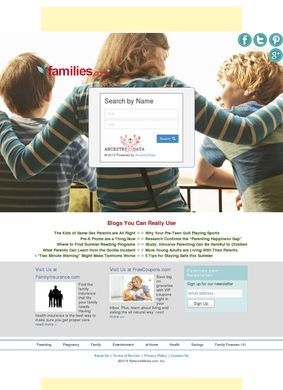
Landing on Families today means landing on an Afternic domain-sale page. The address that once belonged to this site now carries a broker's notice advertising the name for grabs, which tells you everything you need to know about the current state of the project: it has shut down, and whatever content once lived here is no longer reachable from this URL.
What Families was before shutdown
Cached descriptions paint a reasonably clear picture of what Families was. It ran as a content hub aimed at parents and household-minded readers, and at its peak it claimed one of the larger collections of family-related blogs on the web. The writing spanned parenting, family health, and the everyday mechanics of running a home, with an aggregator model built on volume: many contributors, many posts, many short entries gathered under one roof. During the early blogging era that approach made sense for keeping a steady flow of material in front of readers who came back for the next post rather than for any single author.
The genuine strength of the contributor-driven model was breadth. A single visit to the old Families could take you from a post on toddler nutrition to one on stretching a grocery budget to something on a child's fever, each written by a different person from their own household. That spread kept things lively, and it is the most honest thing you can say in the site's favour.
Quality concerns in contributor-driven content
The flip side is that contributor volume tends to produce uneven quality. Coverage goes wide and shallow, with each post only as reliable as whoever wrote it that week. Family health is a category where that variance has real consequences, because casual anecdote and sound medical guidance can look identical on the page. Families was never a curated, editorially reviewed resource in that sense, and readers who needed reliable information on a child's symptoms or development were always on their own when it came to judging which posts to trust and which to ignore.
Checking for cached material and archives
None of that content is reachable now. I went looking for a cached corner that still loaded, and the live domain offers nothing past the sale notice. The old library is effectively gone from this address, even if fragments survive elsewhere on the wider web. Someone who remembers the site fondly is left with a memory and a broker's contact form, which is a deflating thing to find when you came looking for parenting advice.
When a domain is listed for sale, nothing behind it is functioning. There is no contact page, no business hours, no operating team, because there is no longer a business here. Families as an organisation is not reachable through this address. That is simply a fact about what parking a domain means, not a complaint about responsiveness.
Outside reputation does not fill the gap. A search for this exact domain turns up no reviews or ratings that clearly belong to it. The results that surface point to entirely separate organisations: an employer called Families Inc with staff reviews on Indeed, a Families UK presence on Trustpilot, and unrelated parenting sites. None of that speaks to the property under review, and stitching a reputation picture together from look-alike names would be dishonest, so there is no independent feedback to weigh here, positive or negative.
From domain parking to medical risks
There is also a practical issue worth noting. Domain-sale pages often cycle through pay-per-click ad blocks while they wait on the market, so a visitor expecting trustworthy family content may see generic advertising instead. That is harmless if you understand where you are, and a real problem if you assumed you had reached a working publication and were prepared to act on its advice, especially on a health question involving a child.
Comparing with vetted health resources
For anyone who genuinely needs vetted material on children's health and family wellbeing, a working alternative beats a dead link by a long margin. Something like the Mayo Clinic site keeps a deep, physician-reviewed library on child and family health with named medical editors and a clear, dated update process. The contrast with a defunct contributor blog is sharp: one tells you who wrote a page and when it was last checked; the other now sells you the page's web name to the highest bidder.
Families had a real audience once, and the breadth of its old catalogue was a fair selling point in its day. But this listing is reviewing a live destination, and the live destination is a domain on the auction block with nothing behind it to read or rely on. Until someone buys the name and rebuilds, there is nothing here to recommend.