The external rating picture for FitnessSyncer is not encouraging at first glance: one Trustpilot review at 3.7 out of 5, an iOS app sitting at 2.6 across 23 ratings, a Chrome extension around the same score from a small number of reviews, and no presence on Google, Yelp, Facebook or BBB. For most service categories that profile would be enough to stop reading. FitnessSyncer operates in a niche where general consumer audiences rarely leave reviews, and the technical depth of what it offers deserves at least a closer look before a verdict. Whether the picture improves under that inspection depends on what the service actually does and how well it does it.
What FitnessSyncer does
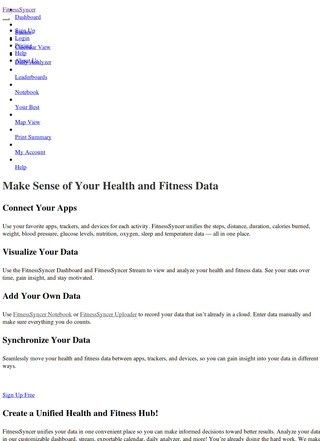
FitnessSyncer, developed by FX Development, Inc. in the United States, is a health data aggregation platform. Its whole purpose is to link more than 50 apps and wearables, pull readings into a single account, and let users view, analyze and export everything from one place. The supported roster covers the devices most people actually own: Apple Health, Fitbit, Garmin Connect, Polar Flow, Strava, Suunto, TrainingPeaks, WHOOP, Samsung Health and Withings are all listed. The data types it handles range from steps, distance, calories and sleep through to blood pressure, glucose and oxygen readings. That last set is not common on aggregators aimed at athletes, and it positions FitnessSyncer for users managing chronic conditions alongside anyone simply logging workouts.
Supported devices and data types
The display layer has more depth than a typical sync dashboard. A customizable main view surfaces graphs and key performance indicators. The Stream view opens workout-level analytics with maps and heart rate charts for individual sessions. A Daily Analyzer breaks activity down minute by minute. A Calendar View and a "Your Best" personal records panel round out the reporting side. A Notebook accepts manual entry for readings no hardware captures automatically, which is an honest concession to how health data actually arrives for most people: some from sensors, some from a clinic printout.
Dashboard views for analysis
A few features separate FitnessSyncer from tools that only move data. Leaderboards let users from different platforms compete on the same board, so a Garmin runner and a Strava cyclist share a ranking without either migrating to the other's app. Automated email progress reports deliver a weekly summary without requiring you to open anything. ShoeRenew tracks gear mileage, a small feature that prevents the recurring mistake of running on dead soles. A Print and Share function produces a clean snapshot a coach or doctor can read without owning a subscription or knowing which app to open.
Features beyond basic syncing
The data portability angle is the most defensible thing FitnessSyncer offers beyond the raw aggregation count. Cloud storage destinations including Google Drive, Dropbox, OneDrive and Amazon S3 are supported, so aggregated health history can live in storage the user controls, not in a vendor's database they cannot export from on demand. A fitness app shutting down or quietly revoking export access is not a hypothetical: it has happened repeatedly in this space. The portability feature addresses a failure mode most users only recognize after they have already lost years of records, at which point there is nothing to retrieve.
Cloud storage and data portability
FitnessSyncer also now supports the Model Context Protocol, allowing an AI assistant such as Claude to query a user's aggregated health data in plain language. Whether this becomes routine or stays a novelty is an open question, but no direct competitor in this category has moved there yet. A Corporate Wellness Services option appears under the FitnessSyncer support section, extending the use case beyond individual trackers into team or employer contexts.
AI integration and corporate options
The free tier allows up to five source and destination tasks with no time limit. That covers a realistic starter configuration: a watch, a scale and one cloud backup destination. Pro removes the cap and expands dashboard metrics for $5.99 a month or $59.99 a year. iOS and Android apps are available. The free tier is where due diligence actually happens here, given the review volume available, because you can connect real hardware and see whether the unified view reflects your specific device combination before any payment is involved.
Pricing and app availability
Contact options are limited. Support runs through a ticket system, and a developer email appears in App Store response threads where the replies suggest an active person behind the address, not a bot queue. There is no phone number and no physical address listed. The App Store engagement is a mild positive, but it will not satisfy anyone who expects live support or a named escalation path for a subscription billing problem.
Support channels
FitnessSyncer does one specific thing with real technical depth: it aggregates multi-device health data across a wide range of platforms, preserves portability, and layers in analysis tools that most single-device apps skip entirely. The device roster, the blood pressure and glucose support, the cloud export destinations and the MCP integration are all concrete and inspectable. None of them depend on taking the company's word for it.
Evaluating sync reliability
The weak point is scope rather than substance. FitnessSyncer has not accumulated meaningful third-party review volume, and its existing scores on iOS and the Chrome extension are below average. A product this narrowly focused will never draw the crowd a mainstream consumer app does, but a 2.6 iOS rating across 23 reviews is a yellow flag, not a clean pass. Users who want a single polished device ecosystem will find the aggregation layer unnecessary.
Who should test the free tier
Users with two or more devices across competing platforms, or anyone who needs blood pressure and glucose data alongside workout records in one timeline, are the ones for whom the free tier is a genuine evaluation path. The pricing is low enough that the test costs nothing. What the listing cannot answer is whether the sync reliability, which drives most negative reviews in this category, has improved since those iOS ratings were posted.
Business address
FitnessSyncer
4574 36th Ave W,
Seattle,
WA
98199
United States
Contact details
Phone: 2067019682