Family Health News is a health-information website that turns individual medical conditions into plain-language symptom lists for general readers. Its homepage is a wall of numbered article headlines: "10 Common Symptoms of Spondylosis," "14 Most Common Symptoms of Lupus," "12 Common Symptoms of Emphysema," each one built around a short rundown of the signals a given illness tends to produce.
Symptom lists as the main draw
The catalogue runs wide. Gout, neuropathy, arthritis, edema, atelectasis, pancreatitis, fatty liver, whooping cough, bronchitis, anemia, HPV, RSV, sarcoidosis, lymphoma, atherosclerosis, bird flu, Hashimoto's disease, basal cell carcinoma: the conditions jump across specialties with no obvious order, and each gets the same treatment, a numbered set of symptoms sitting under a headline. The tagline printed across the top, "Your Family's Health, Decoded Simply," describes the ambition plainly enough.
There is a rhythm to how Family Health News is built. Pick a worry, find the matching listicle, read the symptoms. That is the whole loop, repeated across dozens of articles.
Conditions covered in plain language
What the format does well is stay readable. Someone who has just heard a word like atelectasis or Hashimoto's from a doctor, and wants a quick sense of what it usually involves before the next appointment, gets that in a few paragraphs without a wall of clinical jargon. The reach is not limited to named diseases, either. Pieces like "10 Common Causes of Hip Pain" and "12 Common Causes of Blackheads" bend the same symptom-and-cause angle toward everyday complaints, so a reader arrives whether they are worried about lymphoma or annoyed by breakouts.
Family Health News is clearly built for the person who types a symptom into a search bar and wants a human answer back, and on that narrow ambition it delivers.
Beyond the symptom listicles
The articles are the visible bulk of Family Health News, but the site states its coverage also takes in healthy eating, exercise and physical activity, mental health and illness, and disease prevention. Those are broad promises.
On the pages that were retrieved, the numbered symptom rundowns dominate, and the wellness themes read more as stated territory than as a deep, separately built section. No products, tools, calculators, or paid services turned up alongside the writing. The offering is editorial, and that is the honest measure of it.
Reading it as a health reference
Symptom lists make a reasonable front door and a poor final word. Many of the conditions named here share early signs, and a numbered list cannot tell a reader which one is theirs. Family Health News works best as orientation, a way to put vocabulary and rough expectations around an unfamiliar term, and it should be used that way rather than as a stand-in for a diagnosis.
What was visible gave no sign of who writes the Family Health News articles or whether a clinician checks them before they go up. That is worth knowing before leaning on any single page. The tone stays general and careful, which suits the purpose, but a reader chasing a specific worry is on their own to confirm it with a professional who can examine them.
The name it shares and the trail it leaves
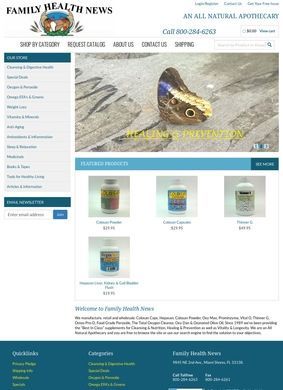
Searching the name is where things get muddy. Results for "Family Health News" surface a Miami-area supplement business that has sold products such as Colosan and Oxy Max for decades, carries a BBB page, a Yellow Pages entry, and a small Facebook following, and even names this same domain as its website. That company sells bottles; the site actually under review sells nothing and publishes symptom articles.
The two do not line up, so none of that outside record can fairly be pinned to the reading site as it stands now.
A name shared with a supplement seller
The mismatch matters for anyone weighing credibility. A shopper who trusted a review of the supplement firm would be trusting it about a different operation than the one publishing these articles.
Taken on its own terms, the current Family Health News turned up no notable third-party reviews or ratings tied to what it now does. That is less a knock than a plain fact: there is little independent word on the writing itself, so a reader has to judge it on the page in front of them.
Where the contact trail runs cold
Contact is the weaker spot. The homepage that came back showed article listings and little else, with no phone number, mailing address, or visible contact link anywhere in the pages seen. For a site handing out health information, a clear route to reach an editor, or even a name to attach to the claims, would count for something, and it is the sort of gap that would draw a second look in any business directory review. Its absence leaves a reader with nowhere to send a question.
Read that way, Family Health News plays a modest, honest role: open the matching symptom article for a plain-language orientation, then take the specific signs to a physician who can examine the person and confirm which condition actually fits.