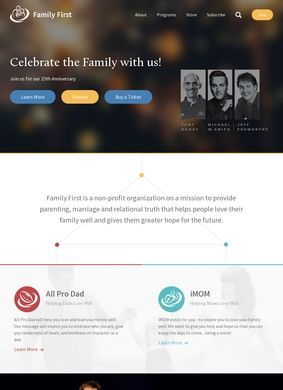
Two newsletters do most of the work for Family First. All Pro Dad goes out to fathers, iMOM goes out to mothers, and both land daily with a short article and a relational prompt meant to be read in a couple of minutes over coffee. That is the core of what this Tampa nonprofit does. Everything else on the site orbits those two lists, and the whole operation is built to be forwarded, printed on a fridge, or skimmed on a phone during a school pickup.
Family First describes its mission as putting out parenting, marriage and relational content, and it claims to reach more than 8 million families a year. That is a large number to hang over a website, and the site does not show its arithmetic for it, so a visitor takes it on trust. Nothing on the page breaks the figure down by subscriber count, open rate, or region, which leaves the claim sitting there unsupported but also unchallenged.
What the two programs deliver
All Pro Dad and iMOM are the product, not a mission statement with a newsletter attached as an afterthought. Each runs as a standing library of articles plus a daily email, and the content leans practical: conversation starters, lists of questions to ask your kids, short pieces on handling conflict in a marriage. The tone across Family First's material is encouraging and mildly faith-inflected without being heavy-handed on the surface pages.
A parent who signs up is mostly signing up for email. Worth knowing going in. Whether a daily nudge in your inbox changes how a person actually talks to their family is something the site cannot settle for you; it can only keep the emails coming and hope the habit sticks.
All Pro Dad and the father-facing material
The dad-facing side carries a sports-coaching flavor in its framing, aimed at getting fathers to be deliberate about time with their children. It is the more recognizable of Family First's two brands, and clearly the one the organization has invested in as a front door for new readers. Coaching metaphors show up often: game plans, playbooks, huddles, the vocabulary of a locker room applied to bedtime routines and school pickups.
Content here is bite-sized by design. A parent looking for deep, sourced guidance on a specific developmental issue will find encouragement and short prompts more than depth. That is a reasonable trade for the format, but it does cap how far the material can carry a reader who has a genuinely hard problem on their hands instead of a general one.
iMOM and the mother-facing material
iMOM mirrors the structure on the maternal side: daily emails, printable resources, articles on marriage and raising kids. The two programs share a spine, and that shared structure makes the whole Family First operation feel coherent rather than scattered across unrelated microsites with their own separate logins and design languages.
What is harder to gauge from the pages is how current the writing stays or who exactly authors it. The material reads as staff-produced and evergreen, which suits its purpose well enough, though it leaves the question of who wrote a given piece, and when, mostly unaddressed. A reader hoping to cite a source or check a credential will come up empty.
The store, the radio, and the donation pitch
Beyond the two newsletters, Family First runs an online store selling books and merchandise, produces radio programming, and offers subscription-based content on top of the free material. There is an FAQ, a press room, and a partnerships page. It is a fuller site than a two-newsletter nonprofit strictly needs, and the extra sections suggest an organization trying to build a media presence beyond a mailing list.
The donation ask is prominent, and it should be, since this is a donor-supported nonprofit rather than a shop dressed up as a cause. That framing is honest. A visitor is being asked to give money, and Family First does not pretend otherwise or bury the request under layers of unrelated content.
Where the subscription and store fit
The paid tiers and the merchandise sit alongside a lot of free content, and the line between what costs money and what does not is the kind of thing a prospective supporter will want to test for themselves.
The store extends the Family First brand into physical products, which is a reasonable move for an organization with two established program names and an audience that already trusts the emails arriving in its inbox.
The radio programming and its role
The radio segment gets less real estate on the site than the newsletters or the store, and it reads more like a legacy piece of the organization than a growth area.
It broadens the Family First footprint beyond a purely digital audience, reaching people who might never sign up for an email list but still catch a broadcast segment. None of the pieces feel predatory. But free email, a paid subscription, retail, and a donation appeal together mean the site is asking for attention and money through several doors at once, and a first-time visitor has to sort out which door applies to them.
Contact, footprint, and what stays unproven
Reaching Family First is straightforward. There is a Tampa street address, a working phone number, and a contact page that routes email through a form. For a nonprofit collecting donations, that physical presence and working phone line count for something a hobby blog would not need, and the site clears that bar without fuss or excess ceremony.
The reputation side goes quiet fast. A search for outside reviews of this specific organization turns up nothing that applies to it directly. The Family First name is shared by a life insurance agency and a credit union, and those unrelated companies crowd the search results, leaving the Tampa nonprofit without a visible trail of independent feedback to point to.
That absence proves nothing bad on its own. Plenty of established nonprofits never accumulate consumer reviews the way a restaurant does, since nobody leaves a star rating for a newsletter. Still, for an organization claiming millions of families reached each year, having no findable third-party assessment leaves the unverified 8 million figure resting on the organization's word alone. Whether Family First earns a donation over a group with a public track record is a judgment this listing cannot make for anyone; the published facts run out before the decision does.