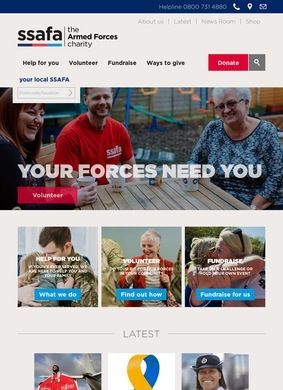
Forcesline sits near the centre of what SSAFA does day to day: a free, confidential helpline reachable on 0800 260 6780, open Monday through Thursday from nine in the morning until five, and Friday until four, with a live chat option for anyone who would rather type than talk. That single service tells you a good deal about the wider organisation. SSAFA is built for a serving soldier, a veteran, or a worried spouse who needs to reach a person who understands military life, and it puts no paywall or form-fill wall in front of that need. The helpline is one thread in a charity that has been doing this work since 1885.
What SSAFA's full name means
The full name, Soldiers, Sailors, Airmen and Families Association, spells out the scope: all three services, plus the families who carry much of the load behind the scenes. SSAFA describes itself as the oldest and largest tri-service welfare charity in the country, and the breadth of what it covers backs that up. The help on offer is not a single programme but a spread of practical support reaching people at very different points in their lives.
Money, housing and mental health support
Take the money side first, because it is often the most urgent. SSAFA provides financial assistance and grants, the kind of help a household reaches for when it hits a wall it cannot climb on its own. Alongside that sits housing and social care advice, which tends to be the area people find hardest to navigate alone. There is mental health and bereavement support, disability and rehabilitation support, and help for people moving out of the forces and into civilian work and routine, a transition that looks simple on paper and rarely is. SSAFA also runs criminal justice support, which acknowledges a reality that gentler organisations sometimes step around: not every veteran lands softly, and some need help inside a system that was never designed with their service in mind.
Support for Gurkha communities abroad
Two details mark SSAFA out as something other than a generic welfare operation wearing a military badge. One is the Gurkha-specific language and welfare services, which recognise that part of the community has needs around language and settlement that a standard English-language helpline would miss entirely. The other is the overseas health and welfare provision, reaching service families posted well beyond the UK, where local support may be absent or very limited. Those are details a smaller charity would quietly drop from its offer. SSAFA keeps them in.
Glasgow programme and choir partnership
The community programmes give the work a more local texture. Glasgow Helping Heroes is named directly, a regional effort rather than a national abstraction, and there is an affiliation with the Military Wives Choirs, which speaks to the social and emotional side of service life as much as the practical one. These are the parts of an armed forces charity that rarely make the front page but tend to be what people actually remember: the choir rehearsal or the local branch volunteer who turned up when nobody else did.
How volunteers and staff work together
How SSAFA delivers all this is worth understanding, because the model shapes the experience. SSAFA works through a national network of trained volunteers and paid staff based at local branches. That mix is deliberate. Paid staff hold the structure and the harder casework together, while volunteers extend the reach into towns and communities where a head office could never go. A veteran in a small town is more likely to be helped by someone a few miles away than by a distant call centre, and the branch structure is built around exactly that logic.
Inside the website's four main routes
The site is organised around what a visitor is trying to do, with clear separate routes for getting help, volunteering, donating, and following news and events. That last grouping has real consequence, since SSAFA leans on fundraising events, corporate partnerships, and volunteer recruitment to keep the welfare side funded and staffed. A person arriving in crisis and a person arriving to give time or money want very different things, and splitting those paths cleanly is the right call. Nobody in distress should have to wade through a donation appeal to find a phone number.
Finding the right service to use
If there is a fair point to raise, it is the same one that comes with any organisation this large and this old. The range of services is wide enough that a first-time visitor might not immediately grasp which door is theirs, whether they need a grant, a housing conversation, mental health support, or simply someone to talk to on Forcesline. The breadth that makes SSAFA genuinely useful is also what can make it feel like a lot to absorb at first glance.
Checking reviews across directory sites
The structure of the help routes goes a long way toward solving that, and the helpline exists precisely so that people who cannot work it out alone can hand the question to a human. SSAFA does not appear in the usual business directory aggregators that carry star ratings, and a search turns up no pooled public reviews, which is normal for a registered charity of this type.
A century of adapting to service life
What gives SSAFA weight is the combination of longevity and specificity. A charity founded in 1885 that still names Gurkha welfare services, overseas postings, and a Glasgow programme by name is one that has kept adapting to the actual shape of service life instead of coasting on history. SSAFA covers the serving member, the veteran decades out, and the family member who never wore a uniform but lives with the consequences of one. The phone number is free, the chat is available, the branches are local. For anyone connected to the British armed forces who has been quietly wondering whether there is somewhere to turn, SSAFA has been the answer to that question for well over a century, and the depth of what is on offer here makes that plain.