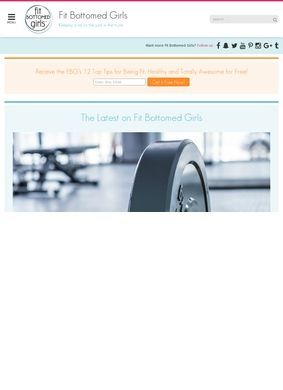
Fit Bottomed Girls is a women's health and wellness publication run at fitbottomedgirls.com by founders Jennipher Walters and Erin Whitehead, and it has been going for more than fifteen years. The premise is stated up front: "Fit isn't a size. It's a feeling," paired with "You can't hate yourself healthy." Those two lines tell you most of what you need to know about the editorial angle. This is fitness writing that sits outside diet culture, aimed at women across the full range of body types and life stages.
Four content sections
The content at Fit Bottomed Girls is organized into four standing sections, each broad enough to keep someone reading well past the article they came for. Fitness covers workouts, motivation, gear reviews, and body image. Mamas handles pregnancy, parenting, and family wellness. Eats deals with recipes and nutrition without the fad-diet framing that dominates so much food writing online. Zen rounds it out with meditation, self-care, mental wellness, and relationships. The split is sensible. A reader who arrives for a workout post can drift into the Eats archive or the Zen material without feeling like she has wandered onto a different site.
Anti-diet philosophy and coaching
That anti-diet stance is the spine of everything on Fit Bottomed Girls, and it gives the publication a clearer identity than most lifestyle outlets manage. The food coverage being explicitly fad-diet-free is consistent with the founders' message instead of contradicting it, which is more than can be said for plenty of wellness brands that preach body acceptance while quietly pushing cleanses. There is also paid structure behind the free articles. Fit Bottomed Girls runs anti-diet coaching programs and a newsletter for people who want the philosophy delivered as ongoing guidance instead of one-off reading. The coaching is the natural commercial extension of the writing, and it stays on message: the same anti-diet thinking that fills the articles is what the programs sell.
Published book and media recognition
Longevity counts for something in a field where most blogs fold inside a couple of years, and a fifteen-plus-year run by Fit Bottomed Girls is worth taking seriously. So is the published book. "The Fit Bottomed Girls Anti-Diet: 10-Minute Fixes to Get the Body You Want and a Life You'll Love" came out in 2014, was named a Top Diet of 2014 by Diets In Review, and was picked as Greatist's number one must-read fitness book of that year. Those are concrete credentials, not vague self-description, and they line up with the site's stated mission instead of sitting awkwardly beside it.
The book is listed on Amazon with multiple positive reader reviews, though no aggregate rating count is confirmed, so the volume of feedback is hard to gauge precisely. Diets In Review also features the anti-diet coaching program with a user rating prompt, but again no aggregate score is shown. Press coverage has come from Huffington Post and Top Sante, among others, which points to editors elsewhere taking the work seriously enough to cite it. None of this amounts to a stack of star ratings, but the recognition that exists is specific and verifiable.
Limited third-party review presence
Where Fit Bottomed Girls has fewer outside data points is the consumer-review platforms people often check first, including the business directory and rating aggregators that many service providers rely on. No Trustpilot, Yelp, Google, BBB, or Glassdoor listings turned up. For a media site that sells coaching and a newsletter, that absence is worth stating plainly. It does not undercut the editorial credibility, but anyone weighing the paid coaching specifically has fewer independent voices to consult than they might want, and will be leaning mostly on the book reviews and the press mentions instead.
Podcast with expert guests
The podcast deserves its own paragraph. The Fit Bottomed Girls Podcast has been running long enough to be tracked on Podstatus across Apple Podcasts and Spotify, and it brings in expert guests around women's health, physical activity, and motherhood. A podcast with that kind of staying power and a guest roster tends to mean the people behind Fit Bottomed Girls have built genuine relationships in the space, rather than a content mill. For someone who absorbs ideas better by ear than by reading, it widens the front door considerably.
One practical note on reaching the people behind it: contact runs through a form on the about-us section of the site, plus a wide social footprint on Instagram, Facebook, Pinterest, Twitter, YouTube, and Spotify. No phone number or physical address appears on the homepage, which is unremarkable for an online publication of this type. A reader with a question, a pitch, or an interest in the coaching has a clear route in, even if it is a form and a social handle rather than a switchboard.
It is worth being honest about what Fit Bottomed Girls is and is not. This is a content and media operation with a coaching arm and a product or two attached, not a gym, a clinic, or a credentialed medical service. The advice carries the authority of long-running editorial experience and a published, recognized book, and it is framed as motivation and lifestyle guidance. Readers looking for clinical treatment of a specific condition will still want a professional, and the framing on Fit Bottomed Girls does not pretend otherwise. That clarity is part of why the site reads as trustworthy: it knows its own lane.
The breadth across fitness, food, parenting, and mental wellness is a strength for the right reader and a possible drawback for the wrong one. Someone who wants a single narrow specialty, say a structured powerlifting program or a clinical nutrition plan, will find Fit Bottomed Girls too wide. Someone who wants a consistent voice across the various corners of her week will find the range is the point. The four sections are tied together by the same governing idea, so the sprawl reads as coverage instead of drift.
What holds the whole thing up is consistency between message and output. The "fit isn't a size" line could easily be a hollow tagline, but the fad-diet-free food content, the anti-diet coaching, the book, and the podcast all push in the same direction. That coherence over fifteen years is the strongest argument in favor of Fit Bottomed Girls, and it is the sort of thing a quick visit to the homepage confirms quickly.
Walters and Whitehead have kept the same voice across formats, which is rare, and it makes the whole catalog feel like one ongoing conversation instead of a pile of disconnected posts. Readers drawn to the anti-diet philosophy will find the Eats and Zen sections do exactly what the banner promises; the podcast is a good early test of whether the tone clicks, and the free archive is wide enough to answer most questions about fit before any money changes hands. Fit Bottomed Girls earns its credibility through the accumulated record, not through any single credential, and that record is long enough to read as genuine.