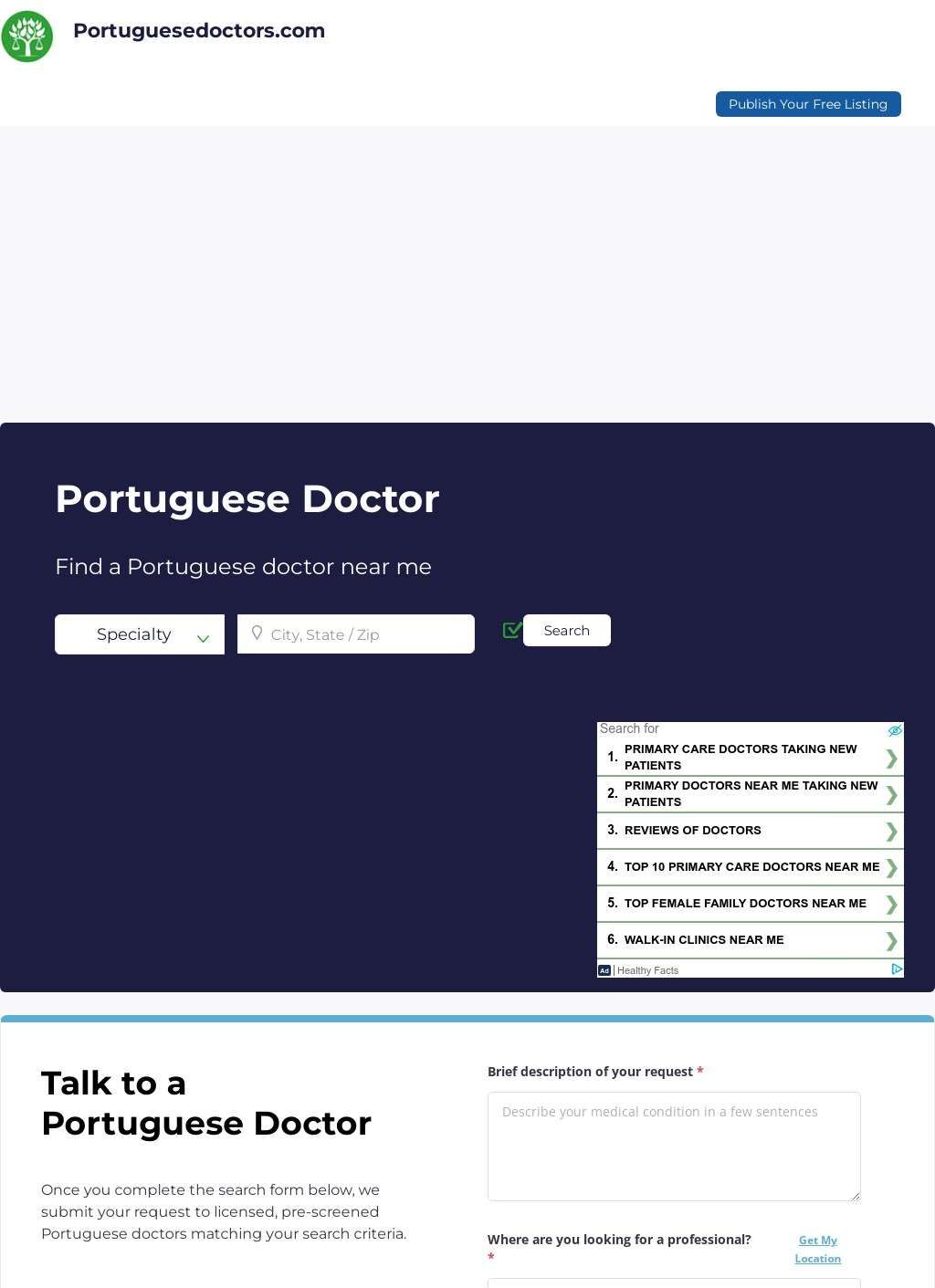
Portuguese Doctors has a narrow focus, and that narrowness is the whole point. It exists to connect patients with healthcare providers who speak Portuguese, built around that one need. A patient in Boston who is more comfortable describing a symptom in their first language, or a family in Miami picking a pediatrician they can actually talk to, is precisely who the site is for. That language-match focus shapes how everything else is organized.
Medical specialties and geographic reach
The coverage is broader than the name might suggest. Portuguese Doctors lists professionals across more than thirty medical specialties, including dentistry, dermatology, cardiology, neurology, OB-GYN, psychiatry, surgery, and physical therapy, with sub-specialties under several of those categories. Geographically it reaches across major US cities such as Boston, Houston, New York, San Francisco, and the New Jersey area, alongside Miami, and extends to Portugal and the wider Portuguese-speaking world, with patients in Brazil and Canada also part of the intended audience. This is not a single-city listing dressed up as something larger. The search runs on two axes at once, specialty and location, which is the sensible approach to a problem where both variables matter equally.
Patient request system and license verification
Two features push Portuguese Doctors past being a static name list. The first is a patient request system: instead of only browsing, a patient can submit an inquiry that the platform routes to matched licensed providers nearby, which suits cases where someone knows what they need but cannot identify who provides it. The second is the verification claim. Portuguese Doctors states that it checks every listed doctor's license each year against state licensing agencies, and listings carry a "verified" designation tied to that. In a field where a wrong choice has real health consequences, an annual license check against the actual state authority is a more meaningful filter than the self-reported badges many directories hand out. The mechanism described is the right one; the claim has not been independently confirmed, but the described process points to an actual state-level check.
How doctors claim and manage listings
For the professional side, the model is straightforward. Doctors can claim a free listing, with paid tiers available, and manage their presence through a dashboard. Free claiming lowers the barrier to a fuller directory, which tends to help patients more than a paywalled wall of empty categories would. The platform runs on Heritage Web infrastructure, which is where one of its rougher edges shows up.
Contact options through web forms
There is a /contact page, but following it lands on Heritage Web's help center rather than contact details for the business directory itself. The homepage shows no phone number, no street address, and no email posted in the open. Everything funnels through web forms. A patient who hits a problem with a routed request, or a provider with a billing question, has no direct line and no name to ask for, only a generic support portal one layer removed from the brand they came to.
Building trust with direct communication
A form-only contact route is workable, and the patient-request flow is itself a structured form, so the absence of a posted email is not a real gap. The missing phone number and address weigh more. Portuguese Doctors asks people to trust it with a health decision, and a visible way to reach a human would do a lot to firm up that confidence. Right now it is handled at arm's length through a third-party platform.
Does the site have user reviews?
On outside opinion, a search turns up the site's own specialty and location sub-pages and not much else: no Google, Trustpilot, Yelp, or BBB ratings for Portuguese Doctors surfaced. That absence is not a mark against the service so much as a sign it has not yet accumulated a public track record, which is common for a niche platform still building its base. A prospective user is left to judge it on the structure and the license-check claim rather than on a pool of past reviews.
Comparing Portuguese Doctors to general platforms
Portuguese Doctors does the specific thing it sets out to do, with a clear search model and a verification process that, if it runs as described, is more rigorous than the annual-review standard most directories skip entirely. The limited contact surface and the empty reputation column are the two things holding it back from an easy recommendation. Weighed against a general option like Zocdoc, the trade is plain: Zocdoc offers live booking, a deep bank of patient reviews, and insurance filtering that Portuguese Doctors does not match. What it cannot do is filter for a Portuguese-speaking provider as its first and central sort. That focus is the genuine differentiator here, and it is not something the bigger platforms have ever prioritized.