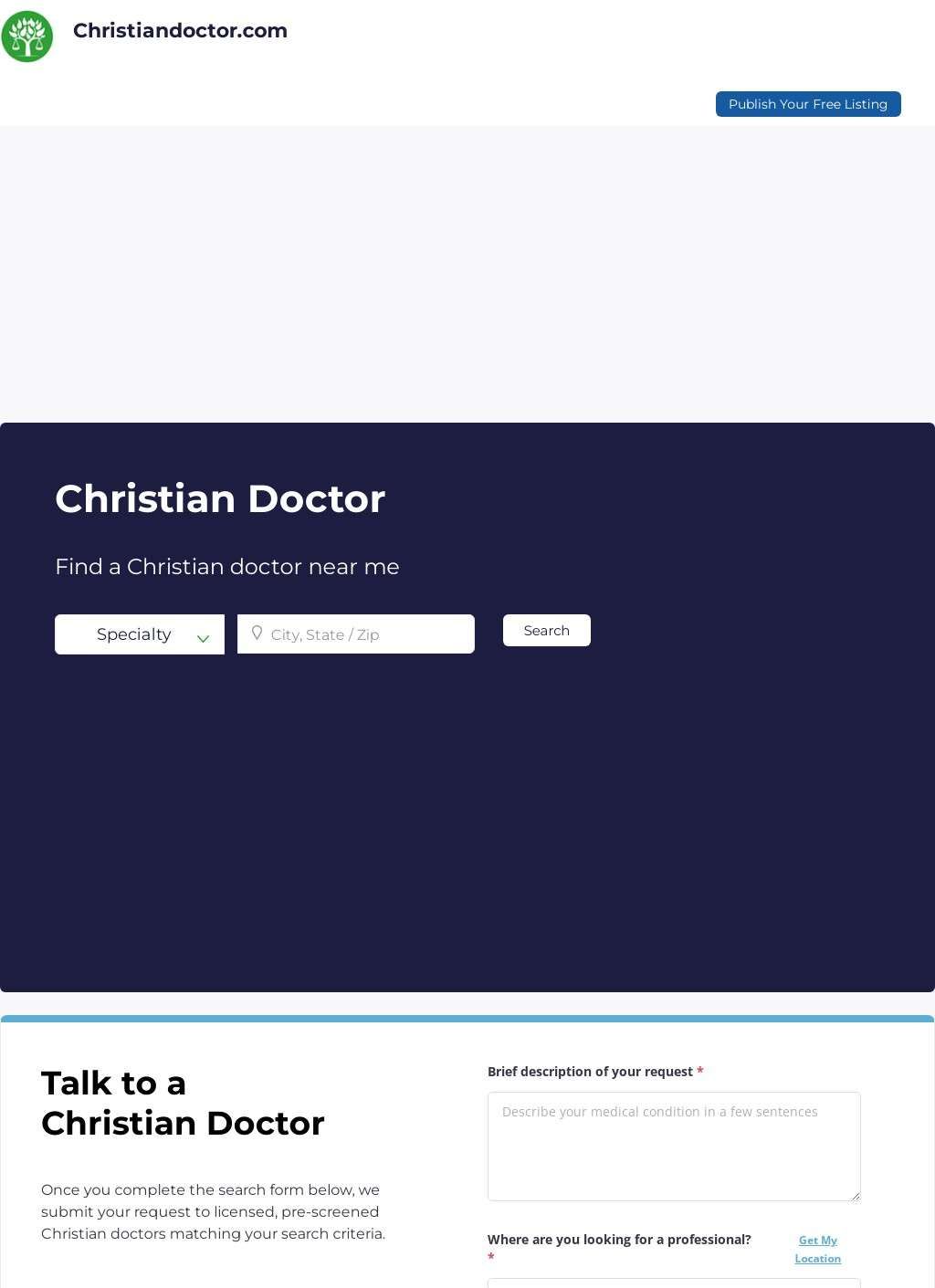
Christian Doctors grew out of a straightforward frustration: faith-minded patients searching for a same-tradition physician had no dedicated tool, just generic results that treated religious preference as invisible. The site was built to fix that. Submit a specialty and a location, and Christian Doctors routes the request to pre-screened, licensed doctors in the relevant area who identify as Christian, with a response promised inside two business days. The operator does the matching; the patient waits rather than cold-calling clinics one by one. That is not a trivial structural choice. It shifts the burden of outreach away from the person seeking care and puts a human-mediated step between the query and the returned name.
How the matching process works
The single most consequential item on the site is the About page claim that Christian Doctors checks judiciary and licensing records in each doctor's state of licensure, looking for disciplinary history before a provider enters the network. If that process runs as described, it clears a real bar above directories that accept self-registration without any follow-up. Most patients cannot run their own disciplinary checks quickly or confidently, so a service doing it upstream would save genuine effort. The problem is that Christian Doctors itself is the only source confirming this happens. No independent auditor, no third-party certification, and no sample result exists to show the process in action. That is not a reason to dismiss the claim outright, but it is a reason to corroborate any matched doctor through the relevant state medical board before booking an appointment.
Specialties and geographic coverage
Christian Doctors covers more than 40 specialties, an unusually wide spread for a faith-niche directory. Dentistry, cardiology, dermatology, psychiatry, pediatrics, OB-GYN, ophthalmology, physical therapy, oral surgery, and acupuncture all appear on the list. Geographic depth leans toward the United States, with dedicated state and city pages for Texas, California, New York, and Colorado. A claim of worldwide coverage also appears on the site, but it receives far less structural support than the state-level pages and deserves proportional skepticism. Broad claims without matching infrastructure are a pattern worth noting.
Provider marketplace and dashboard features
There is a provider-facing side as well. Clinicians can take a free listing, buy into a paid leads marketplace, use a referral system, and manage everything through an account dashboard. That two-sided structure is how the free patient-facing tool sustains itself financially. An articles section, contributed by listed professionals and other subject-matter experts, gives Christian Doctors a reason to stay useful between searches and lets readers judge contributors by what they write and not merely by profile copy. The technical backend runs through help.heritageweb.com, pointing to an established web platform, not a solo side project. That is a different operational profile, though it tells you nothing about how dense the provider network is in any given market.
Reputation and third-party verification
The third-party reputation picture is almost entirely absent. No Google score or Trustpilot entry exists for Christian Doctors as a platform. A thread in r/Christianity raised specific concerns: an About page that offered little detail, poor mobile formatting, empty results on some local searches, and a low-follower Instagram account with typos. These are concrete, repeatable complaints and they deserve full weight here. Searching for "Christian doctors reviews" compounds the picture because most results surface unrelated organisations, including Christian Medical Associates, Christian Health, ChristianaCare, and Christian Healthcare Ministries. None of those are this site, and the confusion makes independent reputation research harder than it should be.
Network gaps in smaller markets
The empty local search results are the sharpest practical problem from that thread. They point to real variation in network depth: a patient in a large metro will likely get usable matches back within the two-day window; someone in a smaller or rural market may get nothing at all. Network gaps in a faith-filtered niche are not surprising given how the directory is structured, but they mean the service is genuinely uneven depending on where you live. No phone number or street address appears on the homepage. Contact runs through a form, a footer link, and the heritageweb support portal. The missing physical address will bother anyone who wants a named, locatable entity behind the service. These are not fatal problems for a niche tool, but they are legitimate grounds for lowered confidence going in.
Who benefits most from this service?
Christian Doctors is most useful to patients in well-covered metros who already know the faith filter matters to them and who are willing to independently verify any matched provider through their state board. The strongest endorsement the site can offer is a match that checks out when you look up the doctor through your state medical licensing board yourself. For rural or smaller-market patients, the network depth issue documented in that Reddit thread is the real test: submit a search first, see what comes back within the two-day window, and if results are empty, move to a general directory or your denomination's own physician referral network; the promise is only as good as the coverage where you live.