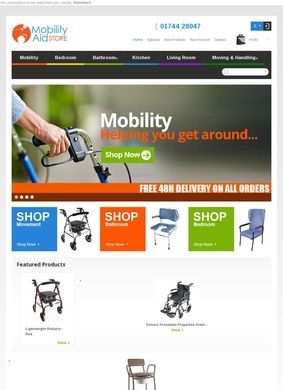
How does an older person, or someone with reduced mobility, work out what has to change around the house to keep living independently? That is the question Mobility Aid Store sets out to answer. The site, at mobilityaidstore.co.uk, is an information resource instead of a shop, carrying its aim in a homepage tagline that reads "Accessibility for people with loss of autonomy." What follows is guidance, organised topic by topic, on adapting a home and a life to reduced mobility.
The name suggests a catalogue of products to buy. What is actually there is written guidance, and that gap between the word "Store" and the content is worth flagging early, because it shapes what a visitor should expect to find.
Adapting the home
The largest body of material on Mobility Aid Store deals with the building itself. Stairlifts and lift chairs, bathroom and toilet adaptations, kitchen modifications, home automation and connected devices, and teleassistance systems all get their own coverage. These are the changes that decide whether a multi-storey house stays workable for someone who can no longer manage the stairs or reach across a standard worktop.
Taken together the home-modification sections read as an orientation guide. A family weighing a stairlift against moving a bedroom downstairs, or wondering whether teleassistance is worth installing for an elderly parent living alone, gets a lay of the land here before they ever call a supplier.
Stairlifts, bathrooms and connected devices
The strongest part of Mobility Aid Store is the breadth of the home coverage. Bathroom and toilet adaptations, the single most common trouble spot in an older home, sit alongside kitchen modifications and the newer territory of connected devices and home automation, which is where a lot of assistive technology is heading. Teleassistance, the systems that let someone call for help without a phone in hand, gets its own treatment too.
For a reader mapping out what a full adaptation might involve, Mobility Aid Store lays the pieces out in one place, though it stops at explaining them and does not sell or fit any of it.
Support beyond the building work
Adaptation is only half of what Mobility Aid Store covers. The other half is the human support that keeps someone independent once the ramps and rails are in. Senior support and assistance, home maintenance help, night security services, and administrative assistance each get a section, which widens the site from a home-improvement guide into something closer to a general handbook for living with reduced autonomy.
That breadth is the site's ambition and, arguably, its weakness. A single resource trying to speak to stairlifts, night security, and paperwork help is spread thin, and the depth on any one topic suffers for the range. Still, as a first map of what support exists, Mobility Aid Store covers a lot of ground that scattered specialist sites would make a reader assemble on their own.
Senior support and night security
The support sections aim squarely at the elderly living alone and the families worried about them. Night security services and senior assistance speak to the fear that sits behind most of these decisions, that something happens overnight and no one is there.
Administrative assistance, the help with forms and paperwork that independent living quietly demands, is a practical inclusion that many sites in this area skip. Mobility Aid Store treats the paperwork as part of the problem, which is fair.
Choosing a wheelchair
Wheelchair selection gets its own guidance on Mobility Aid Store, walking a reader through the choice rather than presenting a product to buy.
For anyone facing that decision for the first time, an explanation of what separates one type from another is the kind of groundwork that makes a later conversation with a supplier or clinician go better. It is guidance, not a fitting, and a reader should treat it as the starting point it is.
Getting out into the world
Beyond the front door, Mobility Aid Store widens again into how a person with reduced mobility moves through public life. There are sections on getting around cities, on employment, on shopping, on travel, and on taking part in sport, alongside material on the accessibility of roads and public spaces, suitable vehicle adaptations, and PMR parking for reduced-mobility drivers.
This is the part of Mobility Aid Store that reaches past the home and toward a fuller idea of independence. Framing shopping, work, and travel as things a person can plan for instead of obstacles to accept, is a reasonable stance for the site to take, and the vehicle and parking material in particular answers questions a newly disabled driver has to solve fast.
Travel, work and PMR parking
The guidance on travel, employment, and PMR parking rounds the site out. Vehicle adaptations and reduced-mobility parking are concrete, checkable subjects where good information saves real time, and Mobility Aid Store gathering them next to the softer topics of work and sport gives the whole thing a coherent shape: independence treated as something built across every part of daily life, the house included.
Where the site falls short is credibility and contact. The homepage shows no phone number, no email, and no address, and the only link at the foot of the page is a sitemap labelled "Plan du site," with no dedicated way to reach anyone behind the content. For a resource asking a vulnerable audience to act on its guidance, that absence of any contact route weighs heavily, and the French label hints at content translated or adapted from elsewhere, not written for a local reader.
Outside reputation offers no reassurance either. A search returns no genuine third-party reviews of this business; the results belong to other companies with similar generic names, and the one direct hit was the site's own tagline rather than a customer's verdict. So Mobility Aid Store lands as a broad, well-intentioned orientation guide that gives a caregiver or an older reader a useful first pass over a daunting subject, while offering nothing to establish who wrote it or how to ask them anything, which is a real limit on how far a reader should lean on it.