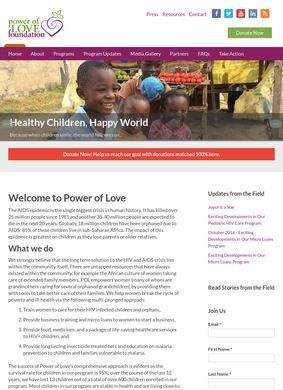
A woman in the Matero neighborhood of Lusaka, Zambia, living with HIV and with children who still need feeding, needs something more durable than a handout: a way to earn that will outlast any single grant. That is the person the Power of Love Foundation built its main program around. Instead of writing a check and moving on, it puts business training and a micro-loan in her hands, so the income comes from a small enterprise she runs and repays herself.
The scale of that one idea is the strongest fact on the record. Per its GuideStar listing, the Power of Love Foundation has issued more than 3,300 micro-loans, and the earnings from the businesses those loans start flow back into supporting families touched by the epidemic. It is a lending model aimed squarely at women impacted or infected by HIV, the group that tends to shoulder the caregiving burden when a household is hit. Targeting women is a deliberate design decision, not a demographic accident, since they are so often the ones holding a family together after a diagnosis.
The mission behind it is stated plainly: to turn back the tide of the global AIDS epidemic through innovative community responses that increase the effectiveness of prevention, alongside related care. The Power of Love Foundation is a secular United States 501(c)(3), started by three friends, Suresh Subramanian, Alka Subramanian, and Ellen Furnari, and headquartered in San Diego, California. A secular footing sets it apart from the many faith-based groups working the same crisis, and its span from a San Diego base to a single Lusaka neighborhood is the reach of a small, founder-led operation, not a large international agency.
Micro-loans and business training in Matero
The pairing of training with capital is what separates this from a straight cash-transfer charity. A loan alone can vanish; a loan attached to business training, given to someone who then has to run and repay it, is built to compound over time. The Power of Love Foundation concentrates that work in one community, Matero in Lusaka, which keeps the program deep in a single place instead of spread thin across many.
For a small organisation, that focus is a defensible choice, since a lender learns a neighborhood, its markets, and its borrowers far better when it is not chasing scale in a dozen countries at once.
What the public record does not supply is much texture about how the loans perform once issued. The Power of Love Foundation's own website could not be reached on repeated attempts, so the picture here is assembled entirely from outside listings, and those report the count of loans and the mission far more clearly than they report repayment rates or the specific outcomes for the women involved. The headline number is solid; the follow-through behind it is where the available information runs out.
Over 3,300 micro-loans to women in Lusaka
That 3,300-plus figure is worth sitting with, because it is a concrete, countable claim, not a rounded guess. Each loan stands for a woman who took on a small business, and, if the model works as described, a family drawing income from it. The Power of Love Foundation ties its anti-AIDS mission to that economic engine on the logic that a household with its own earnings is better placed to manage prevention, treatment, and the cost of both.
The Power of Love Foundation also files IRS Form 990s, tracked through ProPublica's Nonprofit Explorer, so the financial paperwork behind the program sits in the public record where anyone can pull it.
What the public filings and profiles show
On the ratings side, the evidence is modest but not unflattering. Charity Navigator gives the Power of Love Foundation three out of four stars, a respectable mark for a small charity and a step above a merely passing grade. Its Facebook page shows "Not yet rated" with two reviews, and GreatNonprofits hosts a profile without a visible score or count.
No ratings turned up on Google, Trustpilot, Yelp, Tripadvisor, Glassdoor, or the Better Business Bureau. Profiles on GuideStar and Devex fill out the trail, listing jobs, projects, and the places the organisation works. For a donor, the pairing of a mid-to-high Charity Navigator score with open 990 filings is more reassuring than the slim volume of public reviews alone would suggest, since transparency data is far more difficult to fake than a handful of star ratings.
Contact is the one spot where the closed website costs the organisation something real. With the main site down, the reachable details come from its Facebook page, which lists a phone number and an email address next to the web link. A visitor who lands on the broken homepage first would have to go hunting on social media to find a way in, and for a charity that depends on donors and partners reaching it, that broken front door is friction the Power of Love Foundation could do without.
What remains is a compact picture assembled from the edges: a three-star Charity Navigator rating, a Facebook page with two reviews, a run of 990 filings visible on ProPublica, and one program in Matero that has put more than 3,300 micro-loans into the hands of women living with HIV. The Power of Love Foundation's own account of itself, the part that would normally fill in the rest, stayed offline through every attempt to load it.