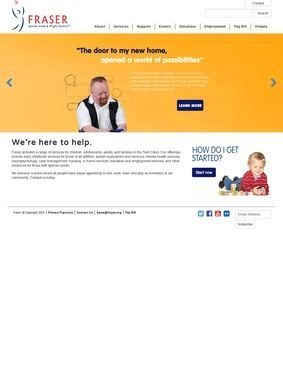
Fraser is a Minnesota nonprofit that provides autism, mental and behavioral health, and disability services to children, teens, and adults across the Twin Cities. The organization has been operating for more than ninety years, and the scale it reports is sizable: roughly 17,000 people served directly each year, plus something on the order of 51,000 family members who fall inside the same programs. Those numbers spread across 64 sites in the metro area and six more satellite locations, which tells you this is a distributed provider running many small footprints instead of one central campus. For a category as broad as disability and disorder support, that reach is the first thing worth knowing.
Service offerings across the Twin Cities
The service list is where the site earns attention. Fraser handles medical referrals and patient assessments, which places it at the front door of a care pathway rather than only somewhere further down it. There is supportive housing, and the housing pages go as far as posting current vacancies, a practical touch for families who are usually told to join a waitlist and hear nothing. Telehealth appointments are offered alongside in-person care, online scheduling exists, and bill payment can be done through the site. Taken together these are the pieces of an organization that has moved most of its administrative surface onto the web, where families transact directly instead of reading about care delivered somewhere else.
Medical referrals and patient assessments
Beyond direct care, the site branches into the surrounding ecosystem of a large provider. Workshops and events are listed. Fraser runs internships, practicums, and fellowships, so it also works as a training ground for the next set of clinicians, a normal role for a long-lived nonprofit in this field. There is a dedicated set of pathways for professionals to make referrals, an employee portal, and fundraising and donation programs that keep the nonprofit engine turning. A newsletter signup rounds it out. The professional-referral track is more telling than any of the donation prompts, because it means other practitioners in the region treat Fraser as a place they hand patients to, and that kind of peer reliance is harder to build than a slick homepage.
Training programs for clinicians
A provider that lists this many services invites a fair question about whether any single one of them is done well, or whether the menu is wide and shallow. The site itself cannot fully answer that. What it can show is structure, and the structure here reads as deliberate. Autism services sit as their own track, mental and behavioral health as another, and disability supports as a third, with assessment feeding into all of them. That layering points to ninety-plus years spent building specialization inside each area rather than bolting on new labels to look comprehensive.
Accountability and family-centered design
The presence of a formal grievance submission portal is a revealing detail. Most service sites bury complaints or omit any route for them entirely. Fraser publishing a grievance channel is the kind of thing an organization does when it expects to be held to a standard and has decided to make that expectation visible. It does not prove the care is good, but it does show a provider that has accepted the paperwork of accountability instead of hiding from it. For families weighing where to place a child with complex needs, that kind of transparency is not a small thing.
Formal grievance submission portal
Depth is also implied by the split between direct clients and family members in the numbers. Serving 51,000 relatives alongside 17,000 primary clients means the programs are built to wrap around a household, which is how autism and developmental work usually has to function to be effective. A bare-bones operation would count only the person in the chair. Fraser counting the family points to a model built wider than a single appointment, though the site stops short of explaining exactly what the family-facing support looks like in practice.
Support extending to family members
There are limits to what any outside look can confirm. The vacancy listings for supportive housing are useful, but housing capacity for this population is chronically short everywhere, and a handful of open beds against a metro-wide demand is a small dent. The workshops and events are named but not deeply detailed on the surface. And a site can present an orderly set of programs while the lived experience of getting an assessment scheduled, or a housing placement approved, runs slower than the clean interface implies. None of that is unusual for a provider of this size, and none of it is a mark against Fraser specifically, but it is the gap between what a website shows and what a family actually encounters.
What the site does communicate clearly is that this is a serious, established operation with a wide remit and a long track record. The combination of assessment, therapy, housing, telehealth, professional referrals, and training is the profile of an anchor institution in its region, the sort of place that other agencies point people toward. Fraser sits in a service area where trust is everything and where fly-by-night operators do real harm, so the ninety-year tenure and the licensed medical and behavioral scope outweigh any single feature on the page.
Digital accessibility for direct transactions
For someone in the Twin Cities looking for autism or disability services, the site gives enough concrete handholds to act on: you can find a location, request an assessment, check housing openings, book a telehealth slot, and pay a bill without leaving the browser. That practical completeness is rarer than it should be among providers in this space, many of whom still run on phone tag and printed forms. Fraser having built the digital plumbing puts it ahead of a good share of its peers on accessibility alone.
Online scheduling and housing vacancies
The doubt that lingers is one the website cannot resolve on its own. Breadth this wide, spread across seventy locations and tens of thousands of people, always raises the risk that capacity is overstretched and that the wait between a first inquiry and actual care is longer than the tidy scheduling tools suggest. Whether Fraser holds its quality steady across every one of those sites, or whether the experience varies sharply depending on which program and which location a family lands in, is the open question, and it is exactly the thing no assessment of the site alone can settle.