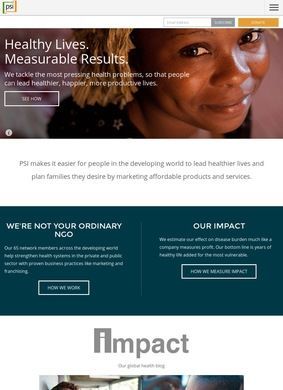
A number worth sitting with: 137 million. That is how many people PSI says it reached with primary healthcare products and services in 2024. It sets the scale of what Population Services International does. PSI is a global health nonprofit working across low- and middle-income countries in Africa, Asia, and Latin America, and it operates through a network of locally-led organizations instead of one central office directing everything from afar. The site treats that structure as a defining feature, not an aside.
Health areas and program scope
What the organization covers is broad, and the site lays it out by health area. Women's health sits alongside HIV and TB programs, malaria work, and water, sanitation and hygiene efforts. There is a strand for health systems strengthening, which is the less glamorous business of making a country's own clinics and supply chains function, and PSI treats it as core work, not a footnote. Digital health gets its own space, as does a set of self-care initiatives that put more control in the hands of individuals. Two areas read as more recent additions to the portfolio: climate change and health, and health security tied to pandemic preparedness. That last pairing tells you the group is tracking where public health pressure is heading rather than only where it has been.
Distribution as a core challenge
Reading through those areas, you get a picture of an outfit that treats health as a supply-and-access problem as much as a clinical one. Malaria prevention, HIV testing, contraception, clean water: these are products and services that fail when distribution fails, and PSI frames much of its work around closing that gap in places where the gap is widest. Someone arriving here to understand what the nonprofit does finds a plainly named set of categories, and each one points to a specific program area a reader can look into further.
Donation and contact options
For anyone wanting to act on what they read, PSI runs a donation portal at giving.psi.org, and the organization maintains a presence on Facebook, LinkedIn, YouTube, and Instagram under the handle psiimpact. Those channels are the usual way a group this size shows its field work to the public, and their existence is worth noting because it gives an outside reader a route to see the programs in action beyond the polished summaries on the main pages.
Physical address and phone verification
The contact details are handled the way a serious organization handles them. There is a physical office address in Washington, DC, on 19th Street NW, a direct phone line, a fax number, an email for donation questions, and a contact page for general inquiries. When a nonprofit is asking the public to trust it with money and to believe reach figures in the tens of millions, being reachable at a real street address with a real phone number does a lot of quiet work. PSI clears that bar without any friction, which is more than can be said for plenty of causes that ask for donations while hiding who and where they are.
Distinguishing PSI from a testing company
The harder question is reputation. A search for outside reviews of PSI as a nonprofit turns up almost nothing that applies to this entity, no meaningful Glassdoor-style record or Trustpilot count tied to the health organization itself. What does surface is a trap worth flagging: a completely separate company also called PSI, the testing and certification firm PSI Services LLC, which carries a pile of employee and consumer reviews on Glassdoor, Indeed, the BBB, Trustpilot, and elsewhere. None of that belongs to the health nonprofit. Anyone researching this organization by name should be careful not to read one company's ratings onto the other, because the two share initials and nothing else.
What independent sources reveal
That absence is not damning on its own. Large humanitarian nonprofits rarely accumulate the kind of star ratings that restaurants or retailers do, and the more useful external signals for a group like this tend to be charity watchdog evaluations, audited financials, and program reporting, none of which the brief speaks to. What can be said from the site itself is that the self-reported scale is stated openly and the operating model is described in specific terms. Whether the 137 million figure would survive independent scrutiny is exactly the sort of thing a careful donor would want to check, and the site does not do that checking for you.
Checking the 137 million figure
Taken together, this listing points to a substantial, wide-ranging global health organization with a clear description of its work, an easy path to contact or donate, and a real institutional footprint in Washington. The main caveat has less to do with the organization's legitimacy than with the evidence a casual visitor can gather at a glance: the strongest claims are the organization's own, and the independent record is quiet. The naming overlap with an unrelated testing company adds a layer of confusion that anyone doing homework needs to see through.
Next steps for donors
PSI describes its programs in malaria, HIV, women's health, and clean water across dozens of countries in plain, specific terms, and it makes the next step, whether that is reading further or giving, simple to find. What it does not do is independently confirm its own headline number; that check is left entirely to whoever reads the page.