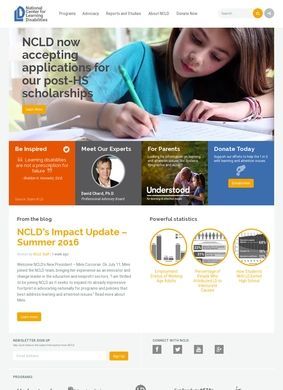
Founded in 1977 as the Foundation for Children with Learning Disabilities by Carrie and Pete Rozelle, the organization goes by a different name today: the National Center for Learning Disabilities. Nearly five decades on, ncld.org is the working home of a U.S. national nonprofit built around a single, sobering figure: an estimated one in five children and adults has a learning disability. That number frames everything the site does.
The organization is a registered 501(c)(3), and its stated mission is to improve outcomes for those millions of people by working alongside educators, students, families, and young adults, and by pushing for policy that removes systemic barriers. What that looks like in practice is a site split cleanly by who is reading it.
Resources sorted by who needs them
The resource sections are organized by audience: Parents and Caregivers, Educators, Young Adults, and Allies and Advocates. It is a sensible way to cut the material, because a parent trying to understand an evaluation and a policy advocate reading disproportionality data want very different things from the same subject. The National Center for Learning Disabilities also folds in assessment guidance written specifically for students with learning disabilities, which is the sort of practical, right-when-you-need-it content that a worried parent actually searches for.
The young-adults track is the piece I find most worth flagging, since resources for adults with learning disabilities are thinner across the field than those aimed at parents of young children, and the National Center for Learning Disabilities gives that older group its own dedicated space.
State snapshots and the NAEP data
The data work is where this site earns serious attention. Its State Snapshots of Learning Disabilities pull together how each state handles special education, and the National Center for Learning Disabilities publishes special-education-disproportionality data that speaks directly to which students get identified and served, and which do not.
Alongside that sit NAEP reading and math data snapshots, drawn from the national assessment, giving the advocacy an evidence base instead of anecdote. For a school-board member, a journalist, or a researcher, this is the kind of material that is genuinely hard to assemble on your own, since it means reconciling federal figures with fifty different state systems. Having it curated in one place, tied back to policy questions, is the strongest practical reason to consult the National Center for Learning Disabilities over a general search.
Student scholarships and the Everyday Champion Award
Money and recognition also change hands here. The National Center for Learning Disabilities runs the Anne Ford Scholarship and the Allegra Ford-Thomas Scholarship, both aimed at students with learning disabilities heading into higher education. The Everyday Champion Award goes the other direction, honoring educators who do right by these students.
Scholarship programs are concrete in a way that mission statements are not. A high schooler with a diagnosed learning disability can look at the National Center for Learning Disabilities and find an actual application to complete and a deadline to meet, which turns the site from a reference into something with real stakes for the reader. Naming the awards after Anne Ford and Allegra Ford-Thomas also ties the money to people, which tends to matter to the students applying.
Advocacy and the councils behind it
The National Center for Learning Disabilities is as much an advocacy body as an information hub. Its legislative work runs through the Quorum platform, the same tooling professional campaigns use to move constituents to contact lawmakers, which signals that the policy push is organized rather than symbolic.
There is also a youth-justice-system initiative that reflects a hard fact the field has documented for years: learning disabilities are heavily overrepresented among young people who end up in the justice system. That the organization treats this as a program area, and not a footnote, says something about how it reads its own mission.
The advocacy and the data are hard to separate here, and that is the point. The disproportionality figures and the NAEP snapshots are the ammunition; the Quorum-driven campaigns and the annual day of action are the delivery. A visitor who cares only about the policy fight can trace it back to the evidence, and a visitor who wants only the evidence can see exactly what it is being used to argue.
The leadership councils and LD Day of Action
Two standing groups give the advocacy its voice: a Young Adult Leadership Council and a Family Leadership Council. Both put people with lived experience, the young adults and the families, into the room where priorities get set. The annual LD Day of Action then channels that into a coordinated push on legislation.
This is where the audience-first structure pays off. The same young adults served by the resource pages can move up into the leadership council and help steer the National Center for Learning Disabilities itself. It is a loop, and a healthy one for a nonprofit that wants its work grounded in the people it serves.
For a family newly working through a diagnosis, someone whose experience is closer to a Learning Disabilities Association of America chapter with its local, in-person support might reasonably ask which route fits better. The National Center for Learning Disabilities operates on a national, policy-and-data footing, so it answers the big-picture and advocacy questions well, while the hands-on, week-to-week guidance a local group provides is a different service. A reader weighing the two is really choosing between national reach and neighborhood presence, and the honest answer is that many families will want both.