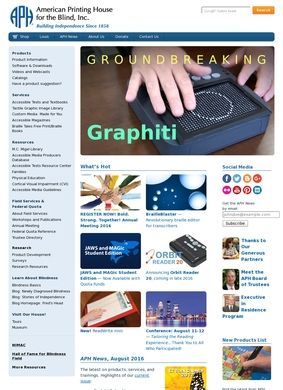
Founded in 1858 and chartered by an act of the U.S. Congress, the American Printing House for the Blind is a nonprofit based in Louisville, Kentucky, and it describes itself as the largest organization of its kind anywhere, working for people who are blind, have low vision, or are DeafBlind. What the American Printing House for the Blind makes and distributes day to day is a catalog of accessible educational products running from braille textbooks to tactile graphics to assistive technology hardware. The site puts that whole operation in front of you: products to buy, databases to search, free help lines, and a federal funding program that schools across the country rely on.
Braille production and hardware line
Start with the manufacturing side, because that is the part most people will recognize. American Printing House for the Blind produces braille materials and tactile graphics at scale, and it sells hardware that goes well beyond the embossers and slates you might expect. The headline device is the Monarch, a refreshable braille display built around ten lines and 3,840 pins, which is a meaningfully different proposition from the single-line displays that have been standard for decades.
A multi-line tactile surface lets a student read a paragraph in context or feel a graph laid out spatially instead of scrolling through it one line at a time. Whether the price and the ecosystem live up to that promise is a separate question, but the ambition is clear, and the product pages give it real estate. For schools and transcribers used to assembling accessible materials from several vendors, having production and equipment in one place is a practical convenience.
Publishing and shared databases
Publishing sits alongside the hardware. APH Press handles accessible-format publishing, putting out professional and instructional titles in formats the rest of the organization is built to serve, which closes a loop that many publishers leave open. The Louis Database is the piece I found most quietly useful: a searchable catalog of accessible materials held by educational agencies nationwide, so a teacher hunting for an already-produced braille or large-print edition of a specific title can check whether it exists somewhere before commissioning a new transcription. That kind of shared registry saves duplicated effort across thousands of districts, and it is the sort of infrastructure that rarely gets headlines. American Printing House for the Blind hosting it centrally is the reason it works at all, since a fragmented version scattered across districts would defeat the purpose entirely.
Support line for newly diagnosed families
APH ConnectCenter is a free information and referral service aimed at individuals living with vision loss and the families around them, a different audience from the school-purchasing crowd and a useful front door for people who have just received a diagnosis and have no idea where to begin. It points toward resources, answers questions, and connects people with services at no cost. That a manufacturer also runs a no-charge help line says something about how American Printing House for the Blind frames its purpose.
Training programs for educators
For the people doing the teaching, APH Hive is a professional learning community where educators can take courses and build skills. That pairs naturally with the training and professional development American Printing House for the Blind offers to teachers of students with visual impairments and to orientation and mobility specialists, two roles where the supply of qualified professionals is chronically tight. Building the workforce is its own form of accessibility work, and it is encouraging to see it treated as a core function instead of an afterthought. A district can buy the best tactile graphics on the market and still fall short if no one on staff knows how to teach with them.
Outreach also extends into adulthood. American Printing House for the Blind runs programs supporting competitive integrated employment for adults with vision loss, which addresses a stage of life that often gets less attention than the school years. The through-line across all of these is a single organization trying to cover the full arc, from a newly diagnosed child to an adult looking for work, and American Printing House for the Blind is one of the few groups positioned to attempt that span.
Federal quota funding program
Probably the most consequential thing American Printing House for the Blind administers is the Federal Quota Program. Through it, eligible educational agencies receive federal funds earmarked for purchasing materials from American Printing House for the Blind for students who are legally blind. In practice that means a school does not have to find room in a tight local budget every time a student needs braille books or specialized equipment, because there is a dedicated federal channel for it. The organization sitting at the center of both the manufacturing and the funding mechanism is a notable arrangement, and the site explains clearly how agencies register and draw on their allocations.
Consulting services for accessibility needs
On top of the catalog, American Printing House for the Blind offers consulting services covering digital accessibility auditing, which is increasingly what organizations need as more of education and daily life moves online, plus tactile graphics production for groups that need custom work, and standardized test accommodations, an area where getting the details right has real stakes for a student sitting an exam. Pulling these into a paid consulting line is a sensible use of expertise the American Printing House for the Blind already holds, and outside clients get access to skills that are genuinely hard to find anywhere else.
Behind the site's navigation challenges
One reservation worth naming: the sheer breadth can make the site feel like several organizations stitched together. A manufacturer, a publisher, a help line, a funding administrator, and a training provider all share one banner, and a first-time visitor may need a few clicks to figure out which door is theirs. The menu does not always make the path obvious. That is a navigation observation, not a criticism of the work, and the underlying mission stays coherent even when the structure sprawls.
Outside reviews on general platforms are sparse; a search across common rating sites turns up very few entries, which is typical for a nonprofit serving a specialized professional audience. The standing of American Printing House for the Blind in the accessibility field rests on its congressional charter, its century-plus production history, and the federal program it administers, none of which show up in star ratings.
American Printing House for the Blind covers an unusually wide span of the accessibility field for vision loss. It manufactures braille and tactile materials, builds hardware including the multi-line Monarch display, publishes through APH Press, runs the Louis Database and the ConnectCenter, trains educators through APH Hive, administers the federal funding that puts products in students' hands, and backs adults entering the workforce. The audiences it names line up with that range: students, educators, families, rehabilitation professionals, and employment specialists. People working in vision-loss education or rehabilitation will find the catalog, the databases, and the Federal Quota mechanics worth knowing in detail, and the product documentation around the Monarch is specific enough to evaluate on its own terms.