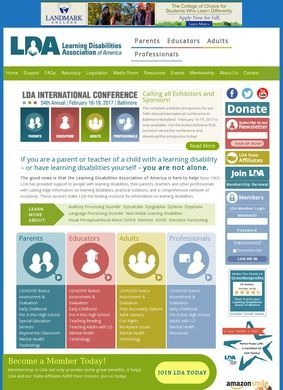
Few advocacy organizations in the learning disabilities space have run an annual conference for 63 consecutive years. That record alone says something about how the Learning Disabilities Association of America (LDA) operates: it has been at this long enough to accumulate real depth, and the website reflects an organization that has not needed to restart its message from scratch every few years. The LD Journal sits alongside a podcast, a searchable webinar archive, and those annual conferences, and together they give the site a research backbone that lighter advocacy resources tend to lack. A podcast without serious published work behind it would feel hollow; the Learning Disabilities Association of America (LDA) avoids that by anchoring its accessible content in peer-reviewed publication and a decades-long conference record.
Reaching different audiences separately
What makes the site genuinely useful is how it handles multiple audiences without collapsing them into one. Parents of children with learning disabilities need different things than educators building intervention plans, and adults who were never properly assessed as children have a third set of concerns altogether, usually centered on workplace accommodation and self-understanding, not schooling. The Learning Disabilities Association of America (LDA) keeps these groups distinct, organizing resources to meet each one where it is. A parent trying to navigate a special education evaluation should not have to wade through material aimed at clinical professionals, and on this site, largely, they do not have to.
Special education law made accessible
The practical material spans intervention strategies, assessment tools, and guidance on special education law. The legal content is worth pausing on: so much of whether a child receives appropriate support depends on understanding legal entitlements, and plain-language guidance on special education law is genuinely hard to find outside of expensive consultants or jargon-heavy federal documents. The Learning Disabilities Association of America (LDA) puts that material alongside concrete assessment resources, which means a parent or a new teacher can find both in the same place.
Position papers on disability policy
Dyslexia, dyscalculia, and related conditions are named directly, not folded into vague "learning differences" language. That specificity helps users search effectively and makes the content easier to trust. The organization also issues position papers on education and disability policy, documents that take a stated view on contested questions instead of hedging around them. For a professional who needs to cite an established body's stance, or a parent trying to understand where an established body stands on a given intervention, those papers are more useful than most of what circulates online.
Podcasts, webinars and the annual conference
The webinar archive and podcast extend that material into formats people will consume more readily than a journal article. A searchable catalog lets someone pull exactly the session they need, whether that is a recent legal update or an older talk on a specific intervention approach. The annual conference, now in its 63rd edition, is the kind of event that has become an institution within its discipline, and the Learning Disabilities Association of America (LDA) uses it as a gathering point for the broader professional community, more than a membership perk.
State affiliates across the country
National advocacy organizations often drift toward abstraction, and one of the stronger structural choices here is a network of state affiliates covering most of the country. Special education law and available services vary considerably from state to state, and a parent in one state dealing with a school district's refusal to evaluate faces a different landscape than a parent two states over facing the same situation. Local chapters give families and educators a connection point tuned to their specific state's rules and resources. Running that kind of federated structure is genuinely harder than maintaining a single national office, and the Learning Disabilities Association of America (LDA) has built it out across most of the country.
Membership tiers for professionals
Membership programs formalize involvement for parents, educators, and field professionals, with stated benefits attached to each tier, not a vague invitation to join. Advocacy runs through all of it: tracking changes to special education law, working on disability rights, and pushing for systemic support for people with dyslexia, dyscalculia, and other learning disabilities. Partnerships with educational institutions extend that reach into the places where research gets done and teachers get trained.
One real limitation is the federated structure itself. The further you are from the central resources, the more the experience depends on how active your particular state affiliate happens to be. A strong local affiliate makes the national network feel close and responsive. A quieter one leaves a family working mostly from the central material, which is substantial but does not substitute for local knowledge about schools and services. That is the trade any networked organization makes, and the depth of what the Learning Disabilities Association of America (LDA) publishes centrally cushions it well enough for most users.
Outside reputation and third-party reviews
Outside reputation is worth noting. A search for third-party reviews of the Learning Disabilities Association of America (LDA) on consumer platforms turns up no significant volume of independent user ratings, which is not unusual for a nonprofit professional body of this kind. The organization's standing rests on its publication record, its conference history, and its policy advocacy, not aggregated public reviews, and those are verifiable through the site itself and through citations in academic and special education policy literature.
The Learning Disabilities Association of America (LDA) has been cited in federal special education discussions and in professional training programs, which gives it a traceable footprint outside its own web presence. Parents and professionals already embedded in the special education world will recognize the name; those coming to it fresh should spend time with the resource library and the state affiliate directory to get a realistic picture of what local support looks like in their specific state. The national material is strong enough to be useful on its own, but the value of the Learning Disabilities Association of America (LDA) as a practical resource depends partly on how active the relevant affiliate is.