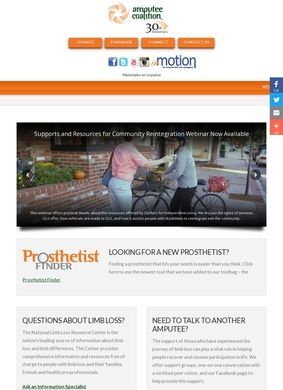
Where does a person turn in the first raw weeks after losing a limb, or a parent whose child is born with a limb difference? The Amputee Coalition of America answers that question with a single organized front door: a nonprofit that gathers guides, trained peers, support groups, and advocacy into one place and points them at the roughly 5.6 million Americans living with limb loss or limb difference. It describes itself as a community, a lifeline, and a source of strength, and the range of what it puts on offer backs up those words.
The audience is broader than a newcomer might expect. The Amputee Coalition of America speaks to individuals and children living with limb loss or limb difference, to military service members and veterans, to caregivers and family members, to healthcare professionals, and to community advocates and organizational partners who work alongside it. That breadth shapes everything the Amputee Coalition of America builds.
A national resource for limb loss
The first thing a visitor meets is information, and a lot of it. The National Limb Loss Resource Center holds more than forty guides and over seventy fact sheets, available in English and Spanish, covering the practical and medical questions that pile up fast after limb loss. This is the reference layer, the part someone reads at two in the morning when a question cannot wait, and having it bilingual widens who can actually use it.
Sitting alongside the written material is healthcare navigation assistance, which is a different and arguably harder service. Guides explain what to expect; navigation help walks a person through the maze of getting it, from insurance to prosthetic care to the specialists involved. Anyone who has tried to coordinate care after a major medical event knows how quickly the paperwork alone becomes its own second injury, and a body that steps in to guide that process is doing something more useful than publishing another leaflet. Between the two, the Amputee Coalition of America covers both the knowing and the doing.
The reach of that material runs past patients, too. Caregivers and family members trying to understand what a loved one is going through, and healthcare professionals who want a reliable reference to hand a newly diagnosed patient, draw on the same library. By writing for several audiences at once, the Amputee Coalition of America turns a set of guides into something closer to a common language, where a clinician, a parent, and a patient can all point at the same fact sheet.
That shared footing is easy to underrate until a person has watched a worried family and a busy care team talk straight past each other.
The resource center also settles an early credibility question. An organization can call itself a lifeline, but forty guides and seventy fact sheets in two languages are a concrete measure of the work behind the claim.
Peer support and community
Information alone does not carry a person through limb loss. The Amputee Coalition of America clearly understands this, because a large share of what it runs is built on people talking to other people who have been through the same thing. This is where the organization moves from a reference library to something living.
Certified peer visitors
The Certified Peer Visitors program trains volunteers, more than eight hundred of them, who have their own experience of limb loss and are prepared to sit with someone facing it new. A trained peer occupies a spot no doctor and no pamphlet can fill: they have worn the prosthetic, felt the phantom pain, learned to drive again.
Training that many visitors, instead of relying on informal goodwill, signals that the Amputee Coalition of America treats peer support as a real service with standards, and mentorship runs through the same channel for those who want an ongoing relationship rather than a single visit.
Support groups and AC Connect
For people who want the group setting, the Amputee Coalition of America connects members to more than three hundred support groups nationwide, which is a serious footprint for a condition many communities rarely discuss out loud. Where an in-person group is out of reach, the AC Connect digital forum carries the same idea online, so someone in a remote town is not cut off from the conversation.
The physical and the digital cover each other, and between them a member has a decent chance of finding a room, real or virtual, that fits.
Youth programs
Children and teenagers get their own track: a young person adjusting to limb difference has needs an adult program cannot meet.
The Youth Engagement Program serves ages ten to nineteen, and the Paddy Rossbach YEP Youth Camp gives kids from ten to seventeen a camp setting built around others like them. A camp where a child is, for once, in the majority does something no clinic visit can, and the Amputee Coalition of America having a dedicated youth camp rather than a token youth mention is a real point in its favour.
Advocacy and staying informed
Support and advocacy are separate jobs, and the Amputee Coalition of America takes on both. Its Certified Lead Advocates program trains members to speak up in the places where policy and access are decided, turning personal experience into organized pressure.
The So Every BODY Can Move initiative pushes on one of the sharpest fights in the field, access to the prosthetic devices that let people stay active, an issue where insurance coverage often lags well behind medical reality. Advocacy of this kind is slow, unglamorous work, and it is a mark of a mature organization that the Amputee Coalition of America invests in it at all.
The organization also keeps its community connected and current through several channels. There is a National Conference and a slate of Regional Community Days for gathering in person, and Limb Loss and Limb Difference Awareness Month gives the whole community a shared moment to raise the profile of the cause. On the reading side, inMotion Magazine and the Thrive E-Newsletter keep members abreast of developments, stories, and practical guidance between the bigger events. Taken together, these pieces mean a member can stay involved at whatever level suits them, from a monthly newsletter skim to a full conference.
It is worth noting how wide a span of lives the Amputee Coalition of America tries to cover. A child at the youth camp, a veteran carrying a service-related amputation, an older adult who lost a limb to diabetes, and the family standing behind each of them all fall inside its stated audience.
Few single organizations attempt that range. The Amputee Coalition of America manages it by keeping the programs modular, so a person takes the piece that fits their moment, whether that is a support group, a peer visitor, or an advocacy campaign, and leaves the rest until it becomes relevant.
That design is why the same website can speak to a frightened parent and a policy-minded advocate without either feeling it landed in the wrong place.
For a parent who has just learned their child has a limb difference, the Amputee Coalition of America is the place to start, and the concrete first step is to head into the Youth Engagement Program and read up on the Paddy Rossbach YEP Youth Camp before their child feels alone in it. An adult adjusting to a recent amputation should begin with the National Limb Loss Resource Center and then look into the Certified Peer Visitors program, because the combination of solid information and a trained peer who has lived it is exactly what those early months demand.
This is a substantial, well-organized resource, and the Amputee Coalition of America is worth turning to before hunting for scattered answers elsewhere.