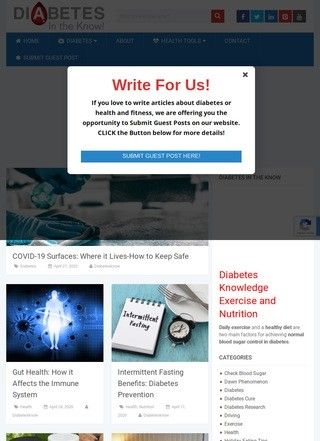
When a newly diagnosed person opens a browser at midnight looking for an A1C converter, diabetesknow.com is the kind of place they land and stay longer than expected. Diabetes Knowledge builds that converter into a small suite of tools: BMI, calorie intake, ketogenic macros, gestational diabetes calculations, and a MODY risk assessment. That last one is notable. MODY is a rare inherited form of diabetes that most consumer health sites never mention, let alone build a screening prompt around. Diabetes Knowledge covers the corners of the condition that get skipped elsewhere.
Tools for diabetes management
Kenny, the person behind Diabetes Knowledge, is a Type 1 diabetic with more than twenty years of living with the disease. A person who has counted carbs and managed insulin for two decades writes about hypoglycemia differently than a freelancer assigned the topic, and the educational guides reflect that lived footing. They walk through the diabetes types, blood sugar management, what A1C levels mean, the mechanics of insulin, and what to do when blood sugar drops too low. The audience is drawn wide: people with Type 1, Type 2, and gestational diabetes, plus the caregivers who often do the practical work of managing someone else's condition.
Kenny's twenty years with Type 1 diabetes
What keeps Diabetes Knowledge from reading like a personal blog is the medical review layer. Content is checked by Seshadri G. Das, MD, an endocrinologist affiliated with Mount Sinai Health System. Pairing a patient's voice with an endocrinologist's sign-off is a sensible structure for health content: the first supplies the texture and the second supplies the guardrails. Diabetes Knowledge is also upfront that its material is educational and not a replacement for professional medical advice, which is exactly the disclaimer you want to see on a page that hosts a risk calculator.
Medical review by an endocrinologist
Beyond the tools and guides, Diabetes Knowledge has a nutrition and recipes section aimed at low-sugar and diabetes-friendly cooking, including smoothies and desserts. Desserts are the honest test of a diabetes recipe collection, since avoiding sugar is easy while making something a person actually wants to eat is the hard part. Whether those recipes perform in a real kitchen is something only a cook can settle, but aiming at the part of eating that people miss most is the right instinct.
Low-sugar recipes for daily eating
The product reviews are where Diabetes Knowledge gets concrete in a way that is genuinely useful. There is a Dexcom G7 continuous glucose monitor review, a top-ten comparison guide for insulin pumps pegged to 2025, and write-ups on keto yogurt and sugar substitutes. These are expensive, daily-use devices and grocery decisions that repeat for years, so a focused comparison from someone inside the patient community can save a reader hours of cross-referencing. The flip side is that product reviews invite a fair question about independence, and nothing on the page settles whether the rankings carry affiliate arrangements or how they were arrived at. That is worth keeping in mind, not because anything looks amiss, but because pump and monitor recommendations carry consequences that go well beyond a bad purchase.
Product comparisons for devices
Diabetes Knowledge also hosts a community forum, where users trade notes on treatments, diet approaches, exercise tips, and research they have come across. A forum lives or dies on whether anyone is actually posting, and that is something a visitor can gauge in a couple of clicks. When active, peer exchange is one of the more valuable things a diabetes site can host, since a lot of day-to-day management knowledge passes between patients before it ever reaches a clinic visit. The exercise and fitness content fits naturally into that mix, because activity is one of the levers people with diabetes are told to pull and rarely told how to pull well.
Community forum for patient exchange
On the practical side of trust, Diabetes Knowledge keeps a contact page, so there is a route to reach whoever is behind the writing. No phone number or physical address appears on the homepage, which is unremarkable for a one-person editorial site. Social profiles are linked across Facebook, X, Pinterest, YouTube, and Tumblr, which gives a reader other surfaces to check the cadence of new material and whether anyone is still home. The harder gap is outside corroboration. A search for what others say about Diabetes Knowledge turns up essentially nothing from third parties: no Google ratings, no Trustpilot or Yelp presence, and results that mention "diabetesknow reviews" point to the site's own product articles. For a health resource, that absence cuts a particular way.
Inside the credibility gaps
The medical-reviewer credential and Kenny's experience are the load-bearing pieces of credibility, and both come from Diabetes Knowledge's own account of itself. Plenty of solid niche sites never accumulate platform reviews, so none of this is a red flag. It does mean a careful reader is taking the site largely at its word, with the Mount Sinai affiliation being the one claim an outsider could in principle verify independently.
Verify the endocrinologist's active role
Weighed up, Diabetes Knowledge is a focused, sincere effort built by someone who knows the condition from the inside and had the sense to put an endocrinologist between his writing and his readers. The calculators are useful, the device reviews answer real purchasing questions, and the scope (Type 1, Type 2, gestational, MODY, nutrition, exercise) covers more ground than the typical single-author health site does. The two things left unresolved from the published record are how independent those product rankings are and whether the endocrinologist review is as active as the byline implies. Those are not reasons to dismiss Diabetes Knowledge, but they are the questions worth settling before it becomes anyone's primary reference.