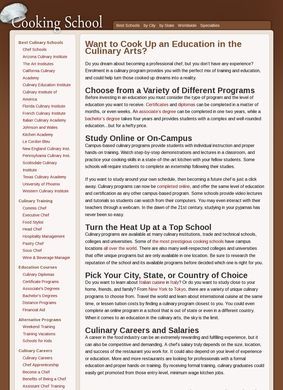
There is no street address, no phone number, and no email anywhere on CookingSchool.org. What you get instead is a single comment form and a great deal of indexed information about where to study cooking. That tells you most of what you need to know about what kind of site this is: an aggregator built to point prospective students toward culinary programs, not a school you can ring up or visit.
Search by location and program format
The actual content sits squarely in the directory tradition. CookingSchool.org collects culinary programs across the United States and a range of other countries, and it lets a visitor narrow the field by city, state, or country. That location-based search is the practical part, because someone who already knows they want to study in, say, a particular state can cut straight to the relevant listings instead of wading through national rankings. Those rankings exist too: the site publishes lists of top culinary schools, which is the kind of thing that draws traffic but also invites the obvious question of who decided the order and on what basis. The brief does not say, and the site itself is not transparent about its ranking method, so a reader should treat the lists as a starting point and verify any school independently.
Finding schools by region and credential type
Where the coverage gets more useful is the range of program formats it accounts for. A person can find short certificates and diplomas that wrap up in weeks or months, all the way up to bachelor's degrees, with both campus-based and online study represented. That breadth fits the audience the site is plainly chasing: career changers who want a credential without four years of commitment, retirees picking up a long-deferred interest, hobbyists, and working cooks who want to put a formal stamp on skills they already have.
It is a wide net, and the wide net is the point. Someone who has no idea whether a six-week diploma or a degree suits their goals can at least see both options sitting side by side, with the time and money trade-off made visible. CookingSchool.org also profiles named institutions, and these are not obscure ones. The Culinary Institute of America, Le Cordon Bleu, and Johnson and Wales University all appear, alongside others, which at least anchors the directory to schools a reader can recognize and cross-check elsewhere.
Career roles paired with salary data
Beyond the school listings, there is a layer of career and lifestyle content. Guides walk through specific kitchen roles, the executive chef, the pastry chef, the sous chef, and the site pairs those with salary information, which is the detail most career changers actually want before they spend money on tuition. Salary figures on a directory should always be read as ballpark numbers, since they vary wildly by region and employer, but having them in front of a beginner alongside the relevant training path is sensible.
There are pages on specialty cuisine programs, including Italian and broader international tracks, for someone whose interest is narrower than general culinary arts. And then there is the recreational end of the spectrum: training vacations and weekend cooking classes for people who have no intention of becoming professionals and simply want to cook better or take a trip built around food. Holding those two audiences, the serious degree-seeker and the weekend hobbyist, on the same site is an awkward balancing act, and it does make the homepage feel like it is trying to be several things at once. The upside is reach; the cost is focus, since neither audience gets a site built entirely around its needs.
Transparency and accountability issues
It is worth being clear about how CookingSchool.org makes its money, because that shapes how much weight to give its recommendations. The site carries third-party display advertising. Directories of this type frequently operate on referral or lead-generation arrangements with the schools they list, and while the brief confirms only the display advertising, the combination of ranked lists and a commercial model is a standard reason to read any "top schools" page with some skepticism. None of that makes the underlying information wrong. It does mean the prudent move is to use CookingSchool.org to build a shortlist and then go directly to each institution for accreditation, costs, and outcomes.
Behind the commercial model
On the matter of who runs it, the trail goes cold quickly. There is an About page and a standard privacy policy disclosure, but no contact route beyond a feedback form. No phone, no email, no postal address surfaced. For a site whose whole purpose is helping people make a significant financial and life decision, the absence of any direct line to a real person is a genuine drawback. A feedback form is a one-way channel; it does not tell a visitor who is behind the recommendations or hold anyone visibly accountable for them.
A search turns up no notable third-party reviews for CookingSchool.org itself. There is a Trustpilot listing that looks relevant at first glance, a four-star rating with fifteen reviews, but that record belongs to cookschool.org, The Cook School in the UK, which is a different operation entirely. Anyone who stumbles on that rating and assumes it applies here would be mistaken. CookingSchool.org arrives, then, without an independent track record that a prospective student can lean on, which throws the burden back onto the visitor to vet everything for themselves.
Verify claims independently before enrolling
To be fair to what it does well: the structure is sound for someone in the early, exploratory phase of choosing a culinary path. The search-by-location feature is practical, the spread from quick certificates to degrees is genuinely useful for comparing time and cost, and the salary and career-role pages give a beginner some grounding before they start contacting schools.
If a person treats CookingSchool.org as an index, a way to discover programs they had not heard of and to get a rough lay of the land, it works for that. The named-school profiles give the directory a measure of credibility that purely anonymous listings would lack, and the international reach means it is not limited to a single country's options, which helps anyone weighing study abroad against a program closer to home. For a first pass, CookingSchool.org saves a fair amount of scattered searching.
The trouble is that an index is only as trustworthy as the hand behind it, and that hand stays hidden. CookingSchool.org asks a visitor to take its rankings and program descriptions on faith while offering no author, no contact, no outside verification, and a revenue model that has at least a theoretical interest in steering choices.
For low-stakes browsing, the recreational classes and the casual curiosity about chef salaries, that gap is no real obstacle. For someone about to commit tuition and years to a credential, the gap is harder to wave away. The information may well be accurate, and much of it is checkable against the schools themselves. But the operator stays anonymous, the ranking method is undisclosed, and the revenue model at minimum nudges toward keeping schools happy. That combination makes CookingSchool.org useful as a map of what exists, and unreliable as a guide to what is best.