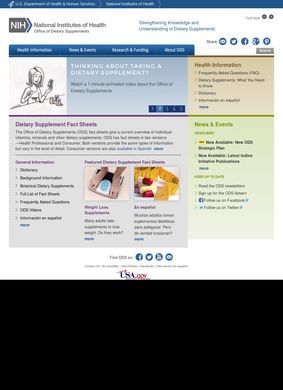
Someone stands in a pharmacy aisle holding a bottle of turmeric capsules, wondering whether the dose on the label means anything and whether the claims on the front are tested or just printed. That gap between what a supplement says and what is actually known is the exact space the NIH Office of Dietary Supplements fills. Set up in 1995 inside the National Institutes of Health, it exists to gather the science on vitamins, minerals, herbs, and botanicals, then hand it back in a form that an ordinary person, a clinician, or a researcher can use without a chemistry degree.
Fact sheets for consumers and health professionals
The most-used part of the site is the collection of Dietary Supplement Fact Sheets. The NIH Office of Dietary Supplements produces two versions of every sheet: a plain-language one written for consumers and a denser one written for health professionals. That split is more useful than it sounds. A worried parent reading about vitamin D gets clear intake numbers and warning signs, while a dietitian reading the same topic gets the dosing tables, the interactions, and the references behind them. The sheets cover individual ingredients in depth instead of lumping everything into vague categories, and a chunk of the consumer material is offered in Spanish, which widens who can actually act on it.
Safety and regulation information for supplement buyers
Alongside the fact sheets sit the broader health-information pages: how to take supplements safely, how the products are regulated (or not), and what quality really means once a bottle leaves the factory. I found the regulation explainers refreshingly blunt about how little pre-market testing supplements undergo in the United States, a point most retail sites quietly skip. For a person trying to decide whether a product is worth the money, that framing changes the question entirely. The NIH Office of Dietary Supplements does not soften this reality for the sake of a friendlier read, and that restraint is exactly what makes it trustworthy.
Databases behind the label claims
Past the reading material, the NIH Office of Dietary Supplements runs three databases that turn it from a pamphlet site into a working tool. The first is the Dietary Supplement Label Database, DSLD, a searchable archive of actual product labels. If you want to compare what a dozen multivitamin brands claim ingredient by ingredient, this is where you check rather than trusting any single manufacturer. The second is the Dietary Supplement Ingredient Database, DSID, built with the USDA Agricultural Research Service, which measures what is genuinely in products against what the label promises. That comparison between stated and measured content is the kind of work no commercial brand has any reason to publish.
CARDS catalogue of federally funded research
The third, CARDS, is Computer Access to Research on Dietary Supplements, a catalogue of federally funded research projects from NIH, USDA, and the Department of Defense going back to the 1999 fiscal year. It is aimed squarely at researchers and grant writers who need to know what has already been studied before proposing something new. None of these three is flashy, and the DSID interface in particular asks for some patience, but the value is in the data behind them, not the styling. The NIH Office of Dietary Supplements built these tools for people doing real work, and they hold up when that real work is applied to them.
Funding for supplement research centers
The NIH Office of Dietary Supplements also puts real money into the field. It co-funds NIH grants and helps sustain dedicated dietary supplement research centers that dig into botanical safety, how plant compounds actually behave in the body, and whether claimed effects are supported by evidence. Pair that with population studies tracking how much of which nutrients people take in and how widely supplements are used, and you get an organisation that both reports the science and pays to create more of it. That combination is rarer than it ought to be in a space this crowded with commercial voices.
Training material for clinicians and educators
Health professionals get their own corner. The NIH Office of Dietary Supplements provides education and training material specifically to help clinicians, instructors, and counsellors talk through supplements with patients, clients, and students. That is a quietly important function, because the supplement conversation in a clinic often falls apart for lack of a neutral, trusted reference both sides can point to. The NIH Office of Dietary Supplements fills that gap without selling anything, which is why practitioners return to it.
Mission to evaluate supplement evidence
What ties the whole thing together is a stated mission to evaluate the scientific evidence on supplements and strengthen public understanding of their role in health. The NIH Office of Dietary Supplements is not a shop and never pretends to be one; you will not find a buy button or an endorsement of a brand anywhere on the site. It judges products by what the analytical data show. A listing in a business directory of nutrition and health resources is well-earned here, given how consistently the NIH Office of Dietary Supplements comes up when clinicians and researchers need a source they can cite without qualification.
Limits of a science-first site
There are limits worth naming. The science-first tone means some pages read drily, and a casual visitor chasing a quick yes-or-no on a trendy supplement may have to wade through nuance to find that the honest answer is often "the evidence is mixed." The databases reward effort and punish skimming. None of that undercuts the substance; it just means the NIH Office of Dietary Supplements is built for people willing to read carefully rather than be reassured quickly.
Comparison with WebMD
Set it next to WebMD, the obvious place many people land first for supplement questions. WebMD is easier to skim, more commercial, and stitched through with advertising and product framing, where the NIH Office of Dietary Supplements gives you the underlying measurements, the funded research, and the regulatory reality with nobody profiting from your conclusion. For a fast, friendly overview WebMD will do. For knowing whether a supplement is worth taking, and whether the bottle in your hand contains what it claims, the NIH Office of Dietary Supplements is the source the careful reader should reach for and the one the practitioner quietly trusts most.