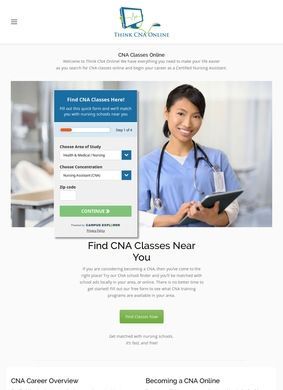
Tracking down a Certified Nursing Assistant program without wading through a dozen state board websites is harder than it should be. ThinkCNAOnline.com addresses that directly: a matching tool branded "Find Classes Now" takes a prospective student's basics and returns CNA training options, both online and in a physical classroom. The site does not run the courses itself. It points people toward programs that do, and it wraps that referral in the kind of background reading a first-time applicant tends to need before spending money or time.
State certification requirements
The most practically useful section is the state-by-state breakdown of CNA certification requirements. Rules differ a lot between states: required training hours, the testing body, how clinical practice is logged, renewal windows. Anyone who has tried to confirm the rules for their own state from official sources knows how scattered that information is. Pulling it into one place is a real service, and ThinkCNAOnline.com treats it as a central part of what the site is for, not an afterthought FAQ buried in a sidebar.
NNAAP exam preparation
Beyond the program search, ThinkCNAOnline.com puts considerable weight on the NNAAP exam, which is the assessment many states use to register nursing assistants. The guidance covers what the exam involves and how to prepare, which is the natural next concern once someone has picked a class. A site that only matched students to programs and then went quiet would leave them at the hardest part. ThinkCNAOnline.com carries the thread forward to the test itself rather than dropping the reader mid-process.
Online versus classroom training
The CPR and First Aid certification material sits alongside that, since most CNA roles expect those credentials in addition to the core training. A student reading about a training program will, sooner or later, run into the CPR requirement, and having it addressed in the same place removes a separate search. ThinkCNAOnline.com also places the classroom format next to the online format and compares them directly, which is the right call for the audience it appears built for: people weighing whether a self-paced online course can fit around a job, or whether they need the in-person clinical hours that a campus provides. The writing meets those readers where they are, speaking to career changers and adults coming back to study after a gap, rather than assuming a fresh high-school graduate with an open timetable.
That audience framing shapes which programs the site bothers to surface, and it also shapes how the content is pitched. There is no jargon wall at the top of each article. The state requirement pages in particular read as though someone wrote them for a person who has never dealt with a state licensing board before, which is almost certainly true of most visitors.
ThinkCNAOnline.com does not stop at getting someone certified. It extends into what a CNA can become, with pathway guides on moving up to LPN, LVN, or RN roles. For a lot of people the nursing assistant credential is a first rung, not a destination, and a site that maps the climb is more honest about the career than one that treats the entry job as the whole picture. These guides give the early decision some context: choosing a CNA program with an eye on a later RN bridge is a different calculation than choosing one to land a single immediate job, and ThinkCNAOnline.com puts that longer arc in front of the reader early enough to be useful.
The footer links out to established professional bodies, the American Nurses Association and the National League for Nursing among them. A referral site that points toward the recognized organizations in the field at least shows awareness of where the authoritative material lives. It does not make ThinkCNAOnline.com an authority in its own right, but it gives a curious reader a route off the site toward sources that carry real standing in nursing.
Worth being plain about what the site is. A disclaimer states that ThinkCNAOnline.com does not endorse specific institutions and does not provide financial or academic advice. It functions as a business directory and referral resource, and the "Find Classes Now" button is the engine that earns the site its keep, almost certainly through lead generation to the training providers it lists. That is a legitimate model, and the disclaimer is the responsible thing to post, but a reader should keep it in mind. The programs surfaced by the matcher are the ones in the network, which is not the same as every program a state has approved. ThinkCNAOnline.com is a starting point for the search, not a complete inventory, and a cross-check against the official state registry is still a good idea.
On the credibility side the picture is mixed. A search for outside reviews of ThinkCNAOnline.com turned up nothing: no ratings on the usual platforms, no body of student feedback to weigh. That absence is not damning for an informational resource of this kind, since people pass through it on the way to a school and rarely treat it as a business they would later rate, but it means there is nothing external to weigh against the content. The assessment has to rest on the content itself, and the content holds up adequately for what the site claims to be.
Contact information limitations
Reaching anyone behind ThinkCNAOnline.com is close to impossible. The landing page carries no phone number, no email, and no street address, and the navigation has no clearly labeled contact page. The entire push is toward the program-matching button. For a site that is upfront about being a referral tool, that omission is understandable: there is no storefront to visit and no service desk to reach. But it does keep the operator at arm's length. A reader who wanted to flag an error in a state requirement, or understand who is behind the matching, has no obvious route to do so.
Taken together, ThinkCNAOnline.com reads as a competently assembled guide for someone at the very start of the CNA process: state rules in one place, exam and CPR requirements explained, online and classroom formats compared, and a sketch of where the credential can lead. The program matcher is the commercial core, the supporting content is the reason to stay and read, and the disclaimer tells you exactly which of the two is paying the bills. ThinkCNAOnline.com works well as a first stop; it was not built to be the last one.
Business address
Think CNA Online
United States