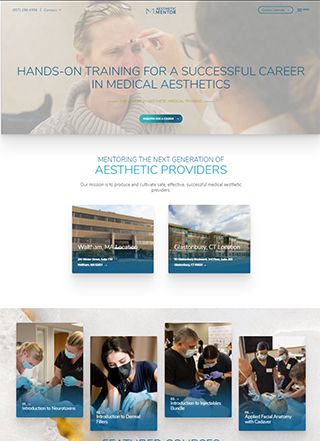
A licensed nurse or PA who wants to add injectables to their practice runs into the same wall early: most weekend "certification" courses pair you with one instructor and a room full of strangers, you watch more than you touch, and you leave holding a certificate but not much real skill with a needle. Aesthetic Medical Training Boston is built around the opposite arrangement. The school, which operates publicly as The Aesthetic Mentor, caps its introductory courses at a two-to-one student-to-instructor ratio and brings in up to fourteen live models per session, so the enrolled participants are the ones doing the injecting on actual faces under close supervision.
Two-to-one student instructor ratio
That structure is worth dwelling on because it directly answers the complaint that sends people looking in the first place. With two students per instructor, a participant is not waiting their turn behind a dozen others. The live-model count matters for a concrete reason: neurotoxin and filler technique is muscle memory and tactile judgement, and you only build those by treating real patients, not mannequins or a slideshow. Plenty of training pages promise hands-on work and then deliver a demo table. The specific numbers Aesthetic Medical Training Boston publishes put clinical practice at the core of the course, not tucked in as a footnote.
Standalone courses in neurotoxins and fillers
The curriculum at Aesthetic Medical Training Boston is laid out as a set of discrete courses that a practitioner can take individually or stack toward the flagship credential. The Aesthetic Intensive Certificate Program is the multi-module path, the comprehensive option for someone building a full aesthetics offering. Below it sit the standalone introductions: Introduction to Neurotoxins covers botulinum toxin injection technique, and Introduction to Dermal Fillers covers volume restoration using hyaluronic acid and similar agents. Both are the bread and butter of an injector's day, and teaching them as separate entry points lets a clinician start narrow and expand over time.
Cadaver lab in Boston
One offering stands apart from the usual injectables roster. Applied Facial Anatomy with Cadaver is a hands-on cadaver lab run in the Boston area, and that is not something most aesthetic schools can or do provide. Working on cadaveric tissue is how an injector actually understands where the facial arteries run and how the fat compartments sit, which is the knowledge that separates a safe practitioner from one who is guessing under the skin. Its presence in the Aesthetic Medical Training Boston catalogue says something concrete about how seriously the program treats the safety side of the field.
Who can enroll in this program?
Aesthetic Medical Training Boston is explicit about eligibility: enrolment is open exclusively to licensed medical professionals, including MDs, DOs, nurse practitioners, physician assistants, registered nurses, licensed practical nurses, and dentists. There is no path for an unlicensed person hoping to break into aesthetics. That gate is a meaningful credibility marker in a corner of the industry where the rules around who may inject vary by state and where some training outfits are looser than they should be.
Surgeon founder behind the curriculum
The founder's background reinforces the same point. Aesthetic Medical Training Boston was established by Dr. Joseph A. Russo, a Harvard-trained Boston plastic surgeon. A plastic surgeon designing and standing behind the curriculum matters for clinical instruction of this kind because the anatomy, the complication management, and the injection planes are his daily professional territory rather than something learned from a manufacturer's brochure. It puts a surgeon's standard behind the certificate, which is a different thing from a training company that licenses a generic slide deck.
Business development and skincare courses
Beyond the core injectables, Aesthetic Medical Training Boston rounds out what a practice actually needs. There are skincare and laser courses, and there is a Business Development Series aimed squarely at practitioners who want to launch their own aesthetic practice. That last one is a practical inclusion: a nurse who has just learned to inject still has to handle pricing, consent, scheduling, and patient acquisition, and most clinical programs leave that part entirely as the student's problem. Including it in the offering shows Aesthetic Medical Training Boston is thinking about the practitioner's whole transition past the point where a certification ends.
Splitting online and in-person training
The delivery model mixes formats in a way that suits busy working clinicians. On-demand online modules carry the didactic material a student can absorb on their own schedule, while the in-person sessions are reserved for the clinical, hands-on components where physical presence is the whole point. Splitting the theory from the practice this way respects that the people enrolling already hold full-time medical jobs and cannot easily clear a week off for lectures they could watch at home.
Two campus locations for training
Logistics are handled across two locations. The main campus sits in Waltham, Massachusetts, at 303 Wyman Street, and a second site in East Hartford, Connecticut, widens the geographic reach for practitioners across southern New England. A course calendar lives at its own subdomain, so a prospective student can see scheduled dates directly instead of emailing to ask what is running and when. For anyone weighing whether the field is even the right move, Aesthetic Medical Training Boston offers a free career discovery consultation as a low-commitment first step before any financial commitment.
Checking public review platforms
Public reputation data is harder to come by. A search across the usual platforms did not surface third-party review counts or ratings for Aesthetic Medical Training Boston. No Google, Yelp, Trustpilot, or BBB tally turned up. That absence is worth stating plainly: it does not mean the training is weak, but it does mean a prospective student cannot lean on a body of public testimony and will be evaluating Aesthetic Medical Training Boston on its founder, its structure, and its stated curriculum instead. For a program with this kind of clinical specificity, the missing aggregated rating is the one genuine information gap a careful buyer will notice.
What supports the case for Aesthetic Medical Training Boston is the concrete detail the site does provide. A capped student ratio with a named maximum, a quantified live-model count, a cadaver lab on the schedule, a surgeon's name on the program, and a strict licensure requirement are all verifiable claims rather than mood. Aesthetic Medical Training Boston has assembled the elements a licensed clinician would actually shop for when choosing where to learn injectables, and it has put the specifics in plain view. The evidence on the page is more substantive than most comparable programs publish, even if outside verification is scarce.
Business address
Aesthetic Mentor
245 Winter Street, Suite 110,
Waltham,
MA
02451
United States
Contact details
Phone: (833) 224-6338