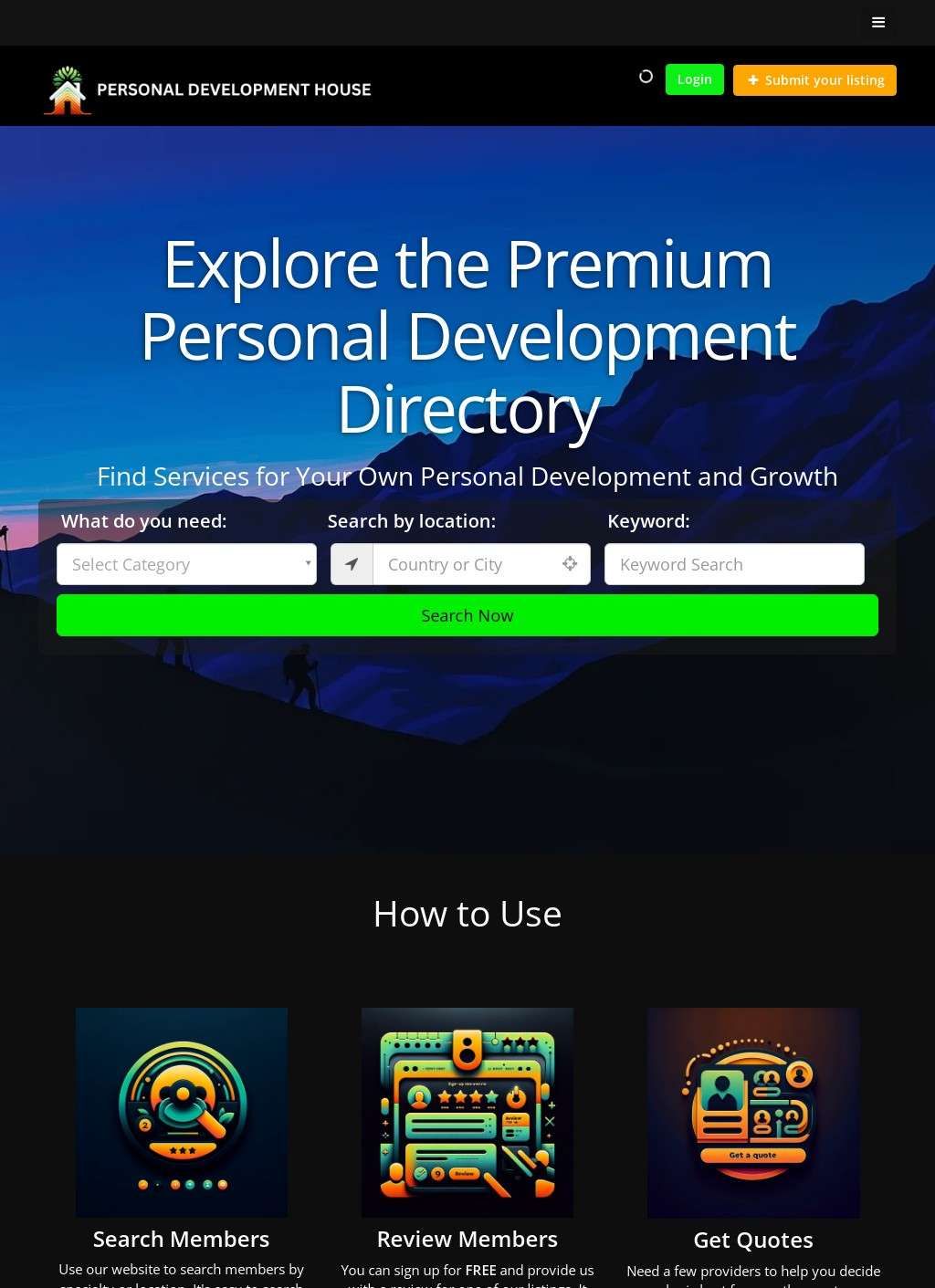
Personal Development House is an Australian directory that connects individuals with personal-development service providers, built and run by a company called My Growth Corporation. The Made in Australia badge sits on it plainly, and a GlobeNewswire press release frames the site as an extension of that company's wider personal-development mission.
The structure is a two-sided marketplace. On one side are people looking for coaching, training, or guidance; on the other are the professionals and businesses who provide it and pay to be listed. Personal Development House stands in the middle and tries to make the introduction stick.
Marketplaces like this succeed or fail on a single unglamorous number, the count of active listings, and everything clever in the design matters only after that number is large enough to give a searcher real choice.
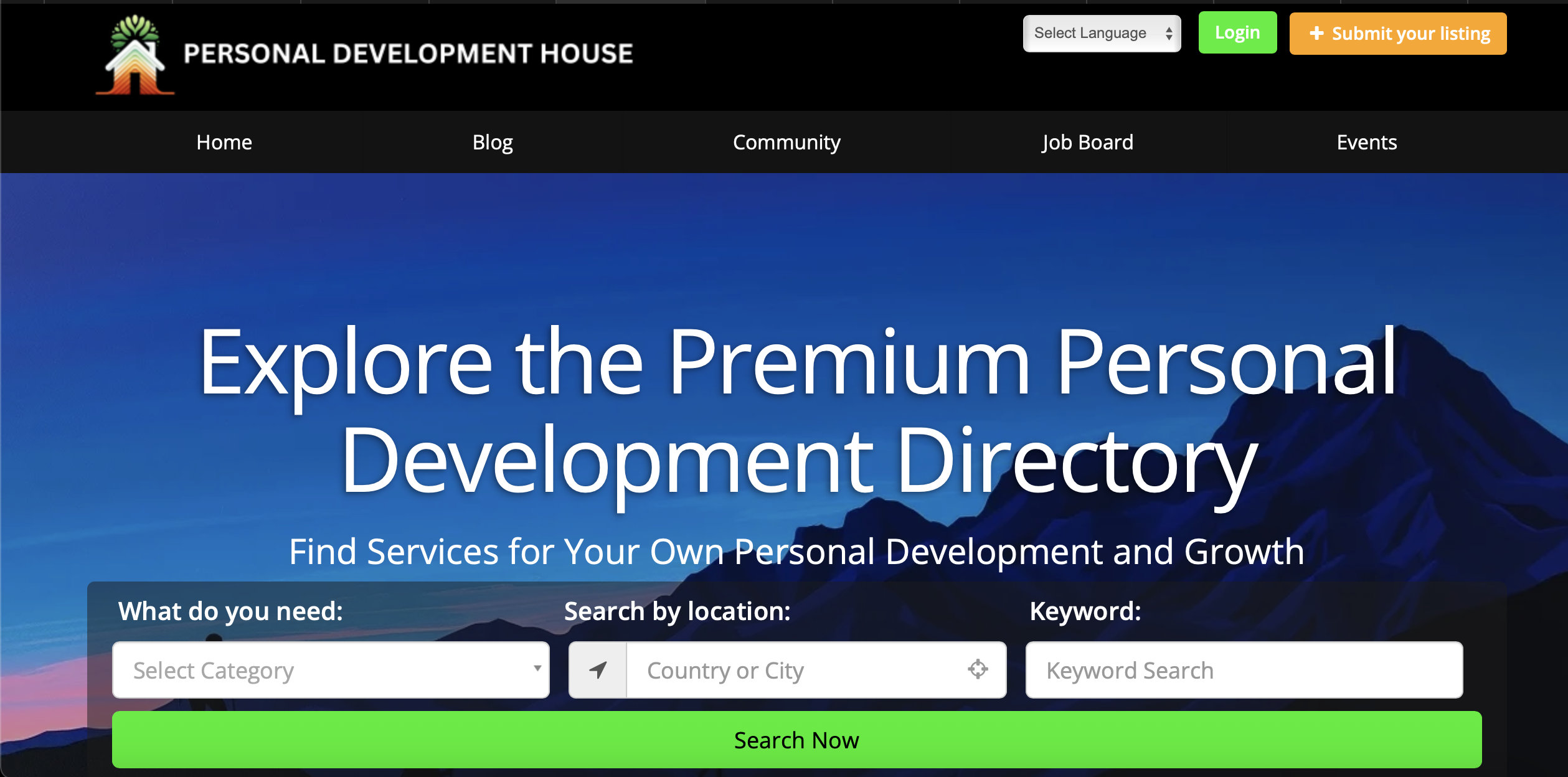
The catalog of categories is wide to the point of sprawling. Beauty and Fashion sits beside Business, Health and Fitness, Hobbies and Art, Spirituality and Esoteric, Sports, Technology and Gaming, Teen Development, and Wealth and Finance, with Social Networks and a general Personal Development bucket alongside them.
Personal Development House clearly wants to be the front door for the whole self-improvement field rather than one narrow slice of it. That breadth is a statement of ambition, and it raises an immediate question about depth, because a directory stretched across eleven headings needs a great many listed providers under each before any single category feels populated instead of bare.
Depth is the whole ballgame for a directory, and it is the one thing Personal Development House cannot demonstrate from the outside. A visitor can count the categories at a glance. Counting the living, contactable providers inside each one takes a real search, and the outcome of that search is what separates a working marketplace from an attractive scaffold.
A visitor searches the provider directory by specialty and by location, which is the correct way to cut a list this broad down to something a person can actually use. Personal Development House pairs that search with a get matched tool, a quote-request feature that reverses the usual flow.
Instead of clicking through profile after profile, a person writes down what they want and lets providers come to them with an offer. For someone who does not yet know which specialty they even need, that reversal is a genuinely sensible piece of design, and it is the feature most likely to pull a hesitant first-timer through.
There is more bolted on than a bare list of names. Personal Development House runs a job board, an events listing, and a blog of personal-development articles, and it invites contributor submissions for that blog along with advertising partnerships and paid memberships. The revenue model is therefore out in the open and entirely ordinary: providers pay to appear, advertisers pay for placement, and members pay for whatever a paid tier includes. None of that is a mark against the site. A directory has to earn its keep somehow, and this one is honest about how.
What sits behind the directory
The piece Personal Development House pushes hardest as its own signature is Mind Growth 360, a community platform fixed onto the marketplace. A directory tells a visitor who exists. A community is what keeps that visitor returning between purchases, swapping questions and advice, and the intent behind bundling one onto the other is easy to read.
Whether Mind Growth 360 carries an active membership is a separate matter, and the site by itself cannot answer it. A community platform is only ever as good as the people posting inside it, and a quiet forum is worse than none at all, because it advertises the emptiness to every new arrival. Personal Development House presents the feature with confidence. What it cannot present, at least from the outside, is any proof that people are actually there talking to one another.
The same doubt shadows the events listing and the job board. Both are strong ideas for holding an audience, and both are only as useful as the volume of real events and real jobs flowing through them, which a visitor cannot gauge without signing up and looking.
The blog is the quieter workhorse in all of this. Steady personal-development articles pull search traffic, and that traffic is the raw material the whole model runs on, since a listing is worth paying for only when there are readers around to see it. Personal Development House opening the blog to contributor submissions is a cheap way to keep the content flowing, though it also means quality will swing with whoever turns up to write.
The member reviews system
Personal Development House builds in a member reviews and ratings system so that buyers can rate the providers they hire. For a marketplace that is exactly the right instinct, because a directory with no feedback is a phone book, and nobody chooses a coach the way they pick a plumber from the Yellow Pages. Reviews are the mechanism that turns a raw list into a place worth trusting.
The irony is sharp. A platform organized around reviews carries almost no reviews of itself. A search for outside opinion on Personal Development House turns up nothing that rates the site at all: the results are generic personal-development think-pieces, an unrelated Personal Development Center appearing on job boards, and scattered discussion of a differently named Personal Development School, none of it about this business.
The internal ratings engine may work beautifully. There is simply no external signal yet that the crowd needed to fill it has shown up, and a review system with nobody reviewing is a lever with nothing on the other end.
An empty ratings system is the chicken-and-egg trap every young marketplace walks into: buyers want reviews before they commit, and reviews only appear once buyers have committed. This platform is clearly early in that cycle, and nothing on the site reveals whether it has started to break out of it.
Getting in touch, and getting listed
Contact follows the shape of a young platform. Personal Development House keeps a contact page tucked under its About section and a separate join page for providers who want to be listed, so both a curious visitor and a would-be provider have a clear door to knock on. What the homepage does not put in front of anyone is a phone number or an email address in plain sight, which is common for a web-first directory and no reason on its own to back away.
A provider weighing whether to pay for a listing would still prefer a faster line to a person than a contact form before parting with money.
The join page is really the commercial heart of Personal Development House. The blog, the events, the community layer, all of it exists to pull the traffic that makes a paid listing worth buying in the first place. That is a legitimate way to run a directory, and the site does not pretend otherwise. A provider signing up is buying exposure to whatever audience the surrounding features can gather, which loops back, again, to the question of how many people are really here.
For an individual arriving with a specific need, coaching through a career change, say, or help steering a teenager, the whole experience narrows to one thing: whether the get matched tool returns real people who actually reply. A directory that surfaces three stale profiles and a dead inbox is worse than useless, because it costs a visitor time and a little hope for nothing. None of that outcome can be judged from what the site says about itself.
The concept is coherent and the feature set looks complete on paper: a searchable directory, a matching tool, a job board, an events feed, a blog, a reviews system, and a community layer, all aimed at the same audience and stitched together sensibly. What Personal Development House cannot yet demonstrate is traction. There are no outside reviews, no visible count of how many providers have actually joined, and a community platform whose real activity stays hidden behind the sign-up wall.
The site reads like a carefully drawn frame still waiting for people to fill it, and the categories that matter most are worth checking directly for real, contactable providers before anyone treats this as more than a promising shell.
Business address
My Growth Corporation
6 Sickle Avenue,
Hope Island,
Queensland
4212
Australia
Contact details
Phone: +61408520486